Chao Ta-Chung, Lin Chia-Huei, Lee Meei-Shyuan, Chang Cheng-Chiang, Lai Chia-Ying, Huang Chien-Yao, Chang Wen-Yuan, Chiang Shang-Lin
Department of Physical Medicine and Rehabilitation, Tri-Service General Hospital, School of Medicine, National Defense Medical Center, Taipei 114, Taiwan.
School of Nursing, National Defense Medical Center, Taipei 114, Taiwan.
Life (Basel). 2024 Jul 5;14(7):847. doi: 10.3390/life14070847.
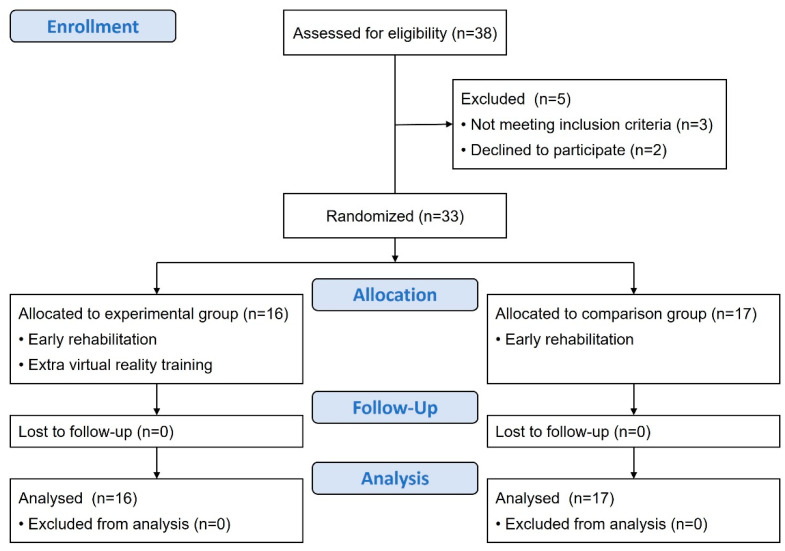
Early rehabilitation has beneficial impacts on functional outcomes for patients with acute stroke. However, whether the addition of virtual reality (VR) training could further improve these patients' muscle strength, functional recovery, and psychological health is unknown. A randomized controlled trial was conducted on 33 patients with first-time acute ischemic stroke. The patients were randomly assigned using a 1:1 randomization ratio to either the experimental group (EG) or the comparison group (CG). Both groups received early rehabilitation, and the EG received extra VR training during their stay in the hospital. Muscle strength, functional status, and psychological health were assessed before the intervention and at discharge. Generalized estimating equations were used to examine the intervention effects via the interaction of time and group. After adjusting for potential covariates, the EG showed a more significant decrease in depression at discharge than the CG ( = 3.77, = 0.011). There were no differences in muscle strength and functional recovery between groups after intervention. Adding VR training into early rehabilitation facilitates substantial positive effects on psychological health, specifically depression, but not muscle strength and functional recovery, compared to receiving early rehabilitation alone in patients with first-time acute stroke during their hospitalized period.
早期康复对急性中风患者的功能预后有有益影响。然而,添加虚拟现实(VR)训练是否能进一步改善这些患者的肌肉力量、功能恢复和心理健康尚不清楚。对33例首次急性缺血性中风患者进行了一项随机对照试验。患者以1:1的随机比例随机分配至实验组(EG)或对照组(CG)。两组均接受早期康复治疗,实验组在住院期间接受额外的VR训练。在干预前和出院时评估肌肉力量、功能状态和心理健康。使用广义估计方程通过时间和组的交互作用来检验干预效果。在调整潜在协变量后,实验组出院时的抑郁程度比对照组有更显著的下降( = 3.77, = 0.011)。干预后两组之间的肌肉力量和功能恢复没有差异。与首次急性中风患者在住院期间仅接受早期康复治疗相比,在早期康复中添加VR训练对心理健康,特别是抑郁有显著的积极影响,但对肌肉力量和功能恢复没有影响。