Monteiro Viana Jaiane Carmelia, da Silva Gomes Gabriela Ellen, Duarte Oliveira Francisca Jennifer, Marques de Araújo Lidya Nara, Teles Guilherme, Mourão Carlos Fernando, de Vasconcelos Gurgel Bruno César
Department of Dentistry, Federal University of Rio Grande do Norte, Natal 59078-970, Brazil.
American Dental Institute, Orlando, FL 32819, USA.
Pharmaceutics. 2024 Jul 4;16(7):893. doi: 10.3390/pharmaceutics16070893.
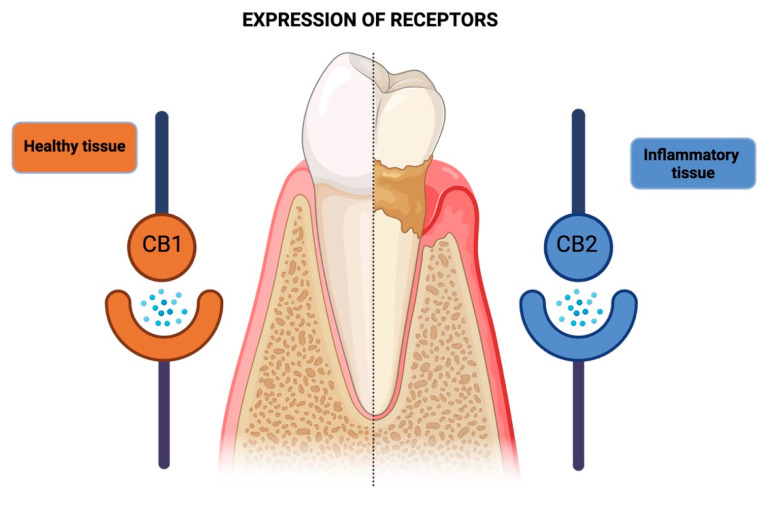
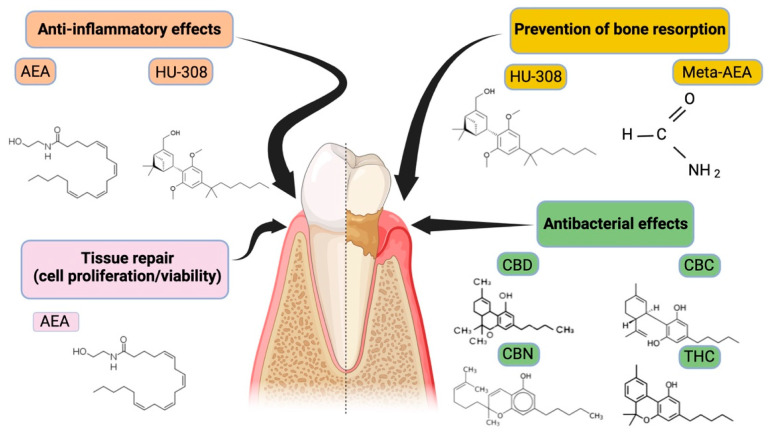
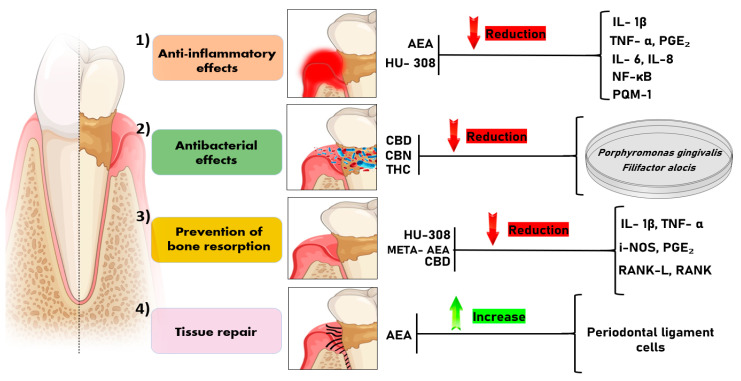
This integrative review addresses the potential of the Endocannabinoid System (ES) and cannabinoids in the pathogenesis and treatment of periodontal disease (PD). Cannabinoid receptors are expressed in healthy and inflamed periodontal tissues, indicating a potential regulatory role for SEC in oral homeostasis. Healthy periodontal cells express more CB1 receptors, while inflamed sites show increased CB2 receptors. This suggests a dynamic involvement of the SEC in the inflammatory response associated with PD. Cannabinoids such as cannabidiol (CBD) and cannabinoid receptor agonists such as HU-308, anandamide (AEA), and methanamide (Meta-AEA) have demonstrated promising therapeutic potential in studies. CBD has been associated with the control of bone resorption, antibacterial activity, and increased production of gingival fibroblasts, indicating effects in mitigating the progression of PD. HU-308 demonstrated preventive effects against alveolar bone loss, and anti-inflammatory, osteoprotective, and pro-homeostatic properties in animal models of periodontitis. AEA and Meta-AEA have anti-inflammatory effects by reducing pro-inflammatory mediators such as IL-1, IL-6, and TNF-α. The activation of cannabinoid receptors attenuates inflammatory processes, inhibits alveolar bone loss, exerts antibacterial effects, and promotes tissue repair. However, clinical trials are especially needed to validate these results and explore the therapeutic potential of cannabinoids in the treatment of PD in humans.
本综述探讨了内源性大麻素系统(ES)和大麻素在牙周病(PD)发病机制及治疗中的潜力。大麻素受体在健康和发炎的牙周组织中均有表达,表明内源性大麻素系统在口腔稳态中可能具有调节作用。健康的牙周细胞表达更多的CB1受体,而发炎部位的CB2受体则增加。这表明内源性大麻素系统动态参与了与牙周病相关的炎症反应。大麻二酚(CBD)等大麻素以及HU-308、花生四烯乙醇胺(AEA)和甲酰胺(Meta-AEA)等大麻素受体激动剂在研究中已显示出有前景的治疗潜力。CBD与控制骨吸收、抗菌活性以及增加牙龈成纤维细胞的产生有关,表明其在减轻牙周病进展方面有作用。HU-308在牙周炎动物模型中显示出对牙槽骨丧失的预防作用以及抗炎、骨保护和促进稳态的特性。AEA和Meta-AEA通过减少白细胞介素-1、白细胞介素-6和肿瘤坏死因子-α等促炎介质发挥抗炎作用。大麻素受体的激活可减轻炎症过程、抑制牙槽骨丧失、发挥抗菌作用并促进组织修复。然而,特别需要临床试验来验证这些结果,并探索大麻素在人类牙周病治疗中的治疗潜力。