Department of Data Science, Prasanna School of Public Health, Manipal Academy of Higher Education, Manipal, India.
Department of Statistics, Mangalore University, Mangalore, India.
Front Public Health. 2024 Jul 16;12:1362406. doi: 10.3389/fpubh.2024.1362406. eCollection 2024.
The global prevalence of crimes against women has made it an enduring public health challenge that has persisted over time. The achievement of the 2030 Sustainable Development Goal (SDG) is intricately tied to the actions taken to prevent these crimes as their repercussions directly affect progress across various SDGs. This study aimed to provide a comprehensive examination of the prevalence of crimes against women across districts and states in India, analyzing changes from 2020 to 2022, and subsequently identifying associated factors.
The study is an ecological analysis conducted across all districts of India using the data on crimes against women for the period 2020 and 2022 obtained from the National Crime Records Bureau (NCRB) of India. A small area estimation method was used to obtain district-level relative risks of crime against women for both periods. Hotspot analysis was carried out to identify the current hotspots and coldspots. Further spatial regression was used to identify the factors associated with crimes against women in the year 2022.
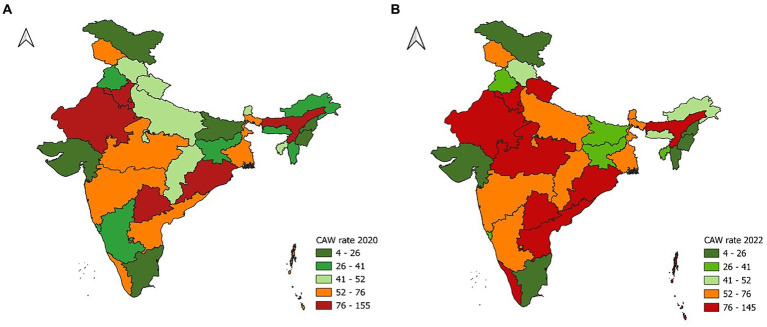
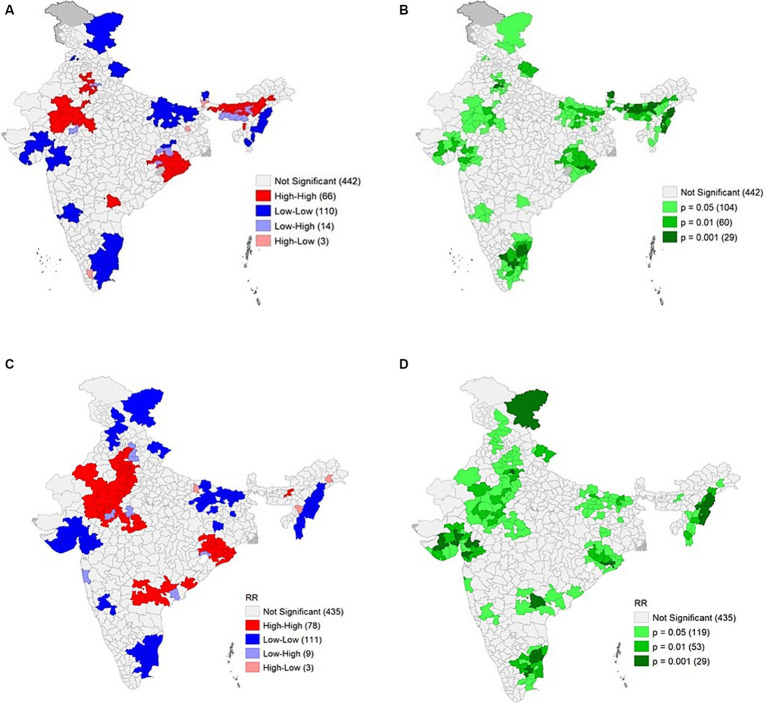
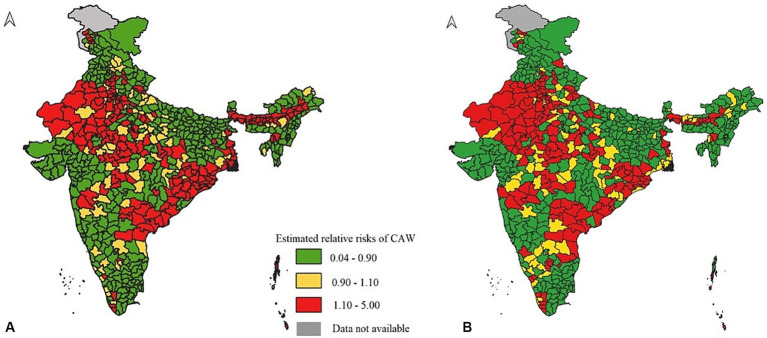
The results indicated a rise in the reported crime against women cases between 2020 and 2022. The rate of crimes against women at the national level was found to be 57 in the year 2020, whereas, in 2022, it increased to 67. The highest crime rate in the year 2022 was found to be 145 in Delhi, while Nagaland had the lowest crime rate of 5. The relative risk of crime against women varied from 0.046 to 4.68 in 2020, while in 2022, it spanned from 0.02 to 6.10. Significant hotspots were found in parts of Rajasthan, Madhya Pradesh, Haryana, Telangana, and Odisha. The results of the spatial error regression model showed that the sex ratio and the population density of the district have significant associations with the occurrence of crimes against women.
The rise in the incidence of crime against women emphasizes the importance of tackling the spatial inequality in relative risk across Indian districts. By thoughtfully addressing this variation and conducting targeted studies in high-risk areas, we can enhance our understanding of the obstacles to implementing effective measures against violence targeting women.
全球范围内针对妇女的犯罪普遍存在,这一问题长期以来一直是一个持久的公共卫生挑战。实现 2030 年可持续发展目标(SDG)与预防这些犯罪的行动密切相关,因为其影响直接影响到各项 SDG 的进展。本研究旨在全面审视印度各邦和地区针对妇女的犯罪发生率,分析 2020 年至 2022 年期间的变化情况,随后确定相关因素。
本研究采用生态分析方法,利用印度国家犯罪记录局(NCRB)提供的 2020 年和 2022 年针对妇女犯罪的数据,对印度所有地区进行了研究。采用小区域估计方法获得了两个时期针对妇女犯罪的地区相对风险。进行热点分析以确定当前的热点和冷点。进一步进行空间回归以确定 2022 年针对妇女犯罪的相关因素。
结果表明,2020 年至 2022 年期间,报告的针对妇女犯罪案件有所增加。全国层面针对妇女犯罪的发生率从 2020 年的 57 上升到 2022 年的 67。2022 年,德里的犯罪率最高,为 145,而那加兰邦的犯罪率最低,为 5。2020 年,针对妇女犯罪的相对风险从 0.046 到 4.68 不等,而 2022 年,该风险从 0.02 到 6.10 不等。在拉贾斯坦邦、中央邦、哈里亚纳邦、特伦甘纳邦和奥里萨邦的部分地区发现了显著的热点。空间误差回归模型的结果表明,该地区的性别比例和人口密度与针对妇女的犯罪发生有显著关联。
针对妇女犯罪发生率的上升强调了应对印度各地区相对风险空间不平等的重要性。通过深思熟虑地解决这种差异,并在高风险地区进行有针对性的研究,我们可以更好地了解在实施针对妇女的暴力行为方面遇到的障碍。