Siontis Konstantinos C, Wieczorek Mikolaj A, Maanja Maren, Hodge David O, Kim Hyung-Kwan, Lee Hyun-Jung, Lee Heesun, Lim Jaehyun, Park Chan Soon, Ariga Rina, Raman Betty, Mahmod Masliza, Watkins Hugh, Neubauer Stefan, Windecker Stephan, Siontis George C M, Gersh Bernard J, Ackerman Michael J, Attia Zachi I, Friedman Paul A, Noseworthy Peter A
Department of Cardiovascular Medicine, Mayo Clinic, 200 First Street SW, Rochester, MN 55905, USA.
Department of Quantitative Health Sciences, Mayo Clinic, 4500 San Pablo Rd S, Jacksonville, FL 32224, USA.
Eur Heart J Digit Health. 2024 Apr 15;5(4):416-426. doi: 10.1093/ehjdh/ztae029. eCollection 2024 Jul.
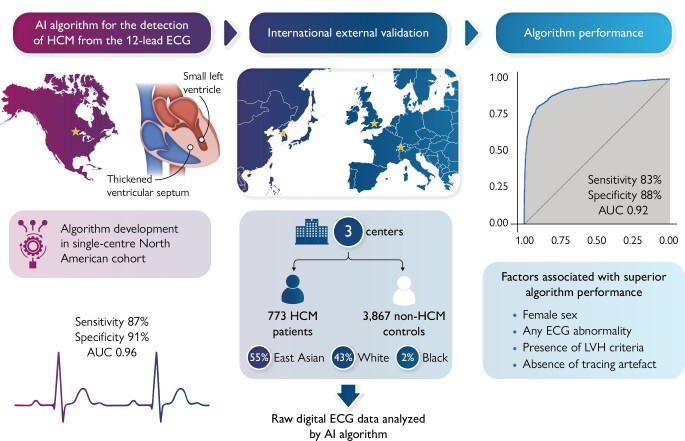
Recently, deep learning artificial intelligence (AI) models have been trained to detect cardiovascular conditions, including hypertrophic cardiomyopathy (HCM), from the 12-lead electrocardiogram (ECG). In this external validation study, we sought to assess the performance of an AI-ECG algorithm for detecting HCM in diverse international cohorts.
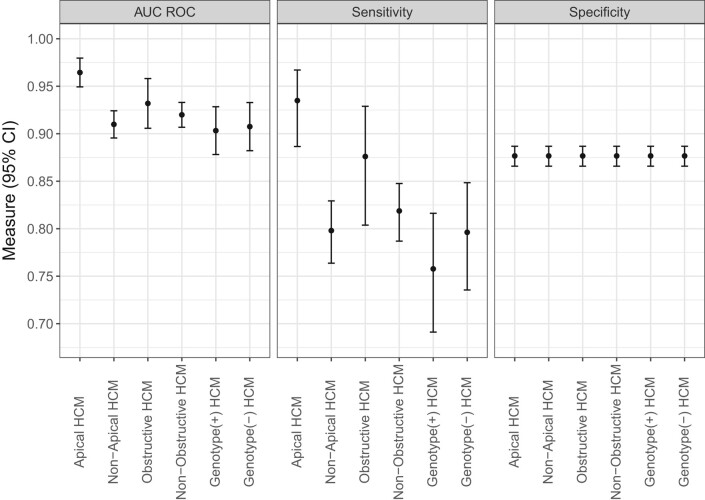
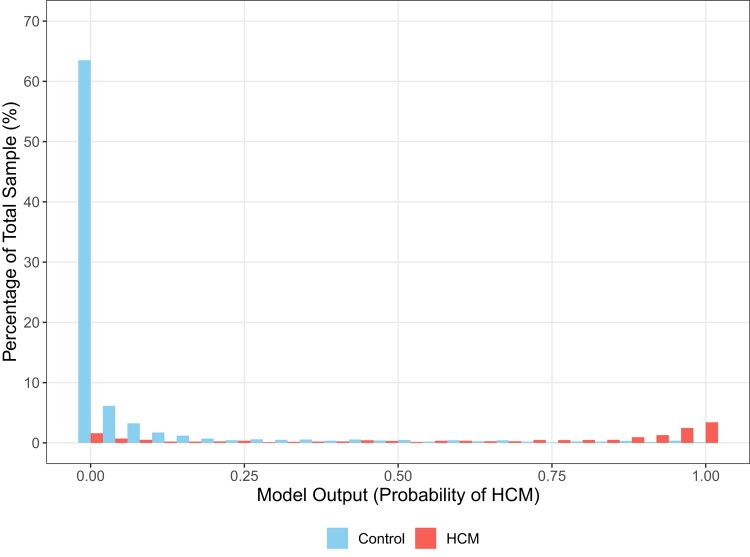
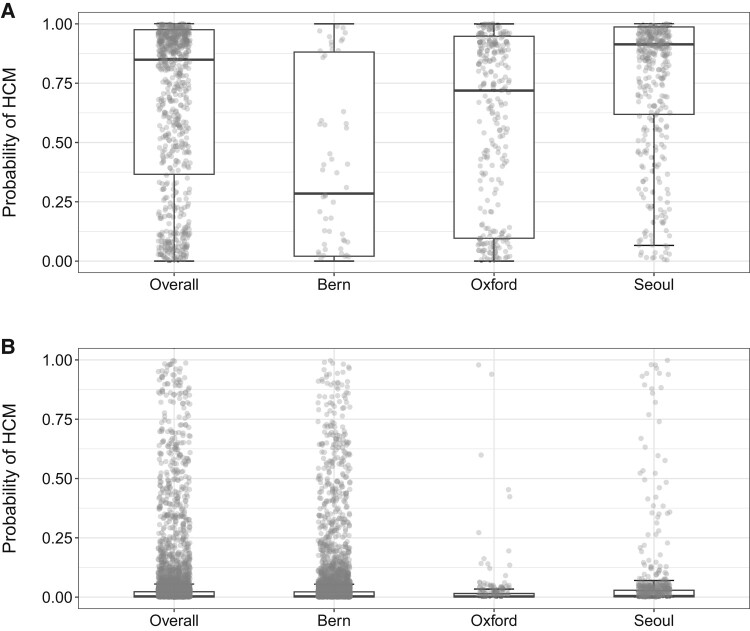
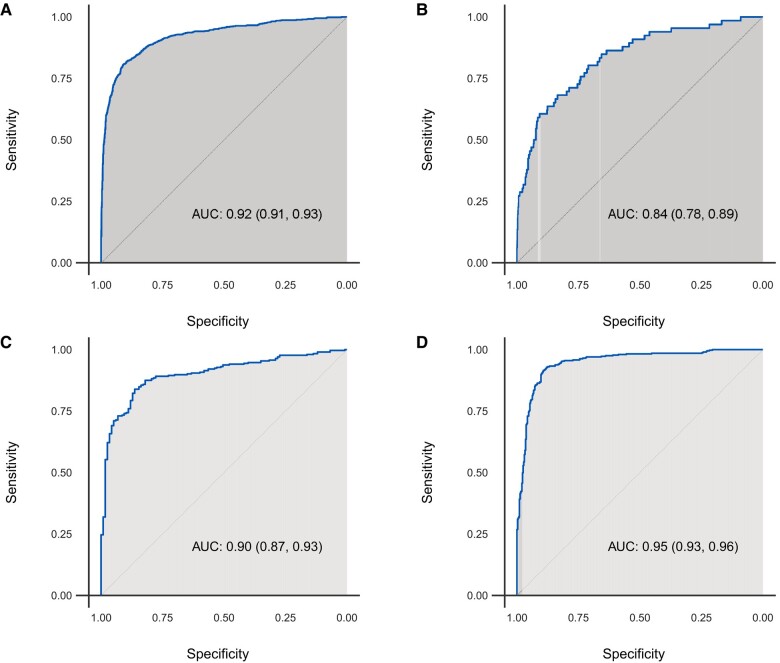
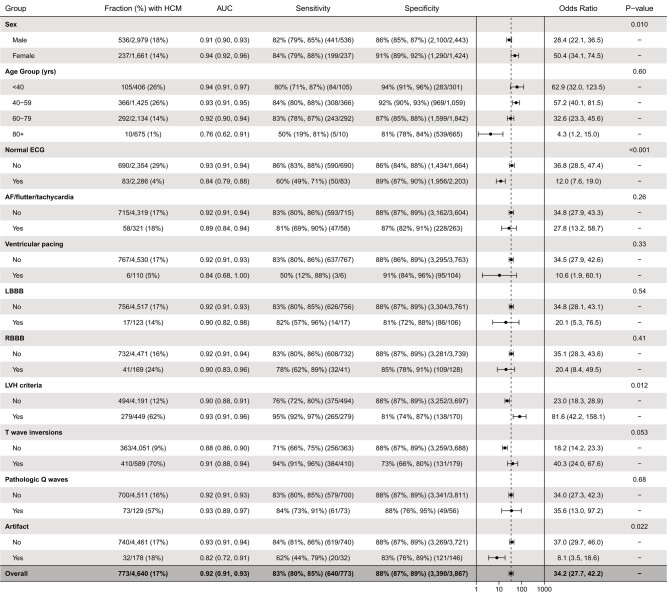
A convolutional neural network-based AI-ECG algorithm was developed previously in a single-centre North American HCM cohort (Mayo Clinic). This algorithm was applied to the raw 12-lead ECG data of patients with HCM and non-HCM controls from three external cohorts (Bern, Switzerland; Oxford, UK; and Seoul, South Korea). The algorithm's ability to distinguish HCM vs. non-HCM status from the ECG alone was examined. A total of 773 patients with HCM and 3867 non-HCM controls were included across three sites in the merged external validation cohort. The HCM study sample comprised 54.6% East Asian, 43.2% White, and 2.2% Black patients. Median AI-ECG probabilities of HCM were 85% for patients with HCM and 0.3% for controls ( < 0.001). Overall, the AI-ECG algorithm had an area under the receiver operating characteristic curve (AUC) of 0.922 [95% confidence interval (CI) 0.910-0.934], with diagnostic accuracy 86.9%, sensitivity 82.8%, and specificity 87.7% for HCM detection. In age- and sex-matched analysis (case-control ratio 1:2), the AUC was 0.921 (95% CI 0.909-0.934) with accuracy 88.5%, sensitivity 82.8%, and specificity 90.4%.
The AI-ECG algorithm determined HCM status from the 12-lead ECG with high accuracy in diverse international cohorts, providing evidence for external validity. The value of this algorithm in improving HCM detection in clinical practice and screening settings requires prospective evaluation.
最近,深度学习人工智能(AI)模型已被训练用于从12导联心电图(ECG)中检测心血管疾病,包括肥厚型心肌病(HCM)。在这项外部验证研究中,我们试图评估一种AI-ECG算法在不同国际队列中检测HCM的性能。
一种基于卷积神经网络的AI-ECG算法先前在北美一个单中心HCM队列(梅奥诊所)中开发。该算法应用于来自三个外部队列(瑞士伯尔尼、英国牛津和韩国首尔)的HCM患者和非HCM对照的原始12导联ECG数据。研究了该算法仅从ECG区分HCM与非HCM状态的能力。合并的外部验证队列中的三个地点共纳入了773例HCM患者和3867例非HCM对照。HCM研究样本包括54.6%的东亚患者、43.2%的白种人和2.2%的黑人患者。HCM患者的AI-ECG中位数概率为85%,对照为0.3%(<0.001)。总体而言,AI-ECG算法的受试者工作特征曲线下面积(AUC)为0.922[95%置信区间(CI)0.910-0.934],检测HCM的诊断准确性为86.9%,敏感性为82.8%,特异性为87.7%。在年龄和性别匹配分析中(病例对照比为1:2),AUC为0.921(95%CI 0.909-0.934),准确性为88.5%,敏感性为82.8%,特异性为90.4%。
AI-ECG算法在不同国际队列中通过12导联ECG确定HCM状态具有很高的准确性,为外部有效性提供了证据。该算法在改善临床实践和筛查环境中HCM检测方面的价值需要前瞻性评估。