State Key Laboratory of Microbial Metabolism, School of Life Sciences and Biotechnology, Shanghai Jiao Tong University, 200240, Shanghai, China.
State Key Laboratory of Bioreactor Engineering, and School of Biotechnology, East China University of Science and Technology (ECUST), 200237, Shanghai, China.
Mol Syst Biol. 2024 Oct;20(10):1134-1150. doi: 10.1038/s44320-024-00060-7. Epub 2024 Aug 12.
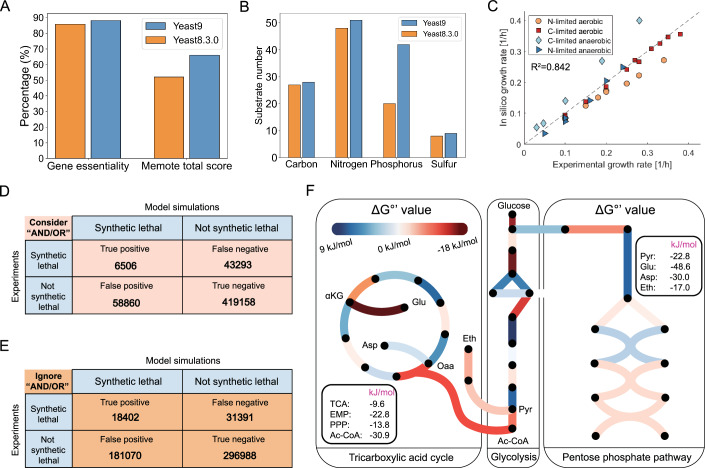
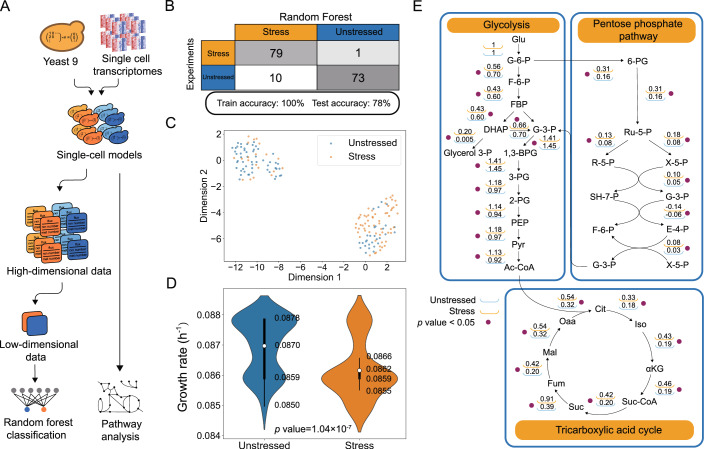
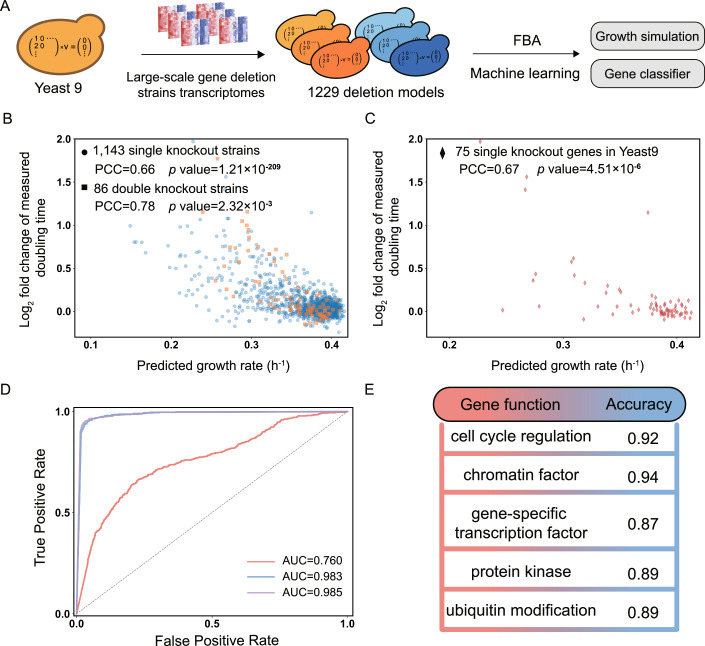
Genome-scale metabolic models (GEMs) can facilitate metabolism-focused multi-omics integrative analysis. Since Yeast8, the yeast-GEM of Saccharomyces cerevisiae, published in 2019, has been continuously updated by the community. This has increased the quality and scope of the model, culminating now in Yeast9. To evaluate its predictive performance, we generated 163 condition-specific GEMs constrained by single-cell transcriptomics from osmotic pressure or reference conditions. Comparative flux analysis showed that yeast adapting to high osmotic pressure benefits from upregulating fluxes through central carbon metabolism. Furthermore, combining Yeast9 with proteomics revealed metabolic rewiring underlying its preference for nitrogen sources. Lastly, we created strain-specific GEMs (ssGEMs) constrained by transcriptomics for 1229 mutant strains. Well able to predict the strains' growth rates, fluxomics from those large-scale ssGEMs outperformed transcriptomics in predicting functional categories for all studied genes in machine learning models. Based on those findings we anticipate that Yeast9 will continue to empower systems biology studies of yeast metabolism.
基因组规模代谢模型(GEMs)可以促进以代谢为重点的多组学综合分析。自 2019 年发布酵母 S. cerevisiae 的酵母-GEM(Yeast8)以来,该模型一直由社区不断更新。这提高了模型的质量和范围,最终形成了 Yeast9。为了评估其预测性能,我们从渗透压或参考条件下的单细胞转录组学生成了 163 个条件特异性 GEMs。比较通量分析表明,适应高渗透压的酵母通过上调中央碳代谢途径的通量而受益。此外,将 Yeast9 与蛋白质组学相结合,揭示了其对氮源偏好的代谢重排。最后,我们为 1229 个突变株创建了转录组学约束的菌株特异性 GEMs(ssGEMs)。这些 GEMs 能够很好地预测菌株的生长速率,从这些大规模 ssGEMs 获得的通量组学在机器学习模型中预测所有研究基因的功能类别方面优于转录组学。基于这些发现,我们预计 Yeast9 将继续为酵母代谢的系统生物学研究提供支持。