Systems Biology Lab, Amsterdam Institute of Molecular and Life Sciences (AIMMS), Vrije Universiteit Amsterdam, Amsterdam, The Netherlands.
TiFN, Wageningen, The Netherlands.
mSystems. 2022 Aug 30;7(4):e0042322. doi: 10.1128/msystems.00423-22. Epub 2022 Aug 11.
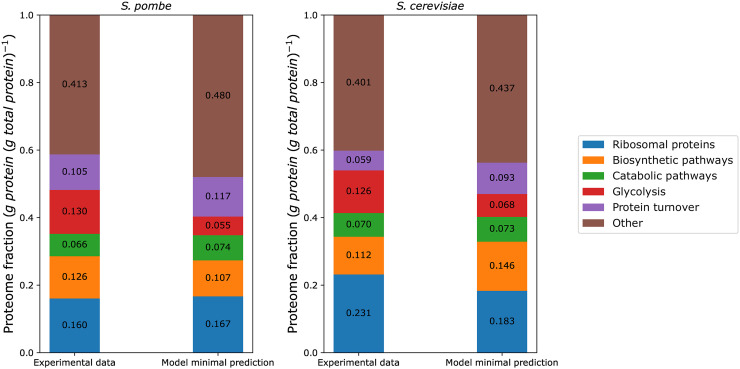
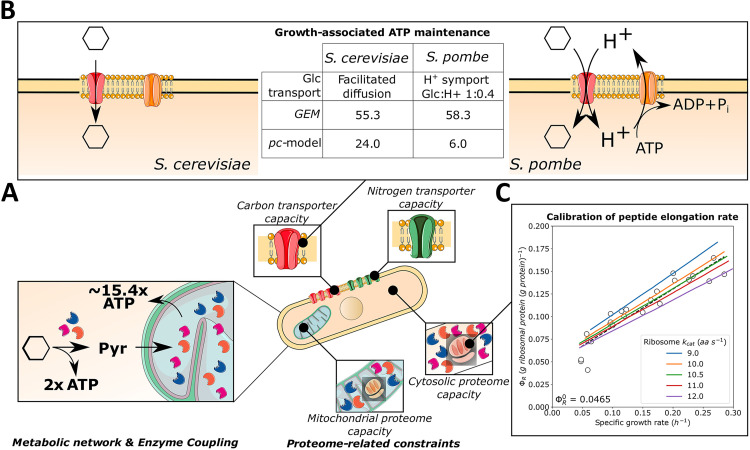
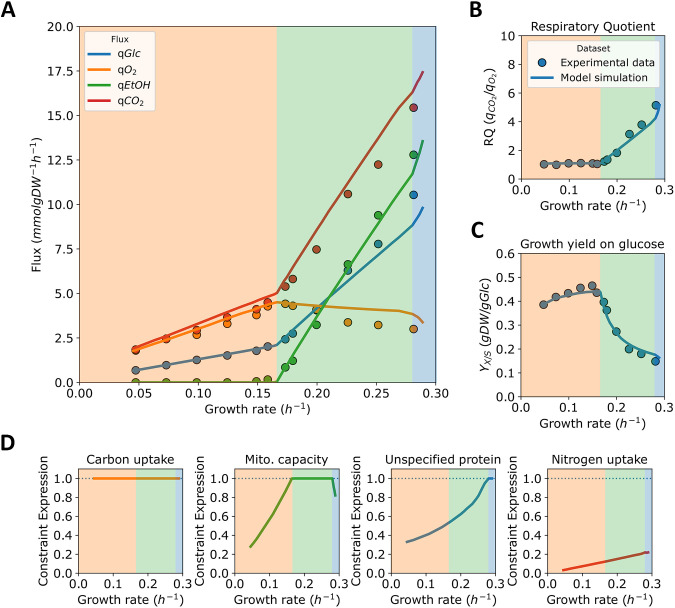
The fission yeast, Schizosaccharomyces pombe, is a popular eukaryal model organism for cell division and cell cycle studies. With this extensive knowledge of its cell and molecular biology, S. pombe also holds promise for use in metabolism research and industrial applications. However, unlike the baker's yeast, Saccharomyces cerevisiae, a major workhorse in these areas, cell physiology and metabolism of S. pombe remain less explored. One way to advance understanding of organism-specific metabolism is construction of computational models and their use for hypothesis testing. To this end, we leverage existing knowledge of S. cerevisiae to generate a manually curated high-quality reconstruction of S. pombe metabolic network, including a proteome-constrained version of the model. Using these models, we gain insights into the energy demands for growth, as well as ribosome kinetics in S. pombe. Furthermore, we predict proteome composition and identify growth-limiting constraints that determine optimal metabolic strategies under different glucose availability regimes and reproduce experimentally determined metabolic profiles. Notably, we find similarities in metabolic and proteome predictions of S. pombe with S. cerevisiae, which indicate that similar cellular resource constraints operate to dictate metabolic organization. With these cases, we show, on the one hand, how these models provide an efficient means to transfer metabolic knowledge from a well-studied to a lesser-studied organism, and on the other, how they can successfully be used to explore the metabolic behavior and the role of resource allocation in driving different strategies in fission yeast. Our understanding of microbial metabolism relies mostly on the knowledge we have obtained from a limited number of model organisms, and the diversity of metabolism beyond the handful of model species thus remains largely unexplored in mechanistic terms. Computational modeling of metabolic networks offers an attractive platform to bridge the knowledge gap and gain new insights into physiology of lesser-studied organisms. Here we showcase an example of successful knowledge transfer from the budding yeast Saccharomyces cerevisiae to a popular model organism in molecular and cell biology, fission yeast Schizosaccharomyces pombe, using computational models.
裂殖酵母(Schizosaccharomyces pombe)是一种用于细胞分裂和细胞周期研究的流行真核模式生物。凭借对其细胞和分子生物学的广泛了解,裂殖酵母在代谢研究和工业应用中也具有广阔的应用前景。然而,与在这些领域中作为主要工作载体的酿酒酵母(Saccharomyces cerevisiae)不同,裂殖酵母的细胞生理学和代谢仍未得到充分探索。一种推进对特定于生物体的代谢理解的方法是构建计算模型并将其用于假设检验。为此,我们利用酿酒酵母的现有知识来生成裂殖酵母代谢网络的手动精心构建的高质量重建,包括模型的蛋白质组约束版本。使用这些模型,我们深入了解了裂殖酵母生长的能量需求以及核糖体动力学。此外,我们预测了蛋白质组组成,并确定了在不同葡萄糖供应条件下决定最佳代谢策略的生长限制约束,并重现了实验确定的代谢谱。值得注意的是,我们发现裂殖酵母的代谢和蛋白质组预测与酿酒酵母存在相似之处,这表明类似的细胞资源限制决定了代谢组织。通过这些案例,我们一方面展示了这些模型如何提供一种有效的方法来将代谢知识从研究充分的生物体转移到研究较少的生物体,另一方面展示了它们如何成功地用于探索代谢行为以及资源分配在驱动不同策略中的作用在裂变酵母中。我们对微生物代谢的理解主要依赖于我们从少数几个模式生物中获得的知识,因此,除了少数几种模式物种之外,代谢的多样性在机制上仍然在很大程度上未被探索。代谢网络的计算建模为缩小知识差距并深入了解研究较少的生物体的生理学提供了一个有吸引力的平台。在这里,我们展示了使用计算模型从出芽酵母酿酒酵母成功转移到分子和细胞生物学中的流行模式生物裂殖酵母的一个成功案例。