Department of Radiology, Zhejiang Chinese Medical University Affiliated Jiaxing TCM Hospital, Jiaxing, China.
Department of Radiology, The First Affiliated Hospital of Zhejiang Chinese Medical University (Zhejiang Provincial Hospital of Chinese Medicine), Hangzhou, China.
J Transl Med. 2024 Sep 6;22(1):826. doi: 10.1186/s12967-024-05619-4.
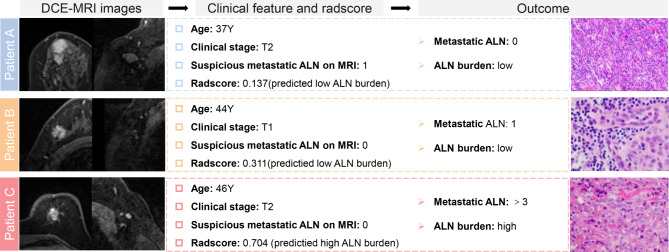
Preoperative prediction of axillary lymph node (ALN) burden in patients with early-stage breast cancer is pivotal for individualised treatment. This study aimed to develop a MRI radiomics model for evaluating the ALN burden in early-stage breast cancer and to provide biological interpretability to predictions by integrating radiogenomic data.
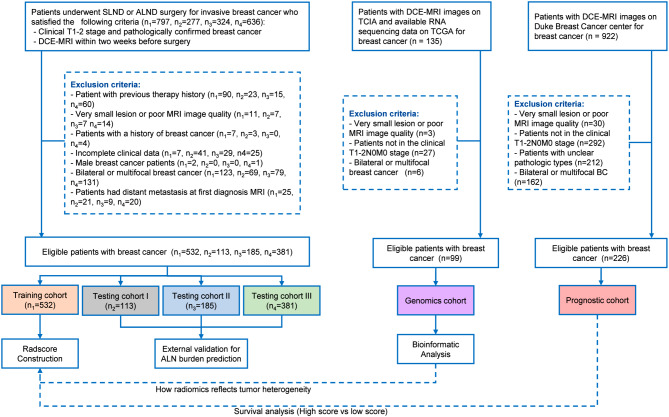
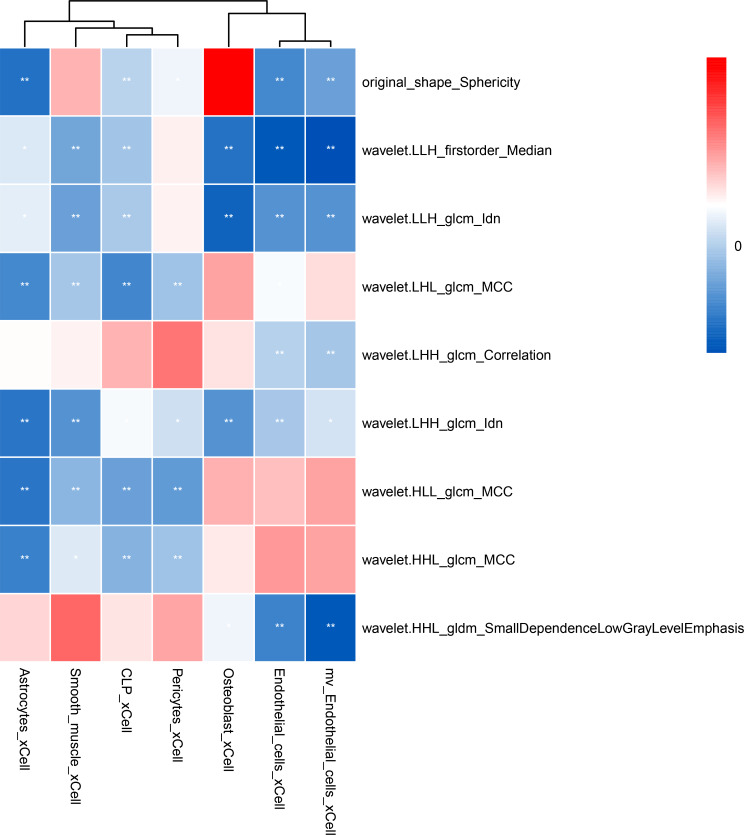
This study retrospectively analyzed 1211 patients with early-stage breast cancer from four centers, supplemented by data from The Cancer Imaging Archive (TCIA) and Duke University (DUKE). MRI radiomic features were extracted from dynamic contrast-enhanced MRI images and an ALN burden-related radscore was constructed by the backpropagation neural network algorithm. Clinical and combined models were developed, integrating ALN-related clinical variables and radscore. The Kaplan-Meier curve and log-rank test were used to assess the prognostic differences between the predicted high- and low-ALN burden groups in both Center I and DUKE cohorts. Gene set enrichment and immune infiltration analyses based on transcriptomic TCIA and TCIA Breast Cancer dataset were used to investigate the biological significance of the ALN-related radscore.
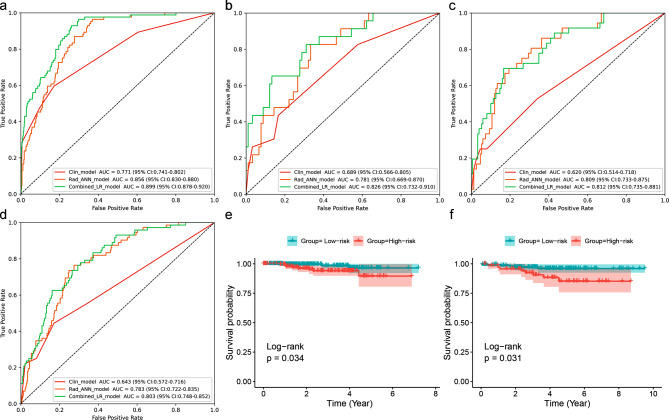
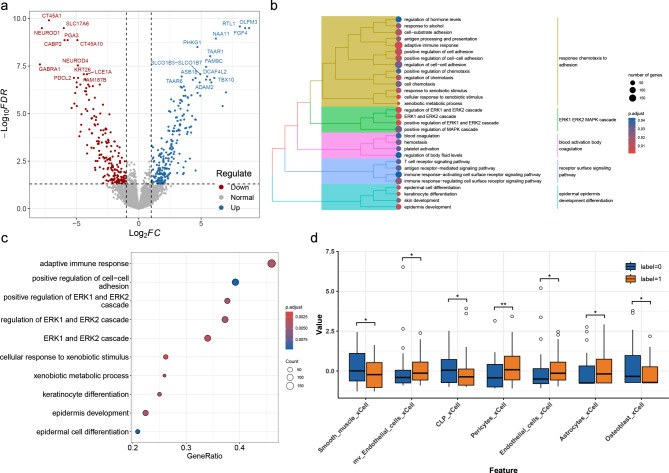
The MRI radiomics model demonstrated an area under the curve of 0.781-0.809 in three validation cohorts. The predicted high-risk population demonstrated a poorer prognosis (log-rank P < .05 in both cohorts). Radiogenomic analysis revealed migration pathway upregulation and cell differentiation pathway downregulation in the high radscore groups. Immune infiltration analysis confirmed the ability of radiological features to reflect the heterogeneity of the tumor microenvironment.
The MRI radiomics model effectively predicted the ALN burden and prognosis of early-stage breast cancer. Moreover, radiogenomic analysis revealed key cellular and immune patterns associated with the radscore.
在早期乳腺癌患者中,术前预测腋窝淋巴结(ALN)负担对于个体化治疗至关重要。本研究旨在开发一种 MRI 放射组学模型,用于评估早期乳腺癌的 ALN 负担,并通过整合放射基因组学数据为预测提供生物学可解释性。
本研究回顾性分析了来自四个中心的 1211 例早期乳腺癌患者的数据,同时补充了来自癌症影像学档案(TCIA)和杜克大学(DUKE)的数据。从动态对比增强 MRI 图像中提取 MRI 放射组学特征,并通过反向传播神经网络算法构建与 ALN 负担相关的 radscore。构建了包含 ALN 相关临床变量和 radscore 的临床和联合模型。Kaplan-Meier 曲线和对数秩检验用于评估中心 I 和 DUKE 队列中预测的高和低 ALN 负担组之间的预后差异。基于转录组 TCIA 和 TCIA 乳腺癌数据集的基因集富集和免疫浸润分析用于研究与 ALN 相关的 radscore 的生物学意义。
MRI 放射组学模型在三个验证队列中的 AUC 为 0.781-0.809。预测的高危人群预后较差(两个队列中的对数秩 P<0.05)。放射基因组学分析显示,高 radscore 组中迁移途径上调,细胞分化途径下调。免疫浸润分析证实了放射学特征能够反映肿瘤微环境的异质性。
MRI 放射组学模型能够有效预测早期乳腺癌的 ALN 负担和预后。此外,放射基因组学分析揭示了与 radscore 相关的关键细胞和免疫模式。