You Chao, Su Guan-Hua, Zhang Xu, Xiao Yi, Zheng Ren-Cheng, Sun Shi-Yun, Zhou Jia-Yin, Lin Lu-Yi, Wang Ze-Zhou, Wang He, Chen Yan, Peng Wei-Jun, Jiang Yi-Zhou, Shao Zhi-Ming, Gu Ya-Jia
Department of Radiology, Fudan University Shanghai Cancer Center; Department of Oncology, Shanghai Medical College, Fudan University, Shanghai, China.
Key Laboratory of Breast Cancer in Shanghai, Department of Breast Surgery, Fudan University Shanghai Cancer Center; Department of Oncology, Shanghai Medical College, Fudan University, Shanghai, China.
NPJ Precis Oncol. 2024 Sep 7;8(1):193. doi: 10.1038/s41698-024-00666-y.
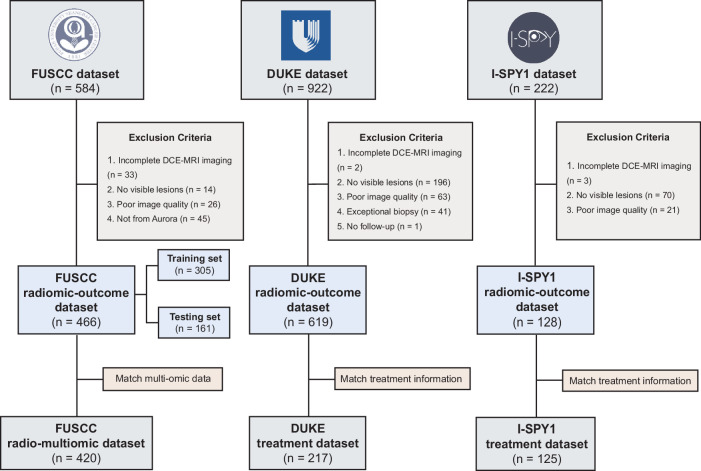
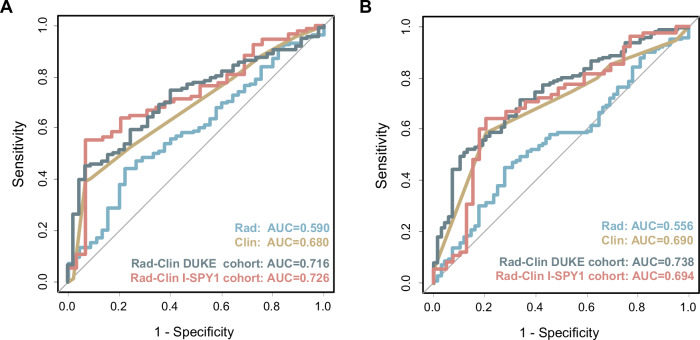
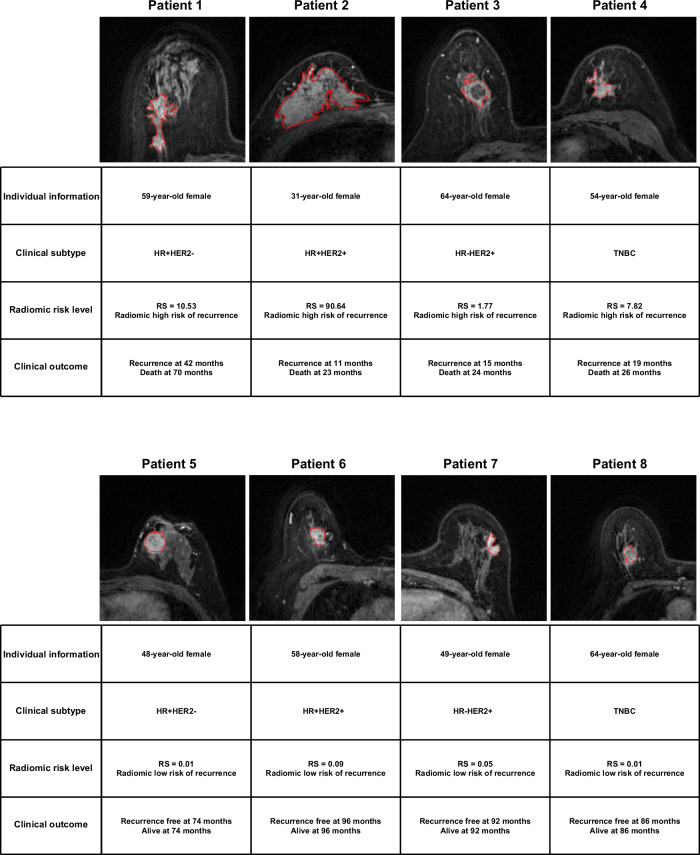
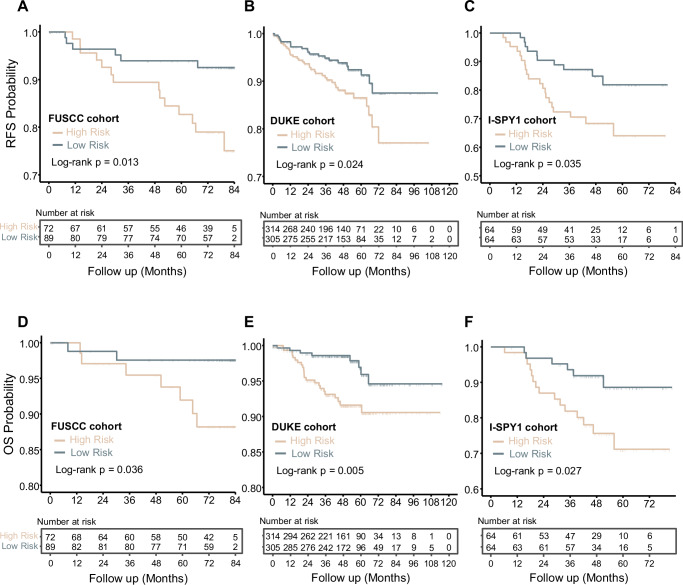
Radiomics offers a noninvasive avenue for predicting clinicopathological factors. However, thorough investigations into a robust breast cancer outcome-predicting model and its biological significance remain limited. This study develops a robust radiomic model for prognosis prediction, and further excavates its biological foundation and transferring prediction performance. We retrospectively collected preoperative dynamic contrast-enhanced MRI data from three distinct breast cancer patient cohorts. In FUSCC cohort (n = 466), Lasso was used to select features correlated with patient prognosis and multivariate Cox regression was utilized to integrate these features and build the radiomic risk model, while multiomic analysis was conducted to investigate the model's biological implications. DUKE cohort (n = 619) and I-SPY1 cohort (n = 128) were used to test the performance of the radiomic signature in outcome prediction. A thirteen-feature radiomic signature was identified in the FUSCC cohort training set and validated in the FUSCC cohort testing set, DUKE cohort and I-SPY1 cohort for predicting relapse-free survival (RFS) and overall survival (OS) (RFS: p = 0.013, p = 0.024 and p = 0.035; OS: p = 0.036, p = 0.005 and p = 0.027 in the three cohorts). Multiomic analysis uncovered metabolic dysregulation underlying the radiomic signature (ATP metabolic process: NES = 1.84, p-adjust = 0.02; cholesterol biosynthesis: NES = 1.79, p-adjust = 0.01). Regarding the therapeutic implications, the radiomic signature exhibited value when combining clinical factors for predicting the pathological complete response to neoadjuvant chemotherapy (DUKE cohort, AUC = 0.72; I-SPY1 cohort, AUC = 0.73). In conclusion, our study identified a breast cancer outcome-predicting radiomic signature in a multicenter radio-multiomic study, along with its correlations with multiomic features in prognostic risk assessment, laying the groundwork for future prospective clinical trials in personalized risk stratification and precision therapy.
放射组学为预测临床病理因素提供了一条非侵入性途径。然而,对于一个强大的乳腺癌预后预测模型及其生物学意义的深入研究仍然有限。本研究开发了一种用于预后预测的强大放射组学模型,并进一步挖掘其生物学基础和转移预测性能。我们回顾性收集了来自三个不同乳腺癌患者队列的术前动态对比增强MRI数据。在复旦大学附属肿瘤医院(FUSCC)队列(n = 466)中,使用套索回归选择与患者预后相关的特征,并利用多变量Cox回归整合这些特征并构建放射组学风险模型,同时进行多组学分析以研究该模型的生物学意义。杜克大学(DUKE)队列(n = 619)和I-SPY1队列(n = 128)用于测试放射组学特征在预后预测中的性能。在FUSCC队列训练集中确定了一个由13个特征组成的放射组学特征,并在FUSCC队列测试集、DUKE队列和I-SPY1队列中进行了验证,用于预测无复发生存期(RFS)和总生存期(OS)(三个队列中RFS:p = 0.013、p = 0.024和p = 0.035;OS:p = 0.036、p = 0.005和p = 0.027)。多组学分析揭示了放射组学特征背后的代谢失调(ATP代谢过程:标准化富集分数(NES)= 1.84,校正p值= 0.02;胆固醇生物合成:NES = 1.79,校正p值= 0.01)。关于治疗意义,在结合临床因素预测新辅助化疗的病理完全缓解时,放射组学特征显示出价值(DUKE队列,曲线下面积(AUC)= 0.72;I-SPY1队列,AUC = 0.73)。总之,我们的研究在一项多中心放射 - 多组学研究中确定了一种乳腺癌预后预测放射组学特征,以及其在预后风险评估中与多组学特征的相关性,为未来在个性化风险分层和精准治疗方面的前瞻性临床试验奠定了基础。