Pal Pratibha, Li Hanrui, Al-Ajeil Ruba, Mohammed Abdul Khayum, Rezk Ayman, Melinte Georgian, Nayfeh Ammar, Shetty Dinesh, El-Atab Nazek
Smart, Advanced Memory Devices and Applications (SAMA) Laboratory, Electrical and Computer Engineering Program, Computer Electrical Mathematical Science and Engineering Division, King Abdullah University of Science and Technology (KAUST), Thuwal, 23955, Kingdom of Saudi Arabia.
Department of Chemistry, Khalifa University of Science & Technology, Abu Dhabi, 127788, UAE.
Adv Sci (Weinh). 2024 Dec;11(45):e2408648. doi: 10.1002/advs.202408648. Epub 2024 Sep 9.
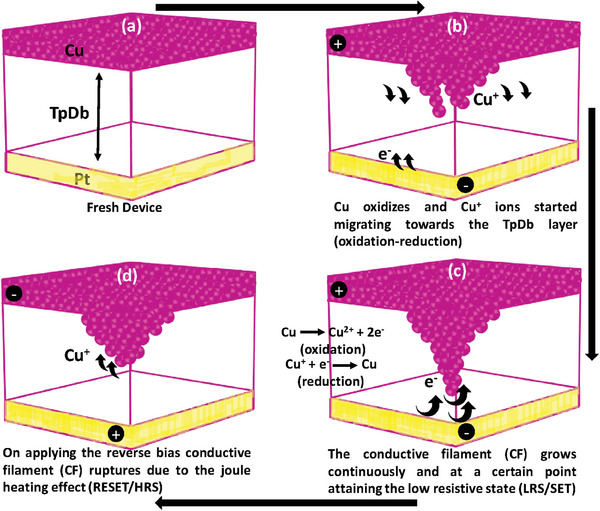
According to the United Nations, around 53 million metric tons of electronic waste is produced every year, worldwide, the big majority of which goes unprocessed. With the rapid advances in AI technologies and adoption of smart gadgets, the demand for powerful logic and memory chips is expected to boom. Therefore, the development of green electronics is crucial to minimizing the impact of the alarmingly increasing e-waste. Here, it is shown the application of a green synthesized, chemically stable, carbonyl-decorated 2D organic, and biocompatible polymer as an active layer in a memristor device, sandwiched between potentially fully recyclable electrodes. The 2D polymer's ultramicro channels, decorated with C═O and O─H groups, efficiently promote the formation of copper nanofilaments. As a result, the device shows excellent bipolar resistive switching behavior with the potential to mimic synaptic plasticity. A large resistive switching window (10), low SET/RESET voltage of ≈0.5/-1.5 V), excellent device-to-device stability and synaptic features are demonstrated. Leveraging the device's synaptic characteristics, its applications in image denoising and edge detection is examined. The results show a reduction in power consumption by a factor of 10 compared to a traditional Tesla P40 graphics processing unit, indicating great promise for future sustainable AI-based applications.
据联合国统计,全球每年产生约5300万吨电子垃圾,其中绝大部分未经处理。随着人工智能技术的迅速发展和智能设备的广泛应用,对高性能逻辑和存储芯片的需求预计将激增。因此,绿色电子产品的发展对于最大限度地减少电子垃圾惊人增长所带来的影响至关重要。在此,展示了一种绿色合成、化学稳定、羰基修饰的二维有机且具有生物相容性的聚合物作为忆阻器器件有源层的应用,该器件夹在潜在可完全回收的电极之间。二维聚合物的超微通道装饰有C═O和O─H基团,能有效促进铜纳米丝的形成。结果,该器件表现出优异的双极电阻开关行为,具有模拟突触可塑性的潜力。展示了大电阻开关窗口(10)、约0.5 / -1.5 V的低设置/重置电压、优异的器件间稳定性和突触特性。利用该器件的突触特性,研究了其在图像去噪和边缘检测中的应用。结果表明,与传统的特斯拉P40图形处理单元相比,功耗降低了10倍,这表明其在未来基于人工智能的可持续应用中具有巨大潜力。