• 文献检索
  • 文档翻译
  • 深度研究
  • 学术资讯
  • Suppr Zotero 插件Zotero 插件
  • 邀请有礼
  • 套餐&价格
  • 历史记录
应用&插件
Suppr Zotero 插件Zotero 插件浏览器插件Mac 客户端Windows 客户端微信小程序
定价
高级版会员购买积分包购买API积分包
服务
文献检索文档翻译深度研究API 文档MCP 服务
关于我们
关于 Suppr公司介绍联系我们用户协议隐私条款
关注我们

Suppr 超能文献

核心技术专利:CN118964589B侵权必究
粤ICP备2023148730 号-1Suppr @ 2026

文献检索

告别复杂PubMed语法,用中文像聊天一样搜索,搜遍4000万医学文献。AI智能推荐,让科研检索更轻松。

立即免费搜索

文件翻译

保留排版,准确专业,支持PDF/Word/PPT等文件格式,支持 12+语言互译。

免费翻译文档

深度研究

AI帮你快速写综述,25分钟生成高质量综述,智能提取关键信息,辅助科研写作。

立即免费体验

重新审视日本脑炎病毒(JEV)传入美国的风险——一项更新的半定量风险评估。

Revisiting the risk of introduction of Japanese encephalitis virus (JEV) into the United States - An updated semi-quantitative risk assessment.

作者信息

Dixon Andrea L, Oliveira Ana R S, Cohnstaedt Lee W, Mitzel Dana, Mire Chad, Cernicchiaro Natalia

机构信息

Center for Outcomes Research and Epidemiology, College of Veterinary Medicine, Kansas State University, Manhattan, KS, USA.

Department of Population Health & Reproduction, School of Veterinary Medicine, University of California, Davis, CA, USA.

出版信息

One Health. 2024 Aug 17;19:100879. doi: 10.1016/j.onehlt.2024.100879. eCollection 2024 Dec.

DOI:10.1016/j.onehlt.2024.100879
PMID:39253386
原文链接:https://pmc.ncbi.nlm.nih.gov/articles/PMC11381889/
Abstract

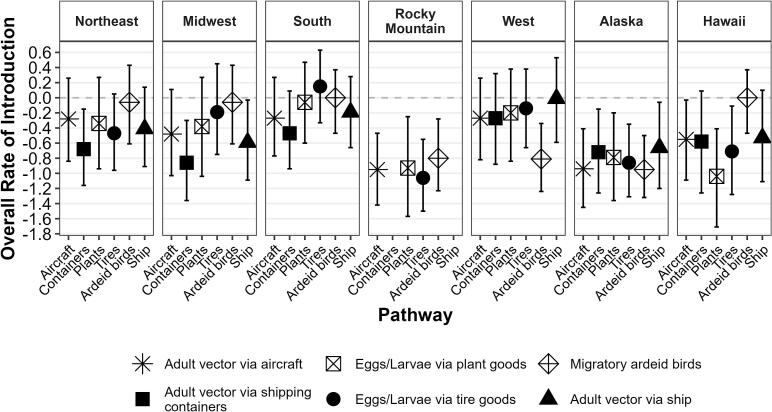
Japanese encephalitis virus (JEV) is associated with encephalitis in humans and reproductive and neurological illness in pigs. JEV has expanded beyond its native distribution in southeast Asia, with identifications in Europe (2010) and Africa (2016), and most recently, its spread into mainland Australia (2021-2022). The introduction of JEV into the United States (US) is a public health risk, and could also impact animal health and the food supply. To efficiently and cost-effectively manage risk, a better understanding of how and where diseases will be introduced, transmitted, and spread is required. To achieve this objective, we updated our group's previous qualitative risk assessment using an established semi-quantitative risk assessment tool (MINTRISK) to compare the overall rate of introduction and risk, including impacts, of JEV in seven US regions. The rate of introduction from the current region of distribution was considered negligible for the Northeast, Midwest, Rocky Mountain, West, Alaska, and Hawaii regions. The South region was the only region with a pathway that had a non-negligible rate of introduction; infected mosquito eggs and larvae introduced via imported used tires (very low; 95% uncertainty interval (UI) = negligible to high). The overall risk estimate for the South was very high (95% UI = very low to very high). Based on this risk assessment, the South region should be prioritized for surveillance activities to ensure the early detection of JEV. The assumptions used in this risk assessment, due to the lack of information about the global movement of mosquitoes, number of feral pigs in the US, the role of non-ardeid wild birds in transmission, and the magnitude of the basic reproduction ratio of JEV in a novel region, need to be fully considered as these impact the estimated probability of establishment.

摘要

日本脑炎病毒(JEV)可导致人类脑炎以及猪的生殖和神经疾病。JEV已超出其在东南亚的原生分布范围,在欧洲(2010年)和非洲(2016年)均有发现,最近还传播到了澳大利亚大陆(2021 - 2022年)。JEV传入美国是一种公共卫生风险,也可能影响动物健康和食品供应。为了高效且经济地管理风险,需要更好地了解疾病将如何以及在何处传入、传播和扩散。为实现这一目标,我们使用一种既定的半定量风险评估工具(MINTRISK)更新了我们团队之前的定性风险评估,以比较JEV在美国七个地区的总体传入率和风险,包括影响。对于东北部、中西部、落基山脉、西部、阿拉斯加和夏威夷地区,当前分布区域的传入率被认为可忽略不计。南部地区是唯一存在传入率不可忽略途径的地区;通过进口二手轮胎引入受感染的蚊卵和幼虫(非常低;95%不确定区间(UI) = 可忽略不计至高)。南部地区的总体风险估计非常高(95% UI = 非常低至非常高)。基于这一风险评估,应优先对南部地区进行监测活动,以确保早期发现JEV。由于缺乏关于蚊子全球移动、美国野猪数量、非鹭科野生鸟类在传播中的作用以及JEV在新区域的基本繁殖率大小等信息,本风险评估中使用的假设需要充分考虑,因为这些会影响建立的估计概率。

https://cdn.ncbi.nlm.nih.gov/pmc/blobs/4718/11381889/8fa319194620/mmc3.jpg
https://cdn.ncbi.nlm.nih.gov/pmc/blobs/4718/11381889/14c3cdbd7087/gr1.jpg
https://cdn.ncbi.nlm.nih.gov/pmc/blobs/4718/11381889/1a89d1d0e014/gr2.jpg
https://cdn.ncbi.nlm.nih.gov/pmc/blobs/4718/11381889/d2b0d1ad368f/gr3.jpg
https://cdn.ncbi.nlm.nih.gov/pmc/blobs/4718/11381889/fe3fd4423186/mmc1.jpg
https://cdn.ncbi.nlm.nih.gov/pmc/blobs/4718/11381889/cc847762414a/mmc2.jpg
https://cdn.ncbi.nlm.nih.gov/pmc/blobs/4718/11381889/8fa319194620/mmc3.jpg
https://cdn.ncbi.nlm.nih.gov/pmc/blobs/4718/11381889/14c3cdbd7087/gr1.jpg
https://cdn.ncbi.nlm.nih.gov/pmc/blobs/4718/11381889/1a89d1d0e014/gr2.jpg
https://cdn.ncbi.nlm.nih.gov/pmc/blobs/4718/11381889/d2b0d1ad368f/gr3.jpg
https://cdn.ncbi.nlm.nih.gov/pmc/blobs/4718/11381889/fe3fd4423186/mmc1.jpg
https://cdn.ncbi.nlm.nih.gov/pmc/blobs/4718/11381889/cc847762414a/mmc2.jpg
https://cdn.ncbi.nlm.nih.gov/pmc/blobs/4718/11381889/8fa319194620/mmc3.jpg

相似文献

1
Revisiting the risk of introduction of Japanese encephalitis virus (JEV) into the United States - An updated semi-quantitative risk assessment.重新审视日本脑炎病毒(JEV)传入美国的风险——一项更新的半定量风险评估。
One Health. 2024 Aug 17;19:100879. doi: 10.1016/j.onehlt.2024.100879. eCollection 2024 Dec.
2
Introduction of the Japanese encephalitis virus (JEV) in the United States - A qualitative risk assessment.美国日本脑炎病毒(JEV)的引入——定性风险评估。
Transbound Emerg Dis. 2019 Jul;66(4):1558-1574. doi: 10.1111/tbed.13181. Epub 2019 Apr 16.
3
A quantitative risk assessment (QRA) of the risk of introduction of the Japanese encephalitis virus (JEV) in the United States via infected mosquitoes transported in aircraft and cargo ships.通过飞机和货船运输的感染性蚊子将日本脑炎病毒(JEV)引入美国的风险的定量风险评估(QRA)。
Prev Vet Med. 2018 Nov 15;160:1-9. doi: 10.1016/j.prevetmed.2018.09.020. Epub 2018 Sep 24.
4
Perspectives Regarding the Risk of Introduction of the Japanese Encephalitis Virus (JEV) in the United States.关于日本脑炎病毒(JEV)传入美国风险的观点。
Front Vet Sci. 2020 Feb 7;7:48. doi: 10.3389/fvets.2020.00048. eCollection 2020.
5
Infection of Feral Phenotype Swine with Japanese Encephalitis Virus.野化猪感染日本脑炎病毒。
Vector Borne Zoonotic Dis. 2023 Dec;23(12):645-652. doi: 10.1089/vbz.2023.0030. Epub 2023 Sep 7.
6
Japanese Encephalitis Virus: The Emergence of Genotype IV in Australia and Its Potential Endemicity.日本脑炎病毒:基因型 IV 在澳大利亚的出现及其潜在的地方性流行。
Viruses. 2022 Nov 9;14(11):2480. doi: 10.3390/v14112480.
7
Potential for the emergence of Japanese encephalitis virus in California.加利福尼亚州日本脑炎病毒出现的可能性。
Vector Borne Zoonotic Dis. 2009 Oct;9(5):511-7. doi: 10.1089/vbz.2008.0052.
8
Japanese Encephalitis: Risk of Emergence in the United States and the Resulting Impact.日本脑炎:在美国出现的风险及其带来的影响。
Viruses. 2023 Dec 28;16(1):54. doi: 10.3390/v16010054.
9
Meta-analyses of the proportion of Japanese encephalitis virus infection in vectors and vertebrate hosts.媒介和脊椎动物宿主中日本脑炎病毒感染比例的荟萃分析。
Parasit Vectors. 2017 Sep 7;10(1):418. doi: 10.1186/s13071-017-2354-7.
10
The Ecology and Evolution of Japanese Encephalitis Virus.日本脑炎病毒的生态学与进化
Pathogens. 2021 Nov 24;10(12):1534. doi: 10.3390/pathogens10121534.

引用本文的文献

1
Managing Japanese Encephalitis Virus as a Veterinary Infectious Disease Through Animal Surveillance and One Health Control Strategies.通过动物监测和“同一健康”控制策略将日本脑炎病毒作为一种兽医传染病进行管理。
Life (Basel). 2025 Aug 7;15(8):1260. doi: 10.3390/life15081260.
2
The alarming spread of Japanese encephalitis: A growing public health concern.日本脑炎的惊人传播:日益严重的公共卫生问题。
Open Vet J. 2025 Apr;15(4):1505-1519. doi: 10.5455/OVJ.2025.v15.i4.1. Epub 2025 Apr 30.

本文引用的文献

1
Introduction of invasive mosquito species into Europe and prospects for arbovirus transmission and vector control in an era of globalization.引言:入侵蚊种进入欧洲以及在全球化时代虫媒病毒传播和病媒控制的前景。
Infect Dis Poverty. 2023 Nov 30;12(1):109. doi: 10.1186/s40249-023-01167-z.
2
A review of qualitative risk assessment in animal health: Suggestions for best practice.动物健康定性风险评估综述:最佳实践建议
Front Vet Sci. 2023 Feb 7;10:1102131. doi: 10.3389/fvets.2023.1102131. eCollection 2023.
3
Effects of constant temperature and daily fluctuating temperature on the transovarial transmission and life cycle of infected with Zika virus.
恒温与每日温度波动对感染寨卡病毒的经卵传播及生命周期的影响。
Front Microbiol. 2023 Jan 4;13:1075362. doi: 10.3389/fmicb.2022.1075362. eCollection 2022.
4
COVID-19 pandemic and prospects for recovery of the global aviation industry.新冠疫情与全球航空业的复苏前景。
J Air Transp Manag. 2021 May;92:102022. doi: 10.1016/j.jairtraman.2021.102022. Epub 2021 Jan 21.
5
Japanese Encephalitis Virus: The Emergence of Genotype IV in Australia and Its Potential Endemicity.日本脑炎病毒:基因型 IV 在澳大利亚的出现及其潜在的地方性流行。
Viruses. 2022 Nov 9;14(11):2480. doi: 10.3390/v14112480.
6
Japanese Encephalitis Virus Emergence in Australia: Public Health Importance and Implications for Future Surveillance.日本脑炎病毒在澳大利亚的出现:公共卫生重要性及对未来监测的影响
Vector Borne Zoonotic Dis. 2022 Nov;22(11):529-534. doi: 10.1089/vbz.2022.0037. Epub 2022 Oct 10.
7
A literature review of dispersal pathways of Aedes albopictus across different spatial scales: implications for vector surveillance.白纹伊蚊在不同空间尺度上的扩散途径的文献综述:对病媒监测的影响。
Parasit Vectors. 2022 Aug 27;15(1):303. doi: 10.1186/s13071-022-05413-5.
8
Modelling Japanese encephalitis virus transmission dynamics and human exposure in a Cambodian rural multi-host system.在柬埔寨农村多宿主系统中模拟日本脑炎病毒传播动态和人类暴露情况。
PLoS Negl Trop Dis. 2022 Jul 11;16(7):e0010572. doi: 10.1371/journal.pntd.0010572. eCollection 2022 Jul.
9
The Emergence of Japanese Encephalitis Virus in Australia in 2022: Existing Knowledge of Mosquito Vectors.2022 年澳大利亚出现日本脑炎病毒:蚊虫媒介的现有知识。
Viruses. 2022 Jun 2;14(6):1208. doi: 10.3390/v14061208.
10
Japanese Encephalitis Virus Interaction with Mosquitoes: A Review of Vector Competence, Vector Capacity and Mosquito Immunity.日本脑炎病毒与蚊子的相互作用:媒介能力、传播能力和蚊子免疫力综述
Pathogens. 2022 Mar 3;11(3):317. doi: 10.3390/pathogens11030317.