Ehrlich Joshua R, Nichols Emma, Chen Yizhou, Nagarajan Niranjani, Zeki Al Hazzouri Adina, Reed Nicholas S, Lee Jinkook, Gross Alden L
Department of Ophthalmology and Visual Sciences, University of Michigan, Ann Arbor, Michigan, USA.
Institute for Social Research, University of Michigan, Ann Arbor, Michigan, USA.
Innov Aging. 2024 Aug 9;8(9):igae071. doi: 10.1093/geroni/igae071. eCollection 2024.
Prior investigations have not considered whether poor vision biases cognitive testing. However, such research is vital given increasing evidence that vision impairment (VI) may be an important modifiable risk factor for dementia, particularly in low- and middle-income settings where the prevalence of VI is high.
This study employed data from 3 784 participants in Wave 1 of the Longitudinal Aging Study in India-Diagnostic Assessment of Dementia (LASI-DAD) who underwent both visual acuity and cognitive function testing. We used multiple indicators and multiple causes models to assess differential item functioning (DIF; eg, bias) in cognitive testing by objectively measured distance and near VI. Multivariable linear regression was used to model the association between VI and cognitive factor scores before and after DIF adjustment. Analyses were performed for general cognition and separate cognitive domains, corresponding to memory, language/fluency, executive functioning, and visuospatial performance. Models were adjusted for demographic, health, and socioeconomic covariates.
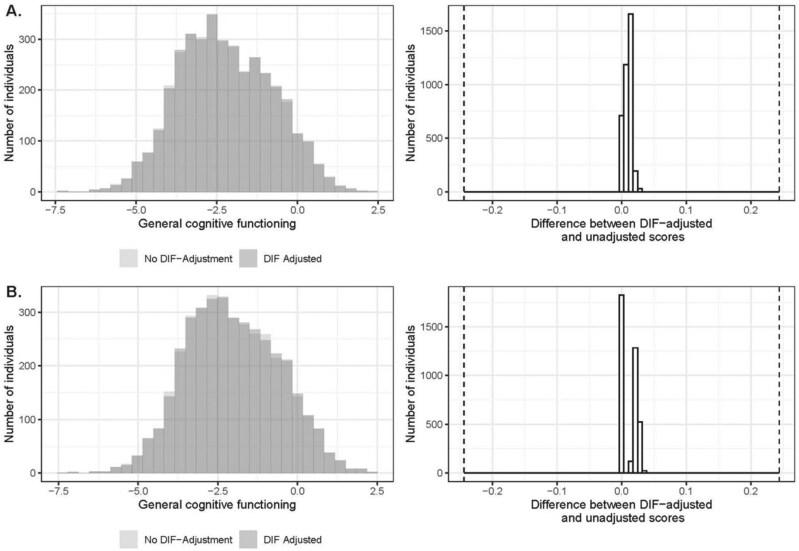
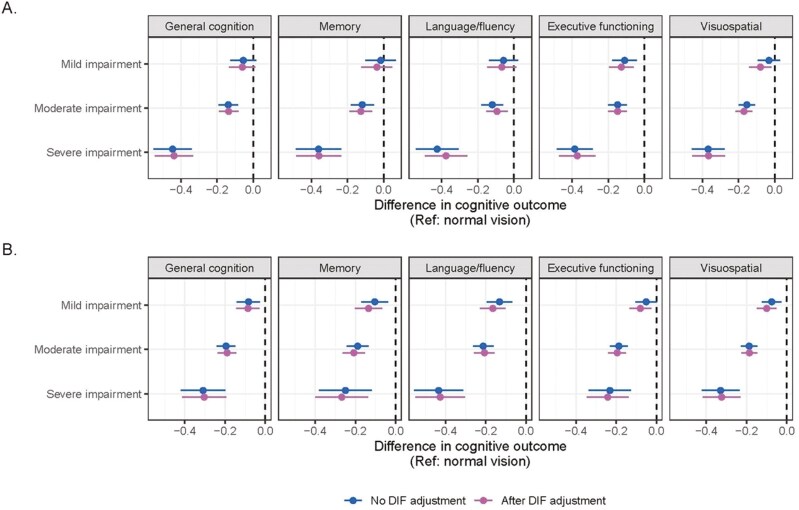
Participants in our sample were 60 and older. Most participants with VI were 60-69 years old (59.6%) and 50.8% were female. Individuals experiencing both distance and near VI tended to be older, have lower educational attainment, be married, reside in rural settings, and belong to lower consumption and BMI categories. Both distance and near VI were associated with poorer cognition before and after DIF-adjustment. Differences between DIF-unadjusted and -adjusted scores were small compared to the standard error of measurement, indicating no evidence of meaningful measurement differences by VI.
In well-conducted large-scale surveys, bias in cognitive testing due to VI is likely minimal. Findings strengthen previous evidence on the association between VI and dementia by showing that such associations are unlikely to be attributable to vision-related measurement error in the assessment of cognitive functioning.
先前的研究尚未考虑视力不佳是否会使认知测试产生偏差。然而,鉴于越来越多的证据表明视力障碍(VI)可能是痴呆症的一个重要可改变风险因素,尤其是在VI患病率较高的低收入和中等收入环境中,此类研究至关重要。
本研究采用了印度纵向衰老研究——痴呆症诊断评估(LASI-DAD)第一波中3784名参与者的数据,这些参与者同时接受了视力和认知功能测试。我们使用多指标和多病因模型,通过客观测量的远距离和近距离VI来评估认知测试中的差异项目功能(DIF;例如偏差)。多变量线性回归用于对DIF调整前后VI与认知因子得分之间的关联进行建模。对一般认知和单独的认知领域进行了分析,分别对应记忆、语言/流畅性、执行功能和视觉空间表现。模型针对人口统计学、健康和社会经济协变量进行了调整。
我们样本中的参与者年龄在60岁及以上。大多数患有VI的参与者年龄在60 - 69岁之间(59.6%),女性占50.8%。同时经历远距离和近距离VI的个体往往年龄较大、受教育程度较低、已婚、居住在农村地区,且属于较低消费和BMI类别。在DIF调整前后,远距离和近距离VI均与较差的认知相关。与测量标准误差相比,未调整DIF和调整后得分之间的差异较小,表明没有证据表明VI会导致有意义的测量差异。
在开展良好的大规模调查中,由于VI导致的认知测试偏差可能极小。研究结果通过表明此类关联不太可能归因于认知功能评估中与视力相关的测量误差,加强了先前关于VI与痴呆症之间关联的证据。