Min Seung Nam, Subramaniyam Murali, Parnianpour Mohammad, Kim Dong Joon
Department of Smart Safety System, Dongyang University, 2784, Pyeonghwa-ro, Dongducheon-si, Gyeonggi-do, Republic of Korea.
Department of Mechanical Engineering, Faculty of Engineering and Technology, SRM Institute of Science and Technology, Kattankulathur, Chennai, 603203, India.
Heliyon. 2024 Sep 3;10(17):e37379. doi: 10.1016/j.heliyon.2024.e37379. eCollection 2024 Sep 15.
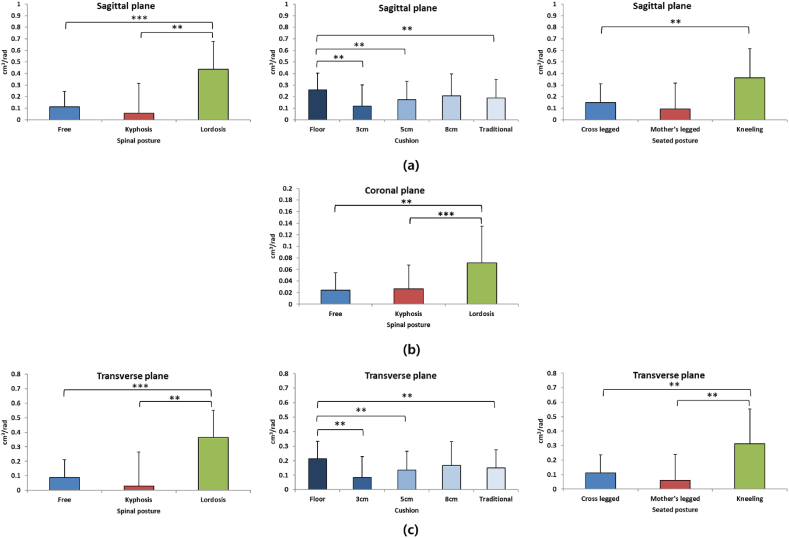
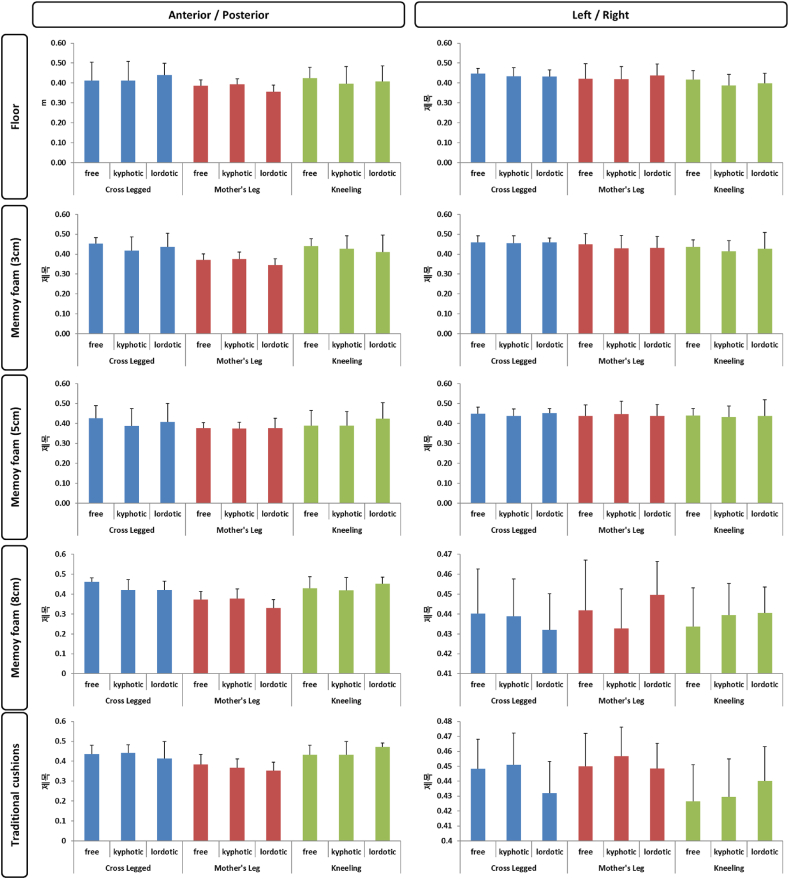
In contrast to Western countries, traditional floor-seating cultures are prevalent in Korea, Japan, the Middle East, and Africa, where sitting on the floor in static positions such as squatting, kneeling, or sitting cross-legged is common. Most studies on sitting posture have predominantly focused on chair sitting in Western cultures, resulting in a cultural bias. This study aimed to investigate the effects of different cushion types (floor and traditional cushions of 3-cm, 5-cm, and 8-cm thickness) and seating postures (cross-legged, mother's leg, and kneeling) on measures of postural stability, trunk muscle activity, rotational spinal stability, and subjective postural stability in an Asian population. Forty right-hand and right-foot-dominant volunteers who did not experience activity-limiting back pain in the past 12 months were recruited. Multivariate analyses of variance (MANOVA) and ANOVA with a repeated-measures design were employed to assess the within-subject effects of the cushion type and seating posture. An alpha value of 0.05 was set for statistical significance. The results of this study suggest that preventing lordosis posture, seating on the floor, and maintaining a kneeling posture may reduce the loss of balance and trunk muscle fatigue. These results emphasize the need for additional ergonomic studies that focus on the seating traditions of Asian cultures.
与西方国家不同,传统的席地而坐文化在韩国、日本、中东和非洲很普遍,在这些地方,以蹲、跪或盘腿等静态姿势坐在地上很常见。大多数关于坐姿的研究主要集中在西方文化中的坐在椅子上,这导致了文化偏见。本研究旨在调查不同类型的垫子(3厘米、5厘米和8厘米厚的地板垫和传统垫子)和坐姿(盘腿、妈妈腿和跪姿)对亚洲人群姿势稳定性、躯干肌肉活动、脊柱旋转稳定性和主观姿势稳定性测量指标的影响。招募了40名在过去12个月内没有经历过限制活动的背痛的右利手和右利足志愿者。采用多变量方差分析(MANOVA)和重复测量设计的方差分析(ANOVA)来评估垫子类型和坐姿的受试者内效应。设定α值为0.05作为统计学显著性标准。本研究结果表明,预防脊柱前凸姿势、坐在地板上和保持跪姿可能会减少平衡丧失和躯干肌肉疲劳。这些结果强调了需要开展更多关注亚洲文化坐姿传统的人体工程学研究。