Son Yuseong, Jeong Sihyeon, Hong Youngtaek, Lee Jina, Jeon Byunghwan, Choi Hyunji, Kim Jaehwan, Shim Hackjoon
Department of Computer Engineering, Hankuk University of Foreign Studies, Seoul 02450, Republic of Korea.
Brain Korea 21 Project, Graduate School of Medical Science, Yonsei University College of Medicine, Seoul 03722, Republic of Korea.
Bioengineering (Basel). 2024 Sep 20;11(9):944. doi: 10.3390/bioengineering11090944.
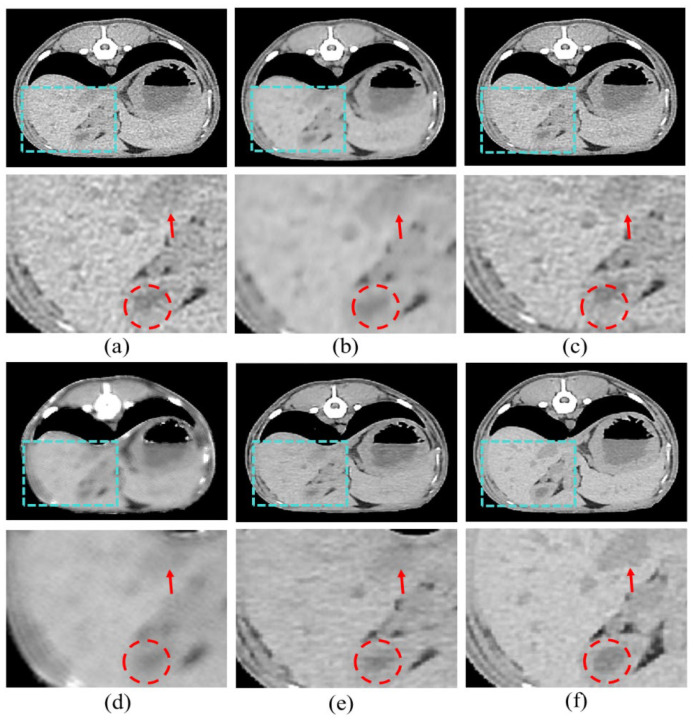
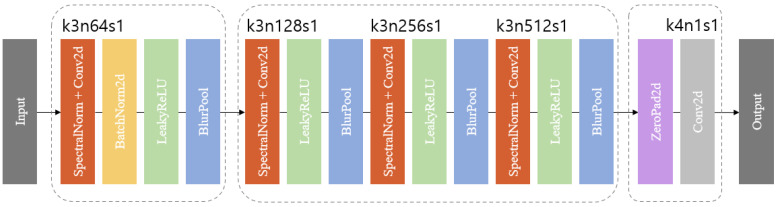
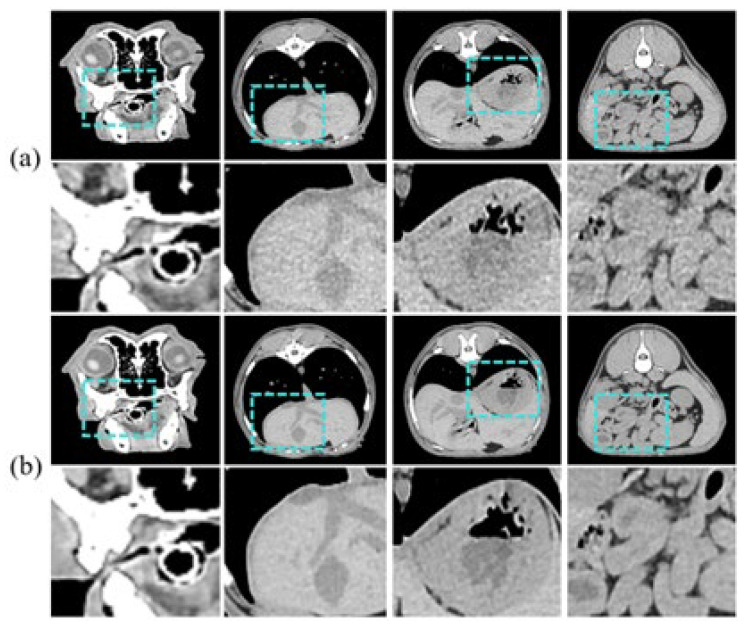
Computed tomography (CT) imaging is vital for diagnosing and monitoring diseases in both humans and animals, yet radiation exposure remains a significant concern, especially in animal imaging. Low-dose CT (LDCT) minimizes radiation exposure but often compromises image quality due to a reduced signal-to-noise ratio (SNR). Recent advancements in deep learning, particularly with CycleGAN, offer promising solutions for denoising LDCT images, though challenges in preserving anatomical detail and image sharpness persist. This study introduces a novel framework tailored for animal LDCT imaging, integrating deep learning techniques within the CycleGAN architecture. Key components include BlurPool for mitigating high-resolution image distortion, PixelShuffle for enhancing expressiveness, hierarchical feature synthesis (HFS) networks for feature retention, and spatial channel squeeze excitation (scSE) blocks for contrast reproduction. Additionally, a multi-scale discriminator enhances detail assessment, supporting effective adversarial learning. Rigorous experimentation on veterinary CT images demonstrates our framework's superiority over traditional denoising methods, achieving significant improvements in noise reduction, contrast enhancement, and anatomical structure preservation. Extensive evaluations show that our method achieves a precision of 0.93 and a recall of 0.94. This validates our approach's efficacy, highlighting its potential to enhance diagnostic accuracy in veterinary imaging. We confirm the scSE method's critical role in optimizing performance, and robustness to input variations underscores its practical utility.
计算机断层扫描(CT)成像对于诊断和监测人类及动物疾病至关重要,但辐射暴露仍然是一个重大问题,尤其是在动物成像中。低剂量CT(LDCT)可将辐射暴露降至最低,但由于信噪比(SNR)降低,往往会影响图像质量。深度学习的最新进展,特别是循环生成对抗网络(CycleGAN),为LDCT图像去噪提供了有前景的解决方案,尽管在保留解剖细节和图像清晰度方面仍存在挑战。本研究介绍了一种专门为动物LDCT成像量身定制的新颖框架,将深度学习技术集成到CycleGAN架构中。关键组件包括用于减轻高分辨率图像失真的模糊池(BlurPool)、用于增强表现力的像素洗牌(PixelShuffle)、用于特征保留的分层特征合成(HFS)网络以及用于对比度再现的空间通道挤压激励(scSE)块。此外,多尺度判别器增强了细节评估,支持有效的对抗学习。对兽医CT图像进行的严格实验表明,我们的框架优于传统去噪方法,在降噪、对比度增强和解剖结构保留方面取得了显著改进。广泛评估表明,我们的方法精度达到0.93,召回率达到0.94。这验证了我们方法的有效性,突出了其在提高兽医成像诊断准确性方面的潜力。我们证实了scSE方法在优化性能方面的关键作用,并且对输入变化的鲁棒性强调了其实际效用。