Cleveland Clinic Genome Center, Lerner Research Institute, Cleveland Clinic, Cleveland, OH 44195, USA; Department of Computer Science, Kent State University, Kent, OH 44242, USA; Genomic Medicine Institute, Lerner Research Institute, Cleveland Clinic, Cleveland, OH 44195, USA.
Genomic Medicine Institute, Lerner Research Institute, Cleveland Clinic, Cleveland, OH 44195, USA.
Cell Rep Methods. 2024 Oct 21;4(10):100865. doi: 10.1016/j.crmeth.2024.100865. Epub 2024 Sep 27.
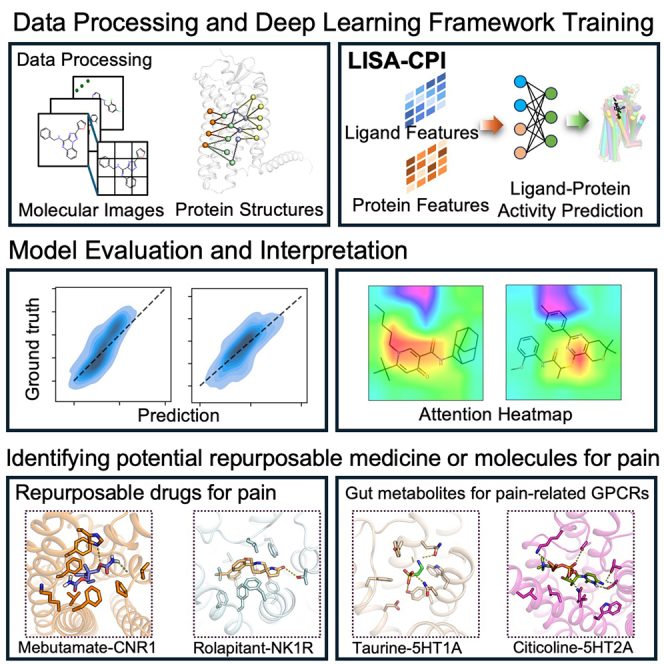
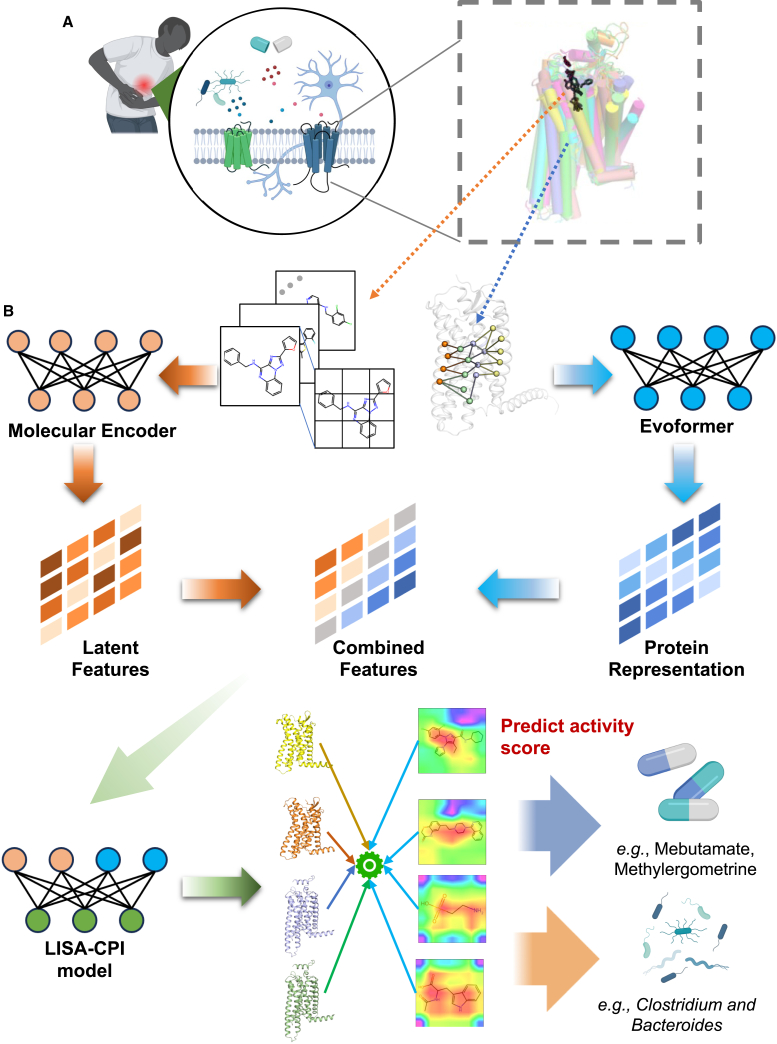
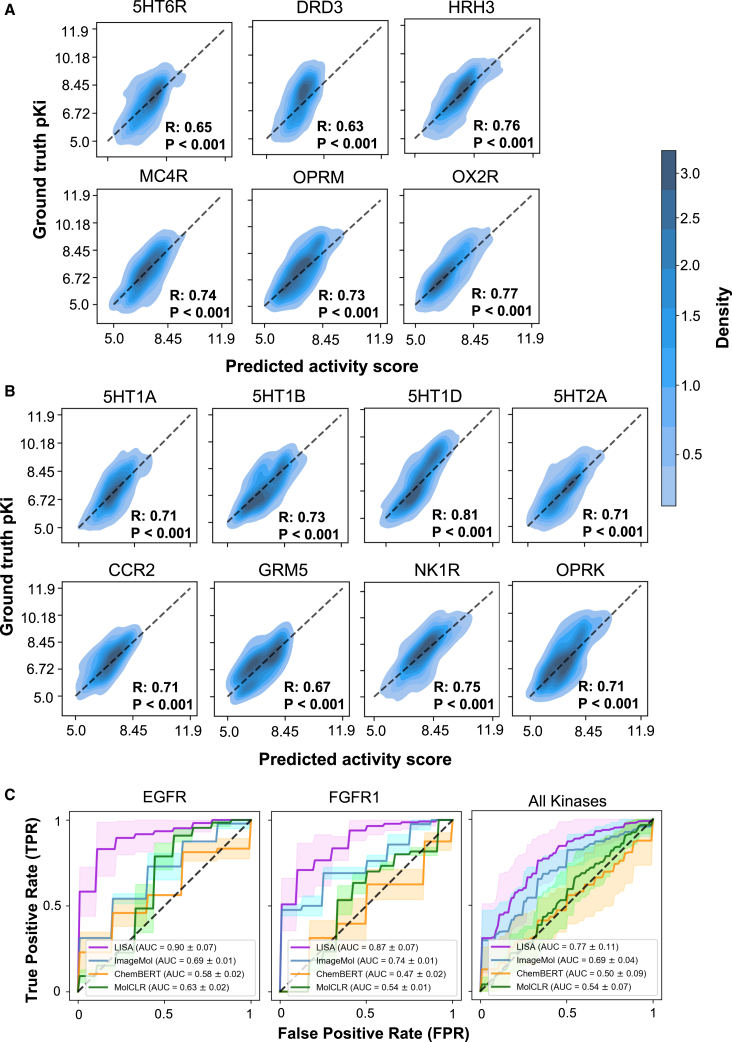
Artificial intelligence (AI) and deep learning technologies hold promise for identifying effective drugs for human diseases, including pain. Here, we present an interpretable deep-learning-based ligand image- and receptor's three-dimensional (3D)-structure-aware framework to predict compound-protein interactions (LISA-CPI). LISA-CPI integrates an unsupervised deep-learning-based molecular image representation (ImageMol) of ligands and an advanced AlphaFold2-based algorithm (Evoformer). We demonstrated that LISA-CPI achieved ∼20% improvement in the average mean absolute error (MAE) compared to state-of-the-art models on experimental CPIs connecting 104,969 ligands and 33 G-protein-coupled receptors (GPCRs). Using LISA-CPI, we prioritized potential repurposable drugs (e.g., methylergometrine) and identified candidate gut-microbiota-derived metabolites (e.g., citicoline) for potential treatment of pain via specifically targeting human GPCRs. In summary, we presented that the integration of molecular image and protein 3D structural representations using a deep learning framework offers a powerful computational drug discovery tool for treating pain and other complex diseases if broadly applied.
人工智能(AI)和深度学习技术有望为人类疾病(包括疼痛)的有效药物的研发提供支持。在这里,我们提出了一种基于可解释的深度学习的配体图像和受体三维(3D)结构感知框架,用于预测化合物-蛋白相互作用(LISA-CPI)。LISA-CPI 整合了一种无监督的基于深度学习的配体分子图像表示(ImageMol)和先进的基于 AlphaFold2 的算法(Evoformer)。我们证明,与连接 104,969 个配体和 33 个 G 蛋白偶联受体(GPCR)的实验 CPIs 的最先进模型相比,LISA-CPI 在平均均方误差(MAE)方面提高了约 20%。使用 LISA-CPI,我们对潜在的可重新利用药物(如甲基麦角新碱)进行了优先级排序,并确定了候选的肠道微生物衍生代谢物(如胞磷胆碱),通过专门针对人类 GPCR,用于潜在的疼痛治疗。总之,如果广泛应用,利用深度学习框架整合分子图像和蛋白质 3D 结构表示为治疗疼痛和其他复杂疾病提供了一种强大的计算药物发现工具。