Department of Rheumatology and Immunology, Peking University International Hospital, Peking University, Beijing, China.
Department of Rheumatology and Immunology, Peking University People's Hospital, Peking University, Beijing, China.
Front Immunol. 2024 Sep 13;15:1431323. doi: 10.3389/fimmu.2024.1431323. eCollection 2024.
Gout is a common type of inflammatory arthritis. Vitamin C is a potent antioxidant that neutralizes reactive oxygen species. However, the association between dietary vitamin C levels and gout remains unclear. This study evaluated the relationship between dietary vitamin C intake and gout.
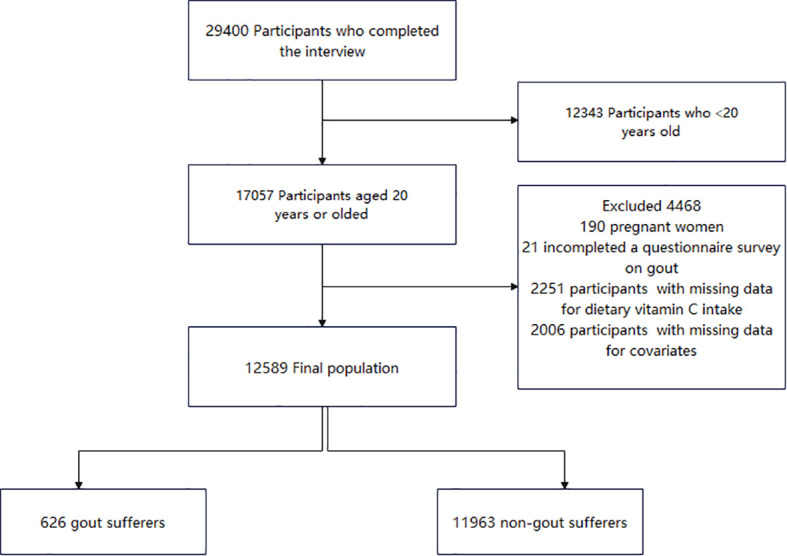
Cross-sectional data from individuals aged > 20 years who participated in the National Health and Nutrition Examination Survey between 2013 and 2018 were collected. Details on gout, dietary vitamin C intake, and several other essential variables were recorded.
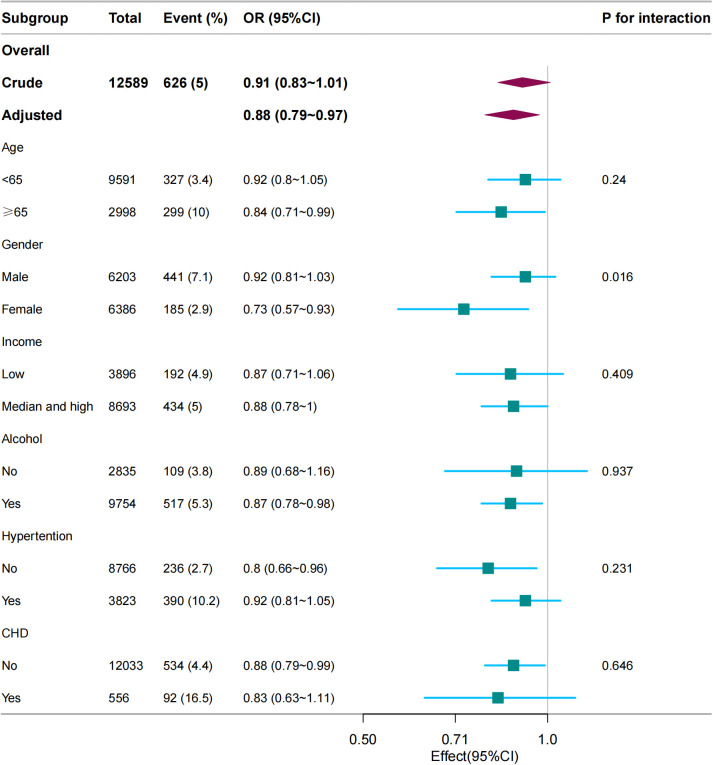
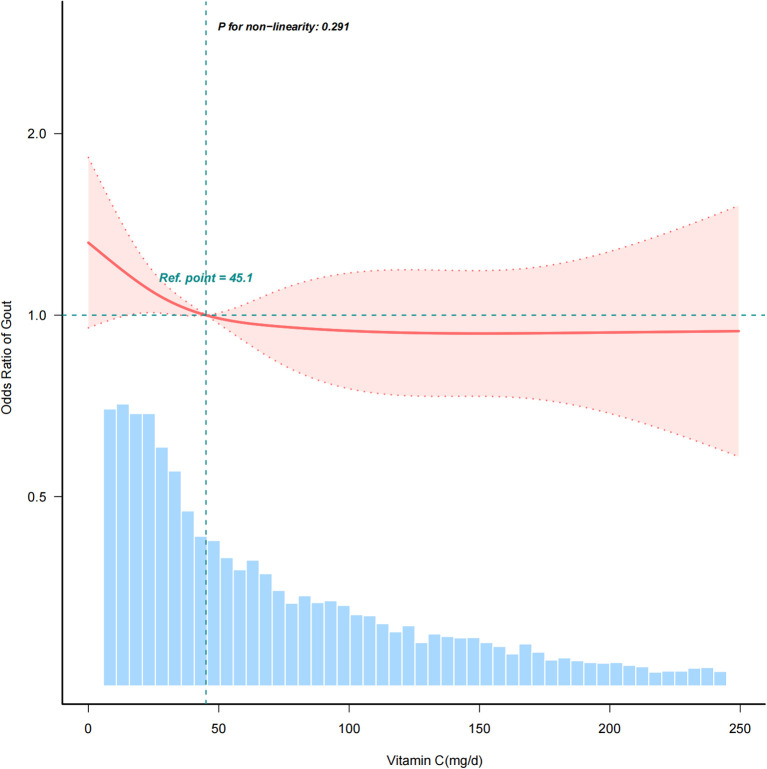
There were 12589 participants, 5% (652/12589) of whom experienced gout. Compared with individuals with lower vitamin C consumption in the Q1 group (≤19.9 mg/day), the adjusted odds ratio(OR)values for dietary vitamin C intake and gout in the Q2 group (19.9-49.7 mg/day), Q3 group (49.7-110.375 mg/day), and Q4 group (≥110.375 mg/day) were 0.87 (95% confidence interval (CI): 0.69-1.1, = 0.237), 0.81 (95% CI: 0.64-1.02, = 0.076), and 0.77 (95% CI: 0.6-0.99, = 0.042), respectively. Accordingly, the association between dietary vitamin C intake and gout exhibited an L-shaped curve (nonlinear, = 0.245) in a restricted cubic spline. Subgroup analysis revealed significant interactions between vitamin C levels and gout according to sex ( < 0.05). When we used data on dietary vitamin C from the second survey, we observed a similar inverse association between vitamin C intake and gout. The vitamin C was also negatively associated with hyperuricemia (OR, 0.94; 95% CI, 0.9-0.98, =0.005). Compared with Q1, the adjusted OR values for dietary vitamin C and hyperuricemia in Q2, Q3, and Q4 were 0.77 (95% CI: 0.69-0.86, = 0.65), 0.81 (95% CI: 0.72-0.91, = 0.014), and 0.72 (95% CI: 0.64-0.81, < 0.001), respectively. No association was observed between vitamin C supplementation and gout.
The population-based data indicate that dietary vitamin C intake is inversely associated with gout. These findings support the potential role of vitamin C in preventing gout.
痛风是一种常见的炎症性关节炎。维生素 C 是一种有效的抗氧化剂,可以中和活性氧。然而,饮食中维生素 C 水平与痛风之间的关系仍不清楚。本研究评估了饮食中维生素 C 摄入量与痛风之间的关系。
收集了 2013 年至 2018 年期间参加国家健康和营养检查调查的年龄> 20 岁的个体的横断面数据。记录了痛风、饮食中维生素 C 摄入量和其他几个重要变量的详细信息。
共有 12589 名参与者,其中 5%(652/12589)患有痛风。与 Q1 组(≤19.9mg/天)中维生素 C 摄入量较低的个体相比,Q2 组(19.9-49.7mg/天)、Q3 组(49.7-110.375mg/天)和 Q4 组(≥110.375mg/天)中饮食维生素 C 摄入与痛风的调整后比值比(OR)值分别为 0.87(95%置信区间(CI):0.69-1.1,=0.237)、0.81(95%CI:0.64-1.02,=0.076)和 0.77(95%CI:0.6-0.99,=0.042)。因此,饮食维生素 C 摄入量与痛风之间的关系呈 L 形曲线(非线性,=0.245)在限制立方样条中。亚组分析显示,维生素 C 水平与痛风之间存在显著的性别交互作用(<0.05)。当我们使用第二次调查的饮食维生素 C 数据时,我们观察到维生素 C 摄入与痛风之间存在类似的负相关关系。维生素 C 也与高尿酸血症呈负相关(OR,0.94;95%CI,0.9-0.98,=0.005)。与 Q1 相比,Q2、Q3 和 Q4 中饮食维生素 C 和高尿酸血症的调整后 OR 值分别为 0.77(95%CI:0.69-0.86,=0.65)、0.81(95%CI:0.72-0.91,=0.014)和 0.72(95%CI:0.64-0.81,<0.001)。维生素 C 补充剂与痛风之间没有关联。
基于人群的数据表明,饮食中维生素 C 的摄入与痛风呈负相关。这些发现支持维生素 C 在预防痛风中的潜在作用。