Department of Dermatology, West China Hospital, Sichuan University, Chengdu, China.
Laboratory of Dermatology, Clinical Institute of Inflammation and Immunology, Frontiers Science Center for Disease-Related Molecular Network, West China Hospital, Sichuan University, Chengdu, China.
Front Immunol. 2024 Sep 16;15:1367994. doi: 10.3389/fimmu.2024.1367994. eCollection 2024.
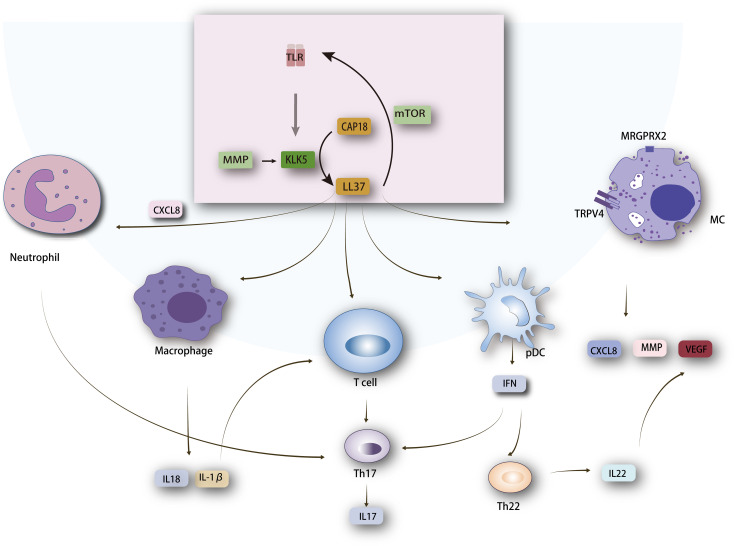
Rosacea is a chronic skin inflammatory disease with a global prevalence ranging from 1% to 20%. It is characterized by facial erythema, telangiectasia, papules, pustules, and ocular manifestations. Its pathogenesis involves a complex interplay of genetic, environmental, immune, microbial, and neurovascular factors. Recent studies have advanced our understanding of its molecular basis, focusing on toll-like receptor (TLR) 2 pathways, LL37 expression, mammalian target of rapamycin (mTOR) activation, interleukin (IL)-17 signaling, transient receptor potential vanilloid (TRPV) functions, and the Janus kinase-signal transducer and activator of transcription (JAK-STAT) pathways. LL37-associated signaling pathways, particularly involving TLR2 and mTORC1, are critical in the pathogenesis of rosacea. LL37 interacts with signaling molecules such as extracellular signal-regulated kinases 1 and 2 (ERK1/2), nuclear factor kappa B (NF-B), inflammasomes, C-X-C motif chemokine ligand 8 (CXCL8), mas-related G-protein-coupled receptor X2 (MRGPRX2)-TRPV4, and vascular endothelial growth factor (VEGF). This interaction activates macrophages, neutrophils, mast cells, and vascular endothelial cells, leading to cytokine release including tumor necrosis factor-alpha (TNF-), IL-6, IL-1, C motif chemokine ligand (CCL) 5, CXCL9, and CXCL10. These processes contribute to immune response modulation, inflammation, and angiogenesis in rosacea pathophysiology. The IL-17 signaling pathway also plays a crucial role in rosacea, affecting angiogenesis and the production of inflammatory cytokines. In addition, recent insights into the JAK/STAT pathways have revealed their integral role in inflammatory and angiogenic mechanisms associated with rosacea. Rosacea treatment currently focuses on symptom management, with emerging insights into these molecular pathways providing more targeted and effective therapies. Biological agents targeting specific cytokines, IL-17 inhibitors, JAK inhibitors, and VEGF antagonists are promising for future rosacea therapy, aiming for enhanced efficacy and fewer side effects. This review provides a comprehensive overview of the current knowledge regarding signaling pathways in rosacea and potential targeted therapeutic strategies.
酒渣鼻是一种慢性炎症性皮肤疾病,全球患病率在 1%至 20%之间。它的特征是面部红斑、毛细血管扩张、丘疹、脓疱和眼部表现。其发病机制涉及遗传、环境、免疫、微生物和神经血管等多种因素的复杂相互作用。最近的研究加深了我们对其分子基础的理解,重点关注 Toll 样受体(TLR)2 途径、LL37 表达、哺乳动物雷帕霉素靶蛋白(mTOR)激活、白细胞介素(IL)-17 信号、瞬时受体电位香草酸(TRPV)功能以及 Janus 激酶-信号转导和转录激活因子(JAK-STAT)途径。LL37 相关信号通路,特别是涉及 TLR2 和 mTORC1 的信号通路,在酒渣鼻的发病机制中起着关键作用。LL37 与细胞外信号调节激酶 1 和 2(ERK1/2)、核因子 kappa B(NF-B)、炎性小体、C-X-C 基序趋化因子配体 8(CXCL8)、mas 相关 G 蛋白偶联受体 X2(MRGPRX2)-TRPV4 和血管内皮生长因子(VEGF)等信号分子相互作用。这种相互作用激活了巨噬细胞、中性粒细胞、肥大细胞和血管内皮细胞,导致细胞因子释放,包括肿瘤坏死因子-α(TNF-α)、IL-6、IL-1、C 基序趋化因子配体(CCL)5、CXCL9 和 CXCL10。这些过程有助于免疫反应调节、炎症和血管生成在酒渣鼻病理生理学中的作用。IL-17 信号通路也在酒渣鼻中发挥着重要作用,影响血管生成和炎症细胞因子的产生。此外,最近对 JAK/STAT 途径的研究揭示了它们在与酒渣鼻相关的炎症和血管生成机制中的重要作用。目前酒渣鼻的治疗侧重于症状管理,对这些分子途径的新认识为更有针对性和更有效的治疗方法提供了依据。针对特定细胞因子的生物制剂、IL-17 抑制剂、JAK 抑制剂和 VEGF 拮抗剂有望成为未来酒渣鼻治疗的新策略,旨在提高疗效和减少副作用。本综述全面概述了酒渣鼻信号通路的最新知识和潜在的靶向治疗策略。