Rowe Dylan, Rowe Mariam, Pontifex Chase, Stubbs Dylan
School of Medicine, Griffith University, Brisbane, AUS.
Faculty of Medicine, University of Queensland, Brisbane, AUS.
Cureus. 2024 Sep 2;16(9):e68477. doi: 10.7759/cureus.68477. eCollection 2024 Sep.
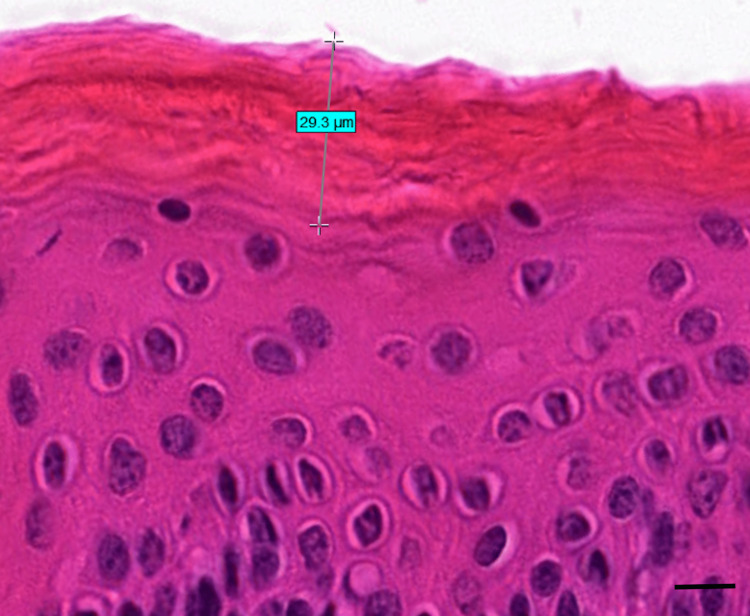
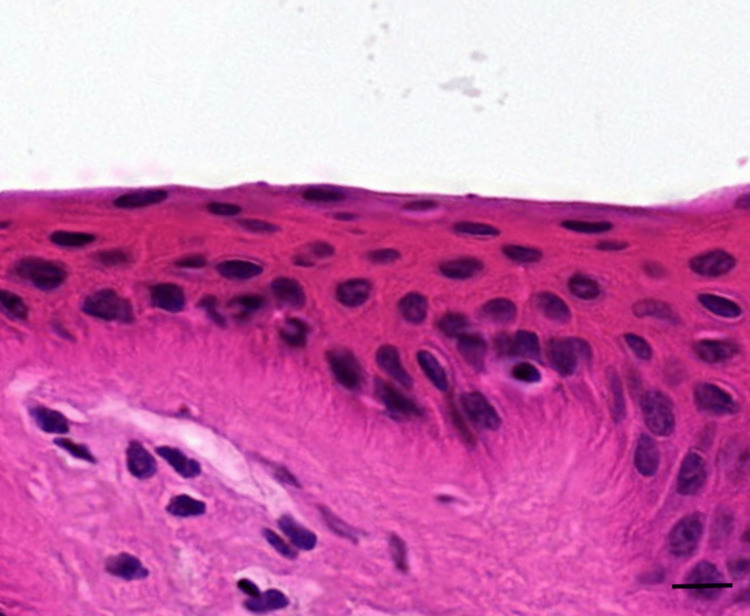
Background The stratum corneum (SC) plays a crucial role in protecting the skin and regulating water loss. Tape stripping is a well-established method for studying skin barrier function and evaluating topical treatments. However, the behavior of fresh versus frozen-thawed skin during tape stripping has not been extensively compared. Objective This study aims to compare the removal of the stratum corneum from fresh and frozen-thawed porcine skin using tape stripping. It also aims to assess the reliability of tape weighing versus histological methods in quantifying SC removal. Methods Fresh and frozen-thawed porcine ears were obtained, cleaned, and subjected to tape stripping at varying numbers of strips from zero to 40. Tape weight and histological measurements were used to quantify SC removal. Statistical analyses were conducted to compare SC thickness and tape weight between the two types of skin. Results The study found that frozen-thawed skin exhibited a non-linear rate (r = 0.65) of SC removal per tape strip in the first five strips compared to a linear removal for fresh skin (r = 0.96). By the fifth tape strip, frozen-thawed samples had lost 80.6% of their SC, while fresh samples had only lost 33.5% (P < 0.03). Tape weighing and histological measurements showed strong correlations (r = 0.93 for fresh skin and r = 0.95 for frozen-thawed skin), indicating that tape weighing is a reliable alternative to histology for assessing SC removal on both sample types. Conclusions Fresh and frozen-thawed porcine skin respond differently to tape stripping, with frozen-thawed skin showing accelerated SC removal in the first five strips. The strong correlation between tape weighing and histological analysis supports the use of tape weighing as a practical tool for evaluating SC removal. These findings have implications for specimen selection and methodological standardization in dermatological and pharmacological research. Future research should explore alternative preservation and SC thickness measurement methods and their impact on tape stripping outcomes.
角质层(SC)在保护皮肤和调节水分流失方面起着关键作用。胶带剥离是一种成熟的研究皮肤屏障功能和评估局部治疗效果的方法。然而,鲜皮与冻融皮在胶带剥离过程中的行为尚未得到广泛比较。
本研究旨在比较使用胶带剥离从鲜猪皮和冻融猪皮上去除角质层的情况。同时旨在评估胶带称重法与组织学方法在量化角质层去除方面的可靠性。
获取鲜猪耳和冻融猪耳,进行清洁,并从零到40条不等的胶带剥离。使用胶带重量和组织学测量来量化角质层的去除情况。进行统计分析以比较两种皮肤类型之间的角质层厚度和胶带重量。
研究发现,与鲜皮的线性去除(r = 0.96)相比,冻融皮在前五条胶带中每条胶带去除角质层的速率呈非线性(r = 0.65)。到第五条胶带时,冻融样本已损失其角质层的80.6%,而鲜样本仅损失33.5%(P < 0.03)。胶带称重和组织学测量显示出很强的相关性(鲜皮r = 0.93,冻融皮r = 0.95),表明在评估两种样本类型的角质层去除方面,胶带称重是组织学的可靠替代方法。
鲜猪皮和冻融猪皮对胶带剥离的反应不同,冻融皮在前五条胶带中显示出加速的角质层去除。胶带称重与组织学分析之间的强相关性支持将胶带称重作为评估角质层去除的实用工具。这些发现对皮肤病学和药理学研究中的样本选择和方法标准化具有重要意义。未来的研究应探索替代的保存方法和角质层厚度测量方法及其对胶带剥离结果的影响。