Furihata Ryuji, Ishida Mami, Nakagami Yukako, Yanase Maya, Uwatoko Teruhisa, Okabayashi Satoe, Kiyohara Kosuke, Kawamura Takashi
Agency for Student Support and Disability Resources Kyoto University Kyoto Japan.
Department of Medical Informatics and Clinical Epidemiology Kyoto Prefectural University of Medicine Kyoto Japan.
PCN Rep. 2024 Oct 5;3(4):e70020. doi: 10.1002/pcn5.70020. eCollection 2024 Dec.
The aim of this study was to investigate the association between unhealthy lifestyle factors and the development of depressive symptoms with adjustment for sociodemographic characteristics in university students using health checkup data.
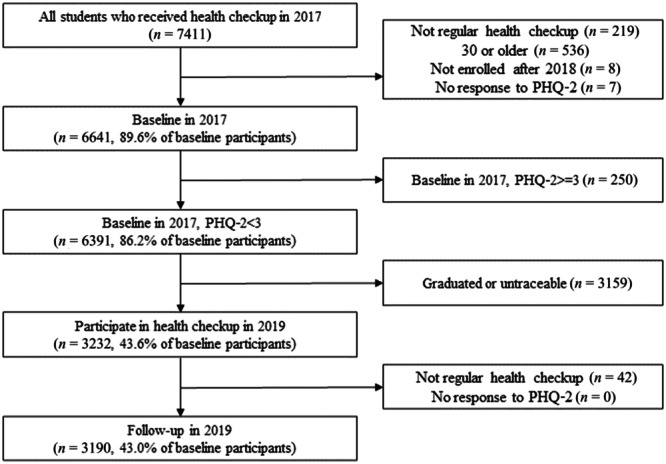
Among information obtained from university student health checkups conducted in 2017 and 2019, we analyzed both the clinical data and responses to questionnaires. The subjects used for analysis were 3190 individuals (2382 men and 808 women, mean age 19.0 years) who had been free of depressive symptoms in the 2017 survey and were available for a 2-year follow-up. The Patient Health Questionnaire (PHQ-2) was used as a self-rating scale for depressive symptoms. Multivariable logistic regression analysis was conducted to investigate the association between lifestyle factors (such as body mass index, self-rated health, whether breakfast was taken, degree of exercise, satisfaction with sleep, smoking, and alcohol drinking) in the 2017 survey and any development of depressive symptoms revealed in the 2019 survey, adjusting for sociodemographic variables and other lifestyle factors.
Multivariable logistic analysis showed that poor satisfaction with sleep (odds ratio [OR), 4.09; 95% confidence interval [CI), 1.96-8.53; < 0.01) and female gender (OR, 2.16; 95% CI, 1.01-4.60; = 0.05) were significantly associated with the development of depressive symptoms 2 years later.
This study has revealed an association between poor satisfaction with sleep and the development of depressive symptoms. We believe that these findings may be useful for the prevention and treatment of depressive symptoms in university students.
本研究旨在利用健康检查数据,在对大学生社会人口学特征进行调整的情况下,调查不健康生活方式因素与抑郁症状发展之间的关联。
在2017年和2019年进行的大学生健康检查所获得的信息中,我们分析了临床数据和问卷回复。用于分析的对象为3190名个体(2382名男性和808名女性,平均年龄19.0岁),他们在2017年的调查中没有抑郁症状,并且可以进行为期2年的随访。患者健康问卷(PHQ - 2)被用作抑郁症状的自评量表。进行多变量逻辑回归分析,以调查2017年调查中的生活方式因素(如体重指数、自评健康状况、是否吃早餐、运动程度、睡眠满意度、吸烟和饮酒)与2019年调查中出现的任何抑郁症状之间的关联,并对社会人口学变量和其他生活方式因素进行调整。
多变量逻辑分析表明,睡眠满意度低(优势比[OR],4.09;95%置信区间[CI],1.96 - 8.53;P < 0.01)和女性(OR,2.16;95% CI,1.01 - 4.60;P = 0.05)与2年后抑郁症状的发展显著相关。
本研究揭示了睡眠满意度低与抑郁症状发展之间的关联。我们认为这些发现可能对大学生抑郁症状的预防和治疗有用。