School of Rehabilitation, Kunming Medical University, Kunming, Yunnan Province, China.
Department of Rehabilitation, School of Medicine, Shanghai Yangzhi Rehabilitation Hospital (Shanghai Sunshine Rehabilitation Center), Tongji University, Shanghai, China.
Trials. 2024 Oct 14;25(1):677. doi: 10.1186/s13063-024-08532-9.
Balance and mobility deficits are major concerns in stroke rehabilitation. Virtual reality (VR) training and Swiss-ball training are commonly used approaches to improve balance and mobility. However, no study has compared the efficacy of VR training, Swiss-ball training, and their combination in improving balance and mobility function or investigated cortical activation and connectivity in individuals with stroke.
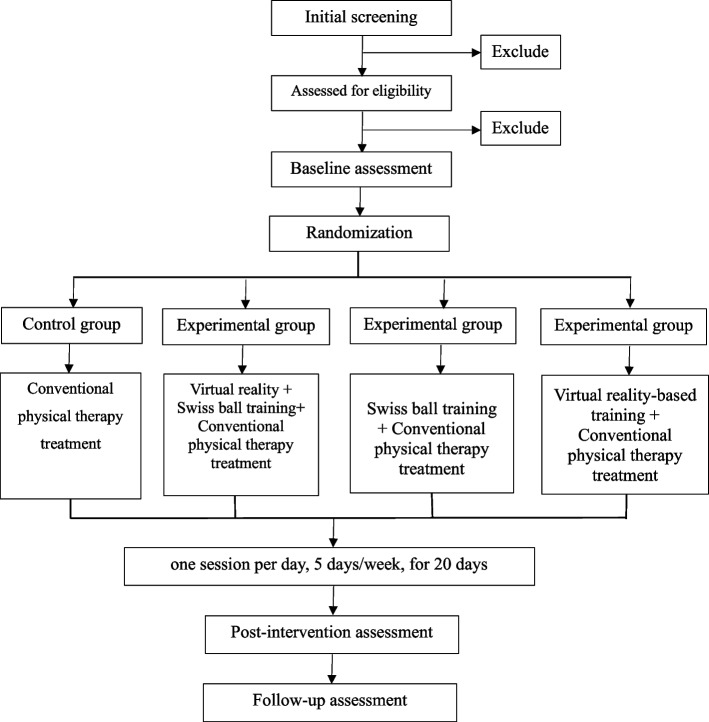
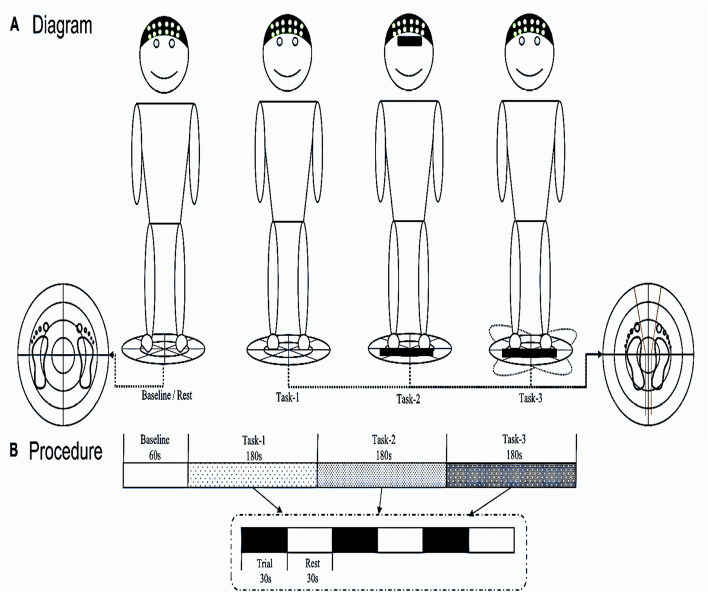
A prospective, single-blinded, parallel-armed, multi-center randomized controlled trial with factorial design will be conducted. Seventy-six participants aged 30-80 years with stroke will be recruited. Participants will be allocated to one of the four groups: (A) the VR training + Swiss-ball training + conventional physical therapy group; (B) the Swiss-ball training + conventional physical therapy group; (C) the VR training + conventional physical therapy group; or (D) the conventional physical therapy group. All participants will receive 50 min of training per day, 5 times per week, for a total of 4 weeks. The primary outcomes will be balance and mobility measures. Secondary outcomes will include the 10-min walk test, dynamic gait index, and cortical activation. Outcomes will be measured on three occasions: at baseline, after the training, and at the 4-week follow-up.
This trial will provide evidence to determine whether there are differences in clinical outcomes and cortical activation following two different types of exercise programs and their combination, and to elucidate the recovery mechanisms of balance and mobility function in individuals with stroke.
Chinese Clinical Trial Registry reference: www.chictr.org.cn (No. ChiCTR2400082135). Registered on May 24, 2024.
平衡和移动能力缺陷是中风康复的主要关注点。虚拟现实 (VR) 训练和瑞士球训练是常用于改善平衡和移动能力的方法。然而,尚无研究比较 VR 训练、瑞士球训练及其组合在改善平衡和移动功能方面的效果,也没有研究过皮质激活和连通性在中风患者中的变化。
将进行一项前瞻性、单盲、平行臂、多中心随机对照试验,采用析因设计。将招募 76 名年龄在 30-80 岁之间的中风患者。参与者将被分配到以下四个组之一:(A) VR 训练+瑞士球训练+常规物理治疗组;(B) 瑞士球训练+常规物理治疗组;(C) VR 训练+常规物理治疗组;或 (D) 常规物理治疗组。所有参与者将每天接受 50 分钟的训练,每周 5 次,共 4 周。主要结局指标将是平衡和移动能力测量。次要结局指标将包括 10 分钟步行测试、动态步态指数和皮质激活。结果将在三个时间点进行测量:基线时、训练后和 4 周随访时。
这项试验将提供证据,以确定两种不同类型的运动方案及其组合在临床结局和皮质激活方面是否存在差异,并阐明中风患者平衡和移动功能恢复的机制。
中国临床试验注册中心参考号:www.chictr.org.cn(注册号:ChiCTR2400082135)。注册于 2024 年 5 月 24 日。