Trengove Anna, Caballero Aguilar Lilith M, Di Bella Claudia, Onofrillo Carmine, Duchi Serena, O'Connor Andrea J
BioFab3D@ACMD, St Vincent's Hospital Melbourne, Fitzroy, VIC, Australia.
Department of Biomedical Engineering, The Graeme Clark Institute, The University of Melbourne, Parkville, VIC, Australia.
Front Cell Dev Biol. 2024 Sep 30;12:1449015. doi: 10.3389/fcell.2024.1449015. eCollection 2024.
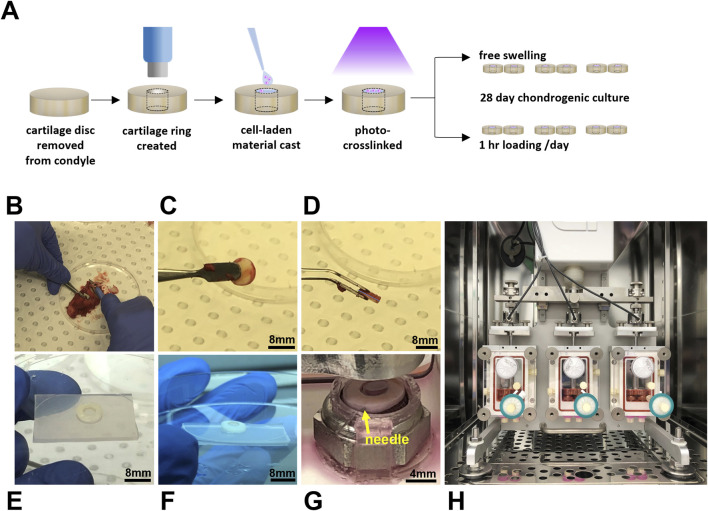
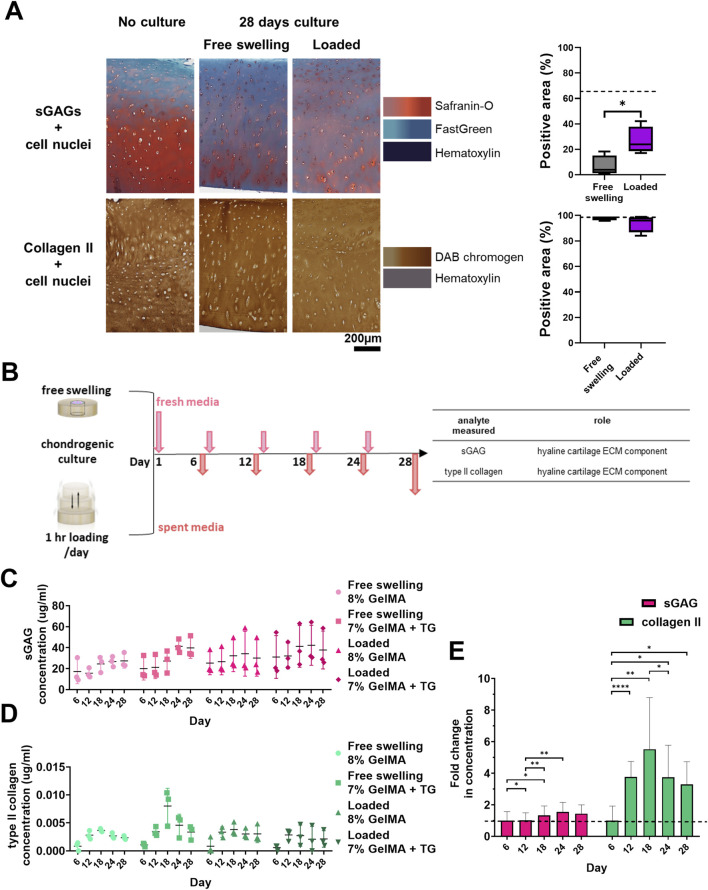
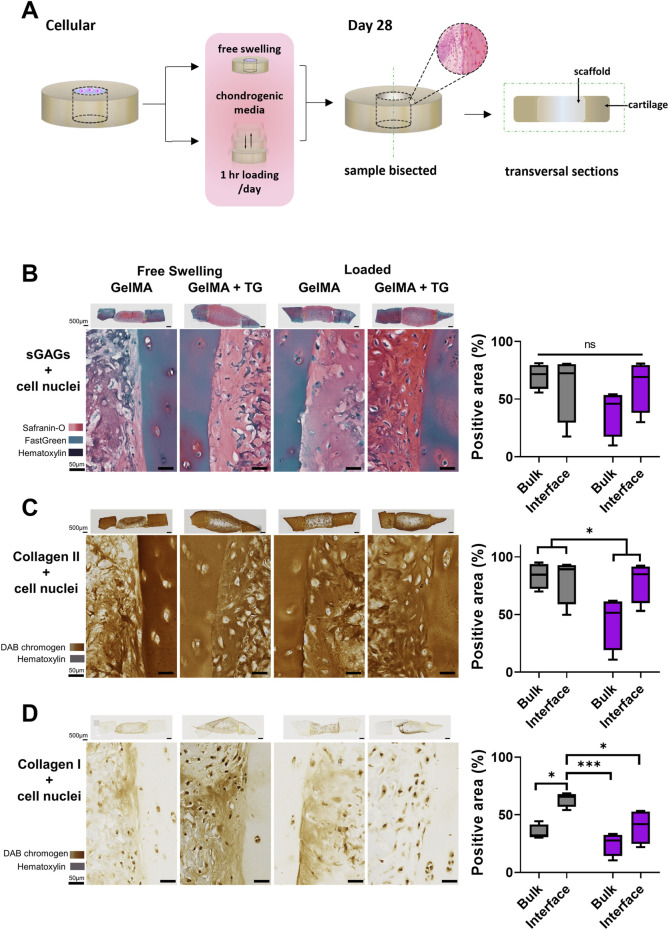
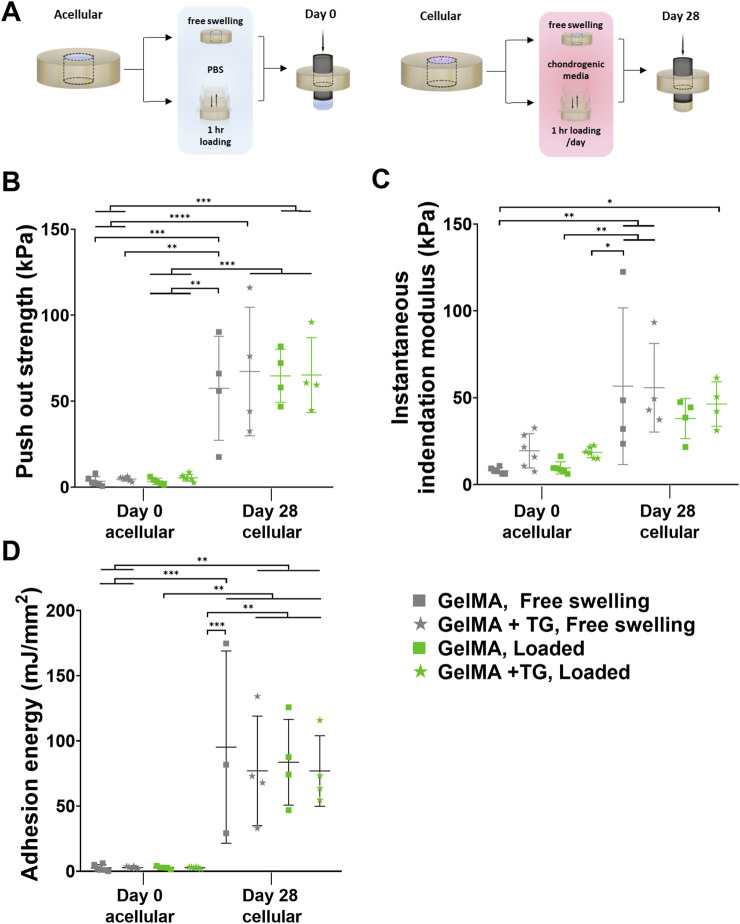
Articular cartilage injuries in the knee can lead to post-traumatic osteoarthritis if untreated, causing debilitating problems later in life. Standard surgical treatments fail to ensure long lasting repair of damaged cartilage, often resulting in fibrotic tissue. While there is a vast amount of research into cartilage regeneration, integrating engineered implants with cartilage remains a challenge. As cartilage is a load bearing tissue, it is imperative to evaluate tissue repair strategies and their ability to integrate under mechanical loading. This work established a dynamically loaded model of cartilage repair using human cartilage explants. The model was used to assess the efficacy of a stem cell therapy delivered in a bioadhesive hydrogel comprised of photocrosslinkable gelatin methacryloyl (GelMA) and microbial transglutaminase to repair the model defect. Extensive neocartilage production and integration were observed via histology and immunohistochemistry after 28 days chondrogenic culture. Analysis of culture media allowed monitoring of glycosaminoglycan and type II collagen production over time. A mechanical assessment of integration via a push out test showed a 15-fold increase in push out strength over the culture duration. The model was successful in exhibiting robust chondrogenesis with transglutaminase or without, and under both culture conditions. The work also highlights several limitations of models and challenges of working with bioreactors that must be overcome to increase their utility. This model has the potential to delay the need for costly pre-clinical studies and provide a more nuanced assessment of cartilage repair strategies than is possible .
膝关节的关节软骨损伤若不治疗,可能会导致创伤后骨关节炎,在日后生活中引发使人衰弱的问题。标准的外科治疗无法确保受损软骨得到持久修复,常常会形成纤维化组织。尽管对软骨再生有大量研究,但将工程化植入物与软骨整合仍然是一项挑战。由于软骨是一种承重组织,因此评估组织修复策略及其在机械负荷下的整合能力至关重要。这项工作建立了一个使用人软骨外植体的动态加载软骨修复模型。该模型用于评估在由光可交联甲基丙烯酰化明胶(GelMA)和微生物转谷氨酰胺酶组成的生物粘附水凝胶中递送的干细胞疗法修复模型缺损的疗效。在进行28天软骨形成培养后,通过组织学和免疫组织化学观察到大量新软骨生成和整合。对培养基的分析可以监测糖胺聚糖和II型胶原蛋白随时间的产生情况。通过推出试验对整合进行的力学评估表明,在培养期间推出强度增加了15倍。该模型成功地展示了在有或没有转谷氨酰胺酶的情况下,以及在两种培养条件下都具有强大的软骨形成能力。这项工作还突出了模型的几个局限性以及使用生物反应器时必须克服的挑战,以提高其效用。该模型有可能推迟进行昂贵的临床前研究的需求,并提供比以往更细致入微的软骨修复策略评估。