Zou Qi, Chen Ao-Qiu, Huang Jing, Wang Mei, Luo Jiang-Hong, Wang An, Wang Xiao-Yin
Key Laboratory of Prevention and Treatment of Cardiovascular and Cerebrovascular Diseases, Ministry of Education, Gannan Medical University, Ganzhou, China.
School of Public Health and Health Management, Gannan Medical University, Ganzhou, China.
Front Nutr. 2024 Sep 30;11:1473648. doi: 10.3389/fnut.2024.1473648. eCollection 2024.
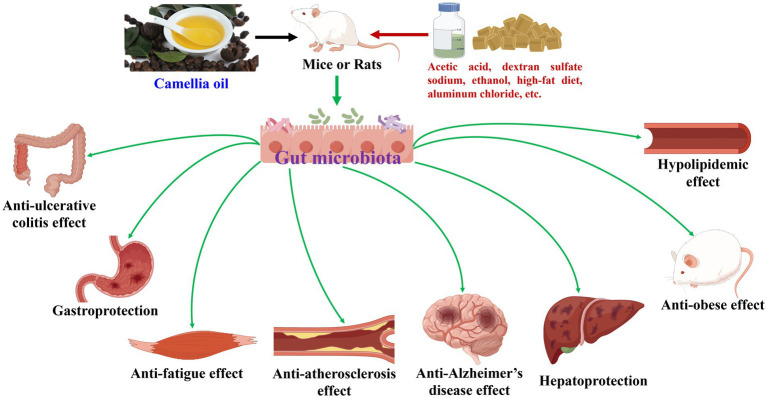
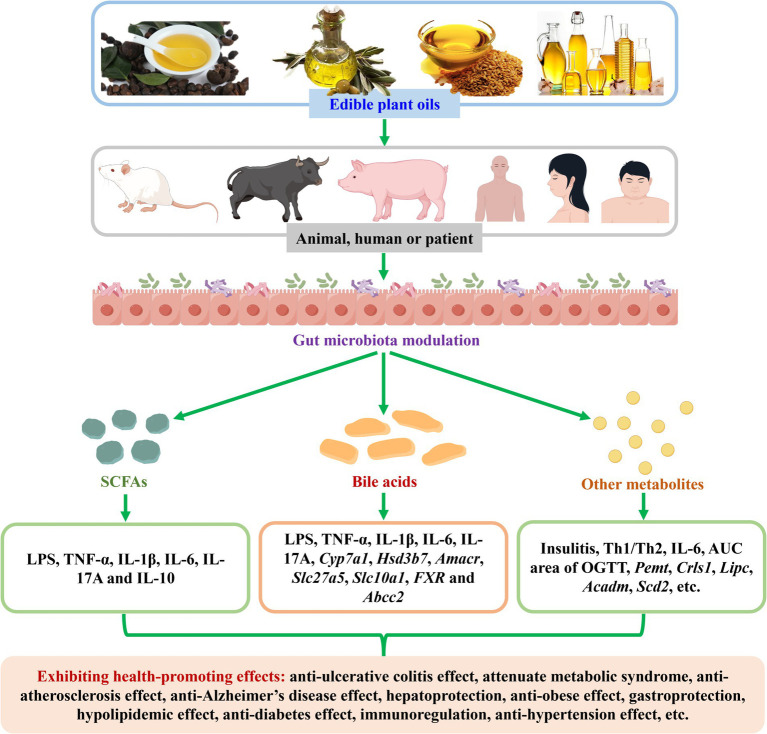
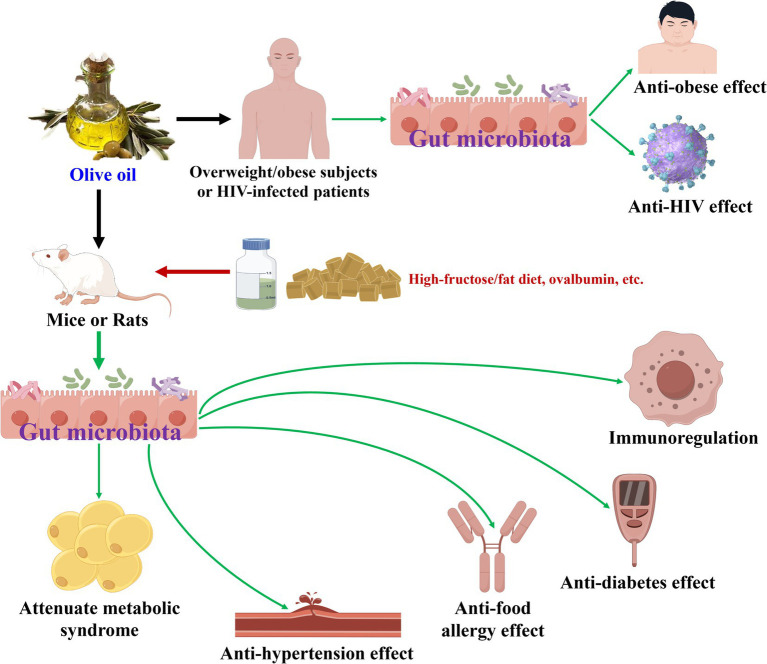
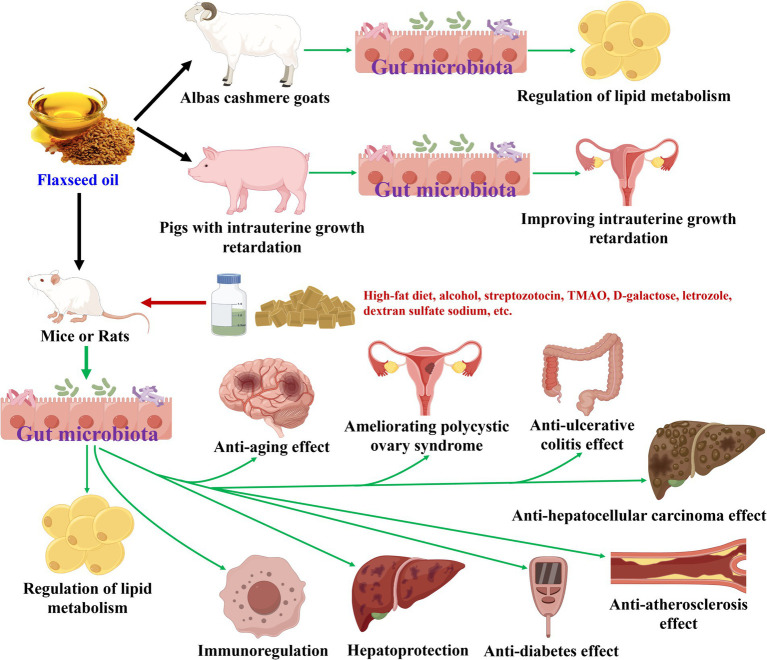
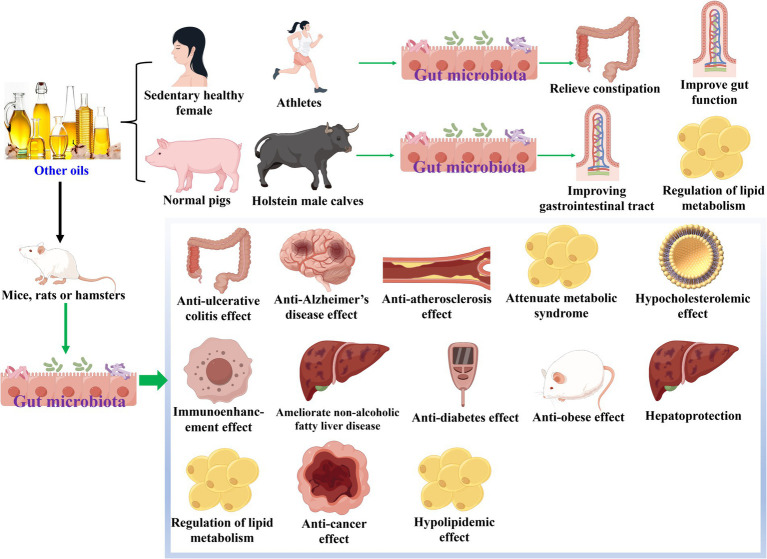
Edible plant oils are widely used in cooking, cosmetics, health supplement capsules, and other industries, due to their various health-promoting effects. There is increasing evidence that edible plant oils can modulate gut microbiota during their health-promoting effects in animal experiments and cohort or clinical studies. However, the information concerning the gut microbiota modulation of edible plant oils during their health-promoting effects is scattered. In this article, the research progress on gut microbiota modulation of edible plant oils (especially camellia oil, olive oil, and flaxseed oil) is summarized. Meanwhile, a summary on correlations between modulated gut microbiota and changed biochemical indexes is provided. The alterations of edible plant oils on gut microbiota-derived metabolites and the correlations between altered metabolites and modulated gut microbiota as well as changed biochemical indexes are reviewed. Furthermore, the prospects for gut microbiota modulation of edible plant oils during their health-promoting effects are put forward. Existing literature has shown that edible plant oils could modulate gut microbiota during their health-promoting effects, and some differential gut microbiota biomarkers were gained. Some similarities and differences existed while the oils exhibited health-promoting actions. Dosage and treatment time have influences on gut microbiota modulation of edible plant oils. Different edible plant oils exhibited different behaviors in modulating gut microbiota, and edible plant oils were mostly different in modulating gut microbiota compared to edible animal oils. Moreover, the modulated gut microbiota was significantly correlated with the changed biochemical indexes. Furthermore, edible plant oils altered SCFAs and other gut microbiota-derived metabolites. The altered metabolites were obviously correlated with the modulated gut microbiota and changed biochemical indexes. This review is helpful to the future research and application of edible plant oils in health-promoting effects from the perspective of gut microbiota.
食用植物油因其多种促进健康的作用,被广泛应用于烹饪、化妆品、健康补充剂胶囊及其他行业。越来越多的证据表明,在动物实验、队列研究或临床研究中,食用植物油在发挥其促进健康作用的过程中能够调节肠道微生物群。然而,关于食用植物油在促进健康作用过程中对肠道微生物群调节的信息较为分散。本文总结了食用植物油(尤其是山茶油、橄榄油和亚麻籽油)对肠道微生物群调节的研究进展。同时,提供了关于调节后的肠道微生物群与生化指标变化之间相关性的总结。综述了食用植物油对肠道微生物群衍生代谢物的影响以及代谢物变化与调节后的肠道微生物群和生化指标变化之间的相关性。此外,还提出了食用植物油在促进健康作用过程中对肠道微生物群调节的前景。现有文献表明,食用植物油在发挥其促进健康作用的过程中能够调节肠道微生物群,并获得了一些不同的肠道微生物群生物标志物。这些植物油在发挥促进健康作用时存在一些异同。剂量和治疗时间对食用植物油调节肠道微生物群有影响。不同的食用植物油在调节肠道微生物群方面表现出不同的行为,与食用动物油相比,食用植物油在调节肠道微生物群方面大多存在差异。此外,调节后的肠道微生物群与生化指标的变化显著相关。此外,食用植物油改变了短链脂肪酸和其他肠道微生物群衍生的代谢物。代谢物的变化与调节后的肠道微生物群和生化指标的变化明显相关。本综述从肠道微生物群的角度有助于食用植物油在促进健康作用方面的未来研究和应用。