• 文献检索
  • 文档翻译
  • 深度研究
  • 学术资讯
  • Suppr Zotero 插件Zotero 插件
  • 邀请有礼
  • 套餐&价格
  • 历史记录
应用&插件
Suppr Zotero 插件Zotero 插件浏览器插件Mac 客户端Windows 客户端微信小程序
定价
高级版会员购买积分包购买API积分包
服务
文献检索文档翻译深度研究API 文档MCP 服务
关于我们
关于 Suppr公司介绍联系我们用户协议隐私条款
关注我们

Suppr 超能文献

核心技术专利:CN118964589B侵权必究
粤ICP备2023148730 号-1Suppr @ 2026

文献检索

告别复杂PubMed语法,用中文像聊天一样搜索,搜遍4000万医学文献。AI智能推荐,让科研检索更轻松。

立即免费搜索

文件翻译

保留排版,准确专业,支持PDF/Word/PPT等文件格式,支持 12+语言互译。

免费翻译文档

深度研究

AI帮你快速写综述,25分钟生成高质量综述,智能提取关键信息,辅助科研写作。

立即免费体验

审视危地马拉农村传统助产士培训项目的文化适宜性与可接受性。

Examining the Cultural Appropriateness and Acceptability of a Traditional Birth Attendants' Training Program in Rural Guatemala.

作者信息

Shtanko Yulia, Litenski Melissa N, Clarke Rachel, Hernandez Sasha, Oliveira Jessica B

机构信息

Medical Education, Florida International University, Herbert Wertheim College of Medicine, Miami, USA.

Psychiatry and Behavioral Health, Florida International University, Herbert Wertheim College of Medicine, Miami, USA.

出版信息

Cureus. 2024 Sep 22;16(9):e69940. doi: 10.7759/cureus.69940. eCollection 2024 Sep.

DOI:10.7759/cureus.69940
PMID:39439612
原文链接:https://pmc.ncbi.nlm.nih.gov/articles/PMC11495898/
Abstract

INTRODUCTION

While there has been notable global advancement in reducing maternal mortality rates (MMRs) in Latin America, the rates among indigenous women remain alarmingly high. This disparity persists in Guatemala, where indigenous women face a two-fold higher MMR compared to their non-indigenous counterparts. Most of the obstetrical care is performed by traditional Mayan birth attendants (TBAs), also known as comadronas, who have minimal formalized clinical training in obstetrical care. Considering there was no national comprehensive training program for TBAs, a unique training program was established in 2014. This program, the School of PowHER (Providing Outreach in Women's Health and Educational Resources), aims to ensure sustainable education led by TBAs for TBAs in rural Guatemala with the ultimate goal of helping TBAs provide basic antenatal care and learn how to identify and refer high-risk pregnancies. The aim of this proposed study is to examine the cultural appropriateness and sensitivity of the training program through a mixed-methods approach.

METHODS

We utilized a mixed-methods strategy, combining quantitative and qualitative methodologies. The quantitative aspect involved a 14-item written survey using a three-point Likert scale for responses, while the qualitative part utilized a semi-structured interview guide to conduct a focus group discussion.

RESULTS

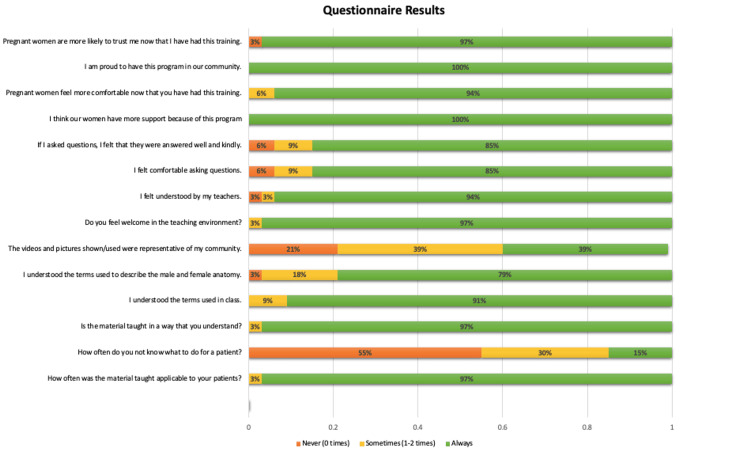
The survey (n=33) showed that 32 comadronas found the curriculum applicable (97%) and comprehensible (97%). However, only 26 comadronas (79%) were comfortable with anatomy terminology. Opinions on teaching tools varied: 13 comadronas (39%) felt they were always representative, 13 comadronas (39%) sometimes, and seven comadronas (21%) never. Group discussions echoed this lack of representation. In the learning environment, 32 comadronas felt welcomed (97%) and 31 felt understood (94%), but five comadronas (15%) were not comfortable asking questions. Thirty-one comadronas (94%) believed training made pregnant women trust comadronas more. Group interviews highlighted increased confidence, better care, and perceived lower maternal mortality.

CONCLUSION

This study found the program to be culturally sensitive and effective. Group interviews highlighted increased confidence, improved patient care, and perceived reductions in maternal mortality. Feedback emphasized the need for more culturally relevant materials, resources, and collaboration with the Ministry of Health. This program's community-centered approach could serve as a model for similar initiatives in low- and middle-income countries addressing high maternal mortality rates, despite language and access challenges.

摘要

引言

尽管拉丁美洲在降低孕产妇死亡率(MMR)方面取得了显著的全球进展,但土著妇女的死亡率仍然高得惊人。危地马拉也存在这种差异,当地土著妇女的孕产妇死亡率是非土著妇女的两倍。大多数产科护理由传统的玛雅助产士(TBA)进行,她们也被称为科马德罗纳,在产科护理方面接受的正规临床培训极少。由于没有针对玛雅助产士的全国性综合培训计划,2014年设立了一个独特的培训计划。这个名为“PowHER学校”(提供妇女健康外展和教育资源)的计划旨在确保由玛雅助产士主导,为危地马拉农村地区的玛雅助产士提供可持续教育,最终目标是帮助玛雅助产士提供基本的产前护理,并学习如何识别和转诊高危妊娠。本拟议研究的目的是通过混合方法来检验该培训计划的文化适宜性和敏感性。

方法

我们采用了混合方法策略,将定量和定性方法相结合。定量方面涉及一项14项的书面调查,采用三点李克特量表进行回答,而定性部分则使用半结构化访谈指南进行焦点小组讨论。

结果

调查(n = 33)显示,32名科马德罗纳认为课程适用(97%)且易于理解(97%)。然而,只有26名科马德罗纳(79%)对解剖学术语感到满意。对教学工具的看法各不相同:13名科马德罗纳(39%)认为它们总是具有代表性,13名科马德罗纳(39%)有时这样认为,7名科马德罗纳(21%)则从不这样认为。小组讨论也反映了这种缺乏代表性的情况。在学习环境方面,32名科马德罗纳感到受到欢迎(97%),31名感到被理解(94%),但有5名科马德罗纳(15%)在提问时感到不自在。31名科马德罗纳(94%)认为培训使孕妇更加信任科马德罗纳。小组访谈强调了信心增强、护理改善以及孕产妇死亡率降低的看法。

结论

本研究发现该计划具有文化敏感性且有效。小组访谈强调了信心增强、患者护理改善以及孕产妇死亡率降低的看法。反馈强调需要更多与文化相关的材料、资源以及与卫生部的合作。尽管存在语言和获取方面的挑战,但该计划以社区为中心的方法可为中低收入国家应对高孕产妇死亡率的类似举措提供范例。
https://cdn.ncbi.nlm.nih.gov/pmc/blobs/1cc2/11495898/4037dd4d7a95/cureus-0016-00000069940-i01.jpg

相似文献

1
Examining the Cultural Appropriateness and Acceptability of a Traditional Birth Attendants' Training Program in Rural Guatemala.审视危地马拉农村传统助产士培训项目的文化适宜性与可接受性。
Cureus. 2024 Sep 22;16(9):e69940. doi: 10.7759/cureus.69940. eCollection 2024 Sep.
2
How a Training Program Is Transforming the Role of Traditional Birth Attendants from Cultural Practitioners to Unique Health-care Providers: A Community Case Study in Rural Guatemala.一个培训项目如何将传统助产士的角色从文化从业者转变为独特的医疗服务提供者:危地马拉农村地区的社区案例研究
Front Public Health. 2017 May 19;5:111. doi: 10.3389/fpubh.2017.00111. eCollection 2017.
3
San Raymundo: Focus Group About Comadronas' Response to Obstetrical Emergencies in Urban Guatemala.圣雷蒙多:危地马拉城市中助产士应对产科急症的焦点小组。
J Transcult Nurs. 2024 Sep;35(5):381-387. doi: 10.1177/10436596241253864. Epub 2024 May 27.
4
Reduction of maternal and perinatal mortality in rural and peri-urban settings: what works?降低农村及城市周边地区孕产妇和围产期死亡率:哪些措施有效?
Eur J Obstet Gynecol Reprod Biol. 1996 Oct;69(1):47-53. doi: 10.1016/0301-2115(95)02535-9.
5
Acceptability, Suitability, and Feasibility of an Evidence-Based Intervention to Reduce HIV Risk Behaviors: Engaging Comadronas in HIV Prevention in Rural Guatemala.采用循证干预措施减少艾滋病毒风险行为的可接受性、适宜性和可行性:在危地马拉农村地区让接生婆参与艾滋病毒预防。
AIDS Educ Prev. 2023 Apr;35(2):101-113. doi: 10.1521/aeap.2023.35.2.101.
6
Perceived differences on the role of traditional birth attendants in rural Tanzania: a qualitative study.坦桑尼亚农村地区传统助产妇角色认知的差异:一项定性研究。
BMC Pregnancy Childbirth. 2021 Feb 15;21(1):137. doi: 10.1186/s12884-021-03611-0.
7
The training of traditional birth attendants in Ghana: experience of the Danfa Rural Health Project.加纳传统助产士的培训:丹法农村卫生项目的经验
Trop Geogr Med. 1977 Jun;29(2):197-203.
8
Improving health and empowering women. Latin America.改善健康状况,增强妇女权能。拉丁美洲。
JOICFP News. 1995 Sep(254):5.
9
Traditional birth attendants in Malawi.马拉维的传统助产士。
Curationis. 1994 Jun;17(2):25-8. doi: 10.4102/curationis.v17i2.1385.
10
mHealth intervention to improve the continuum of maternal and perinatal care in rural Guatemala: a pragmatic, randomized controlled feasibility trial.移动医疗干预改善危地马拉农村地区孕产妇和围产保健连续性:一项实用、随机对照可行性试验。
Reprod Health. 2018 Jul 4;15(1):120. doi: 10.1186/s12978-018-0554-z.

本文引用的文献

1
Threat or Godsend? Evangelicals and Democracy in Latin America.威胁还是天赐之物?拉丁美洲的福音派与民主
J Relig Demogr. 2022;9(1-2):138-164. doi: 10.1163/2589742x-bja10015. Epub 2022 Oct 14.
2
Reducing inequities in maternal and child health in rural Guatemala through the CBIO+ Approach of Curamericas: 6. Management of pregnancy complications at Community Birthing Centers (Casas Maternas Rurales).通过 Curamericas 的 CBIO+方法减少危地马拉农村母婴健康的不平等:6. 社区生育中心(农村产妇之家)妊娠并发症管理。
Int J Equity Health. 2023 Feb 28;21(Suppl 2):204. doi: 10.1186/s12939-022-01758-6.
3
The Acquisition of Directionals in Two Mayan Languages.
两种玛雅语言中方向词的习得
Front Psychol. 2019 Nov 1;10:2442. doi: 10.3389/fpsyg.2019.02442. eCollection 2019.
4
Indigenous language and inequitable maternal health care, Guatemala, Mexico, Peru and the Plurinational State of Bolivia.土著语言与不平等的孕产妇保健:危地马拉、墨西哥、秘鲁和多民族玻利维亚国。
Bull World Health Organ. 2019 Jan 1;97(1):59-67. doi: 10.2471/BLT.18.216184. Epub 2018 Oct 31.
5
How a Training Program Is Transforming the Role of Traditional Birth Attendants from Cultural Practitioners to Unique Health-care Providers: A Community Case Study in Rural Guatemala.一个培训项目如何将传统助产士的角色从文化从业者转变为独特的医疗服务提供者:危地马拉农村地区的社区案例研究
Front Public Health. 2017 May 19;5:111. doi: 10.3389/fpubh.2017.00111. eCollection 2017.
6
Obstetric characteristics of two Mayan populations in the highlands of Guatemala.危地马拉高原两个玛雅人群的产科特征。
Ethn Health. 2017 Oct;22(5):541-550. doi: 10.1080/13557858.2016.1244739. Epub 2016 Oct 17.
7
An analysis of two indigenous reproductive health illnesses in a Nahua community in Veracruz, Mexico.墨西哥韦拉克鲁斯州一个纳瓦社区的两种本土生殖健康疾病分析。
J Ethnobiol Ethnomed. 2012 Aug 22;8:33. doi: 10.1186/1746-4269-8-33.
8
Ethnic inequality in Guatemalan women's use of modern reproductive health care.危地马拉妇女在现代生殖保健方面的种族不平等
Int Perspect Sex Reprod Health. 2012 Jun;38(2):99-108. doi: 10.1363/3809912.
9
Impact of community-based maternal health workers on coverage of essential maternal health interventions among internally displaced communities in eastern Burma: the MOM project.缅甸东部境内流离失所社区中以社区为基础的产妇保健工作者对基本产妇保健干预措施覆盖情况的影响:MOM 项目。
PLoS Med. 2010 Aug 3;7(8):e1000317. doi: 10.1371/journal.pmed.1000317.
10
Monitoring utilization and need for obstetric care in the highlands of Guatemala.
Int J Gynaecol Obstet. 2005 May;89(2):209-17. doi: 10.1016/j.ijgo.2004.11.038.