Chatterjee Aritrick, Fan Xiaobing, Slear Jessica, Asare Gregory, Yousuf Ambereen N, Medved Milica, Antic Tatjana, Eggener Scott, Karczmar Gregory S, Oto Aytekin
Department of Radiology, University of Chicago, Chicago, IL 60637, USA.
Sanford J. Grossman Center of Excellence in Prostate Imaging and Image Guided Therapy, University of Chicago, Chicago, IL 60637, USA.
Cancers (Basel). 2024 Oct 16;16(20):3499. doi: 10.3390/cancers16203499.
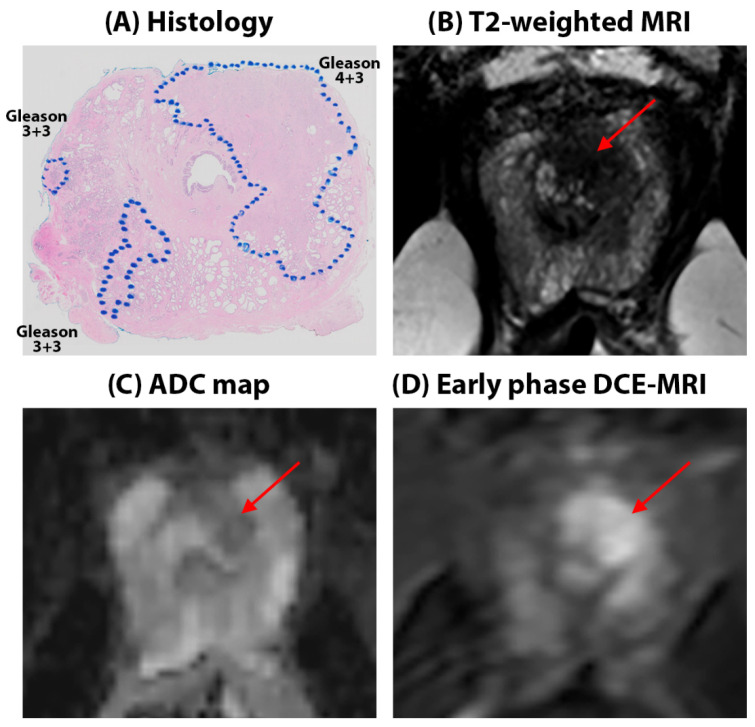
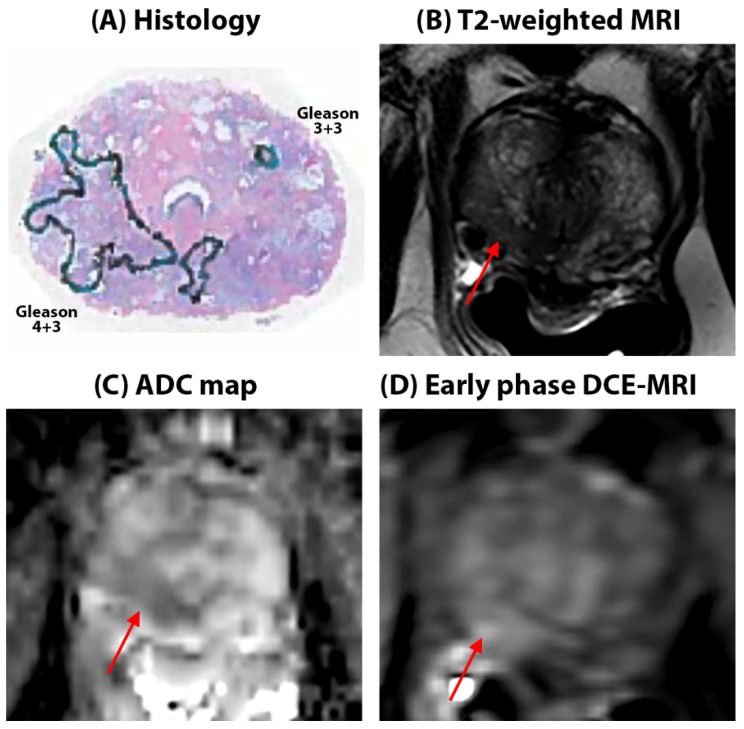
This study investigates whether quantitative MRI and histology of the prostate reveal differences between races, specifically African Americans (AAs) and Caucasian Americans (CAs), that can affect diagnosis. Patients (98 CAs, 47 AAs) with known or suspected prostate cancer (PCa) underwent 3T MRI (T2W, DWI, and DCE-MRI) prior to biopsy or prostatectomy. Quantitative mpMRI metrics: ADC, T2, and DCE empirical mathematical model parameters were calculated. AAs had a greater percentage of higher Gleason-grade lesions compared to CAs. There were no significant differences in the quantitative ADC and T2 values between AAs and CAs. The cancer signal enhancement rate (α) on DCE-MRI was significantly higher for AAs compared to CAs (AAs: 13.3 ± 9.3 vs. CAs: 6.1 ± 4.7 s, < 0.001). The DCE signal washout rate (β) was significantly lower in benign tissue of AAs (AAs: 0.01 ± 0.09 s vs. CAs: 0.07 ± 0.07 s, < 0.001) and significantly elevated in cancer tissue in AAs (AAs: 0.12 ± 0.07 s vs. CAs: 0.07 ± 0.08 s, = 0.02). DCE significantly improves the differentiation of PCa from benign in AAs (α: 52%, β: 62% more effective in AAs compared to CAs). Histologic analysis showed cancers have a greater proportion ( = 0.04) of epithelium (50.9 ± 12.3 vs. 44.7 ± 12.8%) and lower lumen (10.5 ± 6.9 vs. 16.2 ± 6.8%) in CAs compared to AAs. This study shows that AAs have different quantitative DCE-MRI values for benign prostate and prostate cancer and different histologic makeup in PCa compared to CAs. Quantitative DCE-MRI can significantly improve the performance of MRI for PCa diagnosis in African Americans but is much less effective for Caucasian Americans.
本研究调查前列腺的定量磁共振成像(MRI)和组织学是否揭示了种族之间的差异,特别是非裔美国人(AAs)和高加索裔美国人(CAs)之间的差异,这些差异可能会影响诊断。已知或疑似前列腺癌(PCa)的患者(98名CAs,47名AAs)在活检或前列腺切除术前接受了3T MRI(T2加权成像、扩散加权成像和动态对比增强MRI)检查。计算了定量多参数MRI指标:表观扩散系数(ADC)、T2以及动态对比增强经验数学模型参数。与CAs相比,AAs中高Gleason分级病变的比例更高。AAs和CAs之间的定量ADC和T2值没有显著差异。与CAs相比,AAs在动态对比增强MRI上的癌症信号增强率(α)显著更高(AAs:13.3±9.3 vs. CAs:6.1±4.7秒,<0.001)。AAs良性组织中的动态对比增强信号洗脱率(β)显著更低(AAs:0.01±0.09秒 vs. CAs:0.07±0.07秒,<0.001),而AAs癌症组织中的洗脱率显著升高(AAs:0.12±0.07秒 vs. CAs:0.07±0.08秒,P = 0.02)。动态对比增强在区分AAs的PCa和良性病变方面显著更有效(α:与CAs相比,AAs的有效性高52%,β:高62%)。组织学分析显示,与AAs相比,CAs的癌症上皮比例更高(P = 0.04)(50.9±12.3 vs. 44.7±12.8%),管腔比例更低(10.5±6.9 vs. 16.2±6.8%)。本研究表明,与CAs相比,AAs的良性前列腺和前列腺癌的定量动态对比增强MRI值不同,且PCa的组织学构成也不同。定量动态对比增强MRI可显著提高MRI对非裔美国人PCa诊断的性能,但对高加索裔美国人的有效性要低得多。