
拉曼光谱在术中神经外科的当前应用
Current Applications of Raman Spectroscopy in Intraoperative Neurosurgery.
作者信息
Rivera Daniel, Young Tirone, Rao Akhil, Zhang Jack Y, Brown Cole, Huo Lily, Williams Tyree, Rodriguez Benjamin, Schupper Alexander J
机构信息
Department of Neurosurgery, Icahn School of Medicine at Mount Sinai, One G. Levy Place, New York, NY 10029, USA.
Sinai BioDesign, Department of Neurosurgery, Mount Sinai, New York, NY 10029, USA.
出版信息
Biomedicines. 2024 Oct 16;12(10):2363. doi: 10.3390/biomedicines12102363.
BACKGROUND
Neurosurgery demands exceptional precision due to the brain's complex and delicate structures, necessitating precise targeting of pathological targets. Achieving optimal outcomes depends on the surgeon's ability to accurately differentiate between healthy and pathological tissues during operations. Raman spectroscopy (RS) has emerged as a promising innovation, offering real-time, in vivo non-invasive biochemical tissue characterization. This literature review evaluates the current research on RS applications in intraoperative neurosurgery, emphasizing its potential to enhance surgical precision and patient outcomes.
METHODS
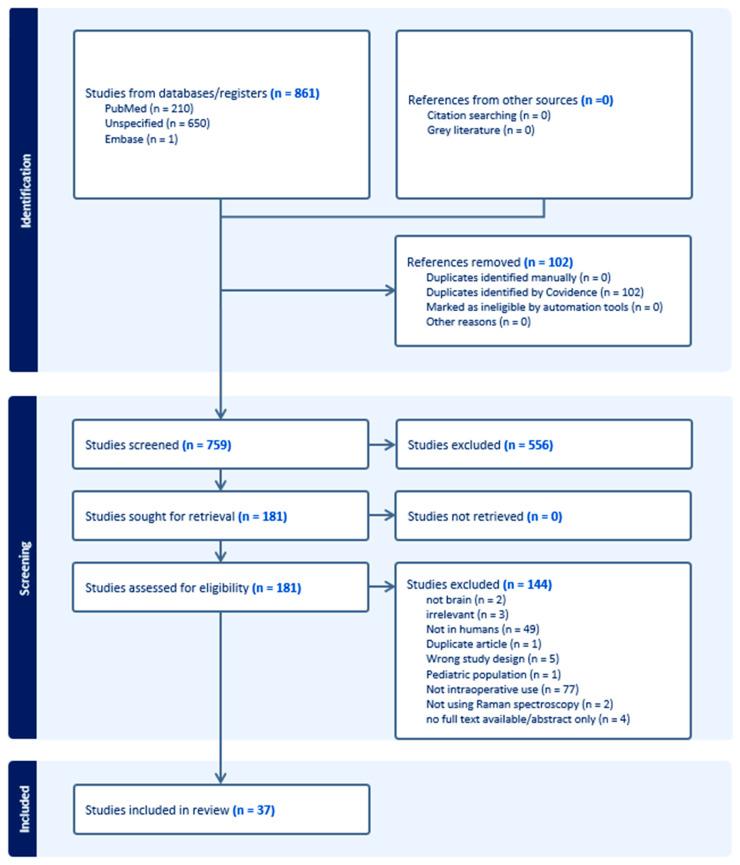
Following PRISMA guidelines, a comprehensive systematic review was conducted using PubMed to extract relevant peer-reviewed articles. The inclusion criteria focused on original research discussing real-time RS applications with human tissue samples in or near the operating room, excluding retrospective studies, reviews, non-human research, and other non-relevant publications.
RESULTS
Our findings demonstrate that RS significantly improves tumor margin delineation, with handheld devices achieving high sensitivity and specificity. Stimulated Raman Histology (SRH) provides rapid, high-resolution tissue images comparable to traditional histopathology but with reduced time to diagnosis. Additionally, RS shows promise in identifying tumor types and grades, aiding precise surgical decision-making. RS techniques have been particularly beneficial in enhancing the accuracy of glioma surgeries, where distinguishing between tumor and healthy tissue is critical. By providing real-time molecular data, RS aids neurosurgeons in maximizing the extent of resection (EOR) while minimizing damage to normal brain tissue, potentially improving patient outcomes and reducing recurrence rates.
CONCLUSIONS
This review underscores the transformative potential of RS in neurosurgery, advocating for continued innovation and research to fully realize its benefits. Despite its substantial potential, further research is needed to validate RS's clinical utility and cost-effectiveness.
背景
由于大脑结构复杂且脆弱,神经外科手术需要极高的精准度,这就要求精确瞄准病变靶点。实现最佳手术效果取决于外科医生在手术过程中准确区分健康组织和病变组织的能力。拉曼光谱(RS)已成为一项有前景的创新技术,可提供实时、体内、非侵入性的生化组织特征分析。本文献综述评估了RS在术中神经外科应用的当前研究,强调其提高手术精准度和改善患者手术效果的潜力。
方法
按照PRISMA指南,使用PubMed进行了全面的系统综述,以提取相关的同行评审文章。纳入标准侧重于讨论在手术室或其附近使用人体组织样本进行实时RS应用的原创研究,排除回顾性研究、综述、非人体研究及其他不相关的出版物。
结果
我们的研究结果表明,RS显著改善了肿瘤边缘的界定,手持设备具有高灵敏度和特异性。受激拉曼组织学(SRH)可提供与传统组织病理学相当的快速、高分辨率组织图像,但诊断时间缩短。此外,RS在识别肿瘤类型和分级方面显示出前景,有助于做出精确的手术决策。RS技术在提高胶质瘤手术的准确性方面特别有益,因为区分肿瘤组织和健康组织至关重要。通过提供实时分子数据,RS帮助神经外科医生在最大程度切除肿瘤(EOR)的同时,将对正常脑组织的损伤降至最低,有可能改善患者手术效果并降低复发率。
结论
本综述强调了RS在神经外科中的变革潜力,主张持续创新和研究以充分实现其益处。尽管其潜力巨大,但仍需要进一步研究来验证RS的临床实用性和成本效益。
 Zotero 插件