Ahmad Mansoor, Bahri Mohamed, Sawan Mohamad
CenBRAIN Neurotech, School of Engineering, Westlake University, Hangzhou 310030, China.
Zhejiang Key Laboratory of 3D Micro/Nano Fabrication and Characterization, Westlake Institute for Optoelectronics, Fuyang, Hangzhou 311421, China.
Micromachines (Basel). 2024 Sep 30;15(10):1233. doi: 10.3390/mi15101233.
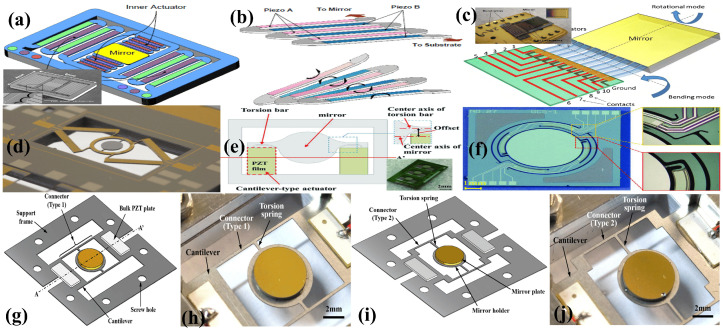
Micromirrors have recently emerged as an essential component in optical scanning technology, attracting considerable attention from researchers. Their compact size and versatile capabilities, such as light steering, modulation, and switching, are leading them as potential alternatives to traditional bulky galvanometer scanners. The actuation of these mirrors is critical in determining their performance, as it contributes to factors such as response time, scanning angle, and power consumption. This article aims to provide a thorough exploration of the actuation techniques used to drive micromirrors, describing the fundamental operating principles. The four primary actuation modalities-electrostatic, electrothermal, electromagnetic, and piezoelectric-are thoroughly investigated. Each type of actuator's operational principles, key advantages, and their limitations are discussed. Additionally, the discussion extends to hybrid micromirror designs that combine two types of actuation in a single device. A total of 208 closely related papers indexed in Web of Science were reviewed. The findings indicate ongoing advancements in the field, particularly in terms of size, controllability, and field of view, making micromirrors ideal candidates for applications in medical imaging, display projections, and optical communication. With a comprehensive overview of micromirror actuation strategies, this manuscript serves as a compelling resource for researchers and engineers aiming to utilize the appropriate type of micromirror in the field of optical scanning technology.
微镜最近已成为光学扫描技术中的一个重要组件,吸引了研究人员的广泛关注。它们紧凑的尺寸和诸如光转向、调制和切换等多功能能力,使其成为传统大型振镜扫描仪的潜在替代品。这些微镜的驱动对于确定其性能至关重要,因为它会影响响应时间、扫描角度和功耗等因素。本文旨在深入探讨用于驱动微镜的驱动技术,描述其基本工作原理。对四种主要的驱动方式——静电驱动、电热驱动、电磁驱动和压电驱动——进行了全面研究。讨论了每种类型致动器的工作原理、主要优点及其局限性。此外,讨论还扩展到在单个器件中结合两种驱动类型的混合微镜设计。共查阅了Web of Science中索引的208篇密切相关的论文。研究结果表明该领域正在不断取得进展,特别是在尺寸、可控性和视野方面,这使得微镜成为医学成像、显示投影和光通信应用的理想候选者。通过对微镜驱动策略的全面概述,本文为旨在在光学扫描技术领域中使用合适类型微镜的研究人员和工程师提供了极具价值的参考资源。