Beck Timon, van der Linden Lize-Mari, Borcherds Wade M, Kim Kyoohyun, Schlüßler Raimund, Müller Paul, Franzmann Titus, Möckel Conrad, Goswami Ruchi, Leaver Mark, Mittag Tanja, Alberti Simon, Guck Jochen
Max Planck Institute for the Science of Light, Erlangen, Germany.
Max-Planck-Zentrum für Physik und Medizin, Erlangen, Germany.
bioRxiv. 2024 Oct 23:2024.03.19.585750. doi: 10.1101/2024.03.19.585750.
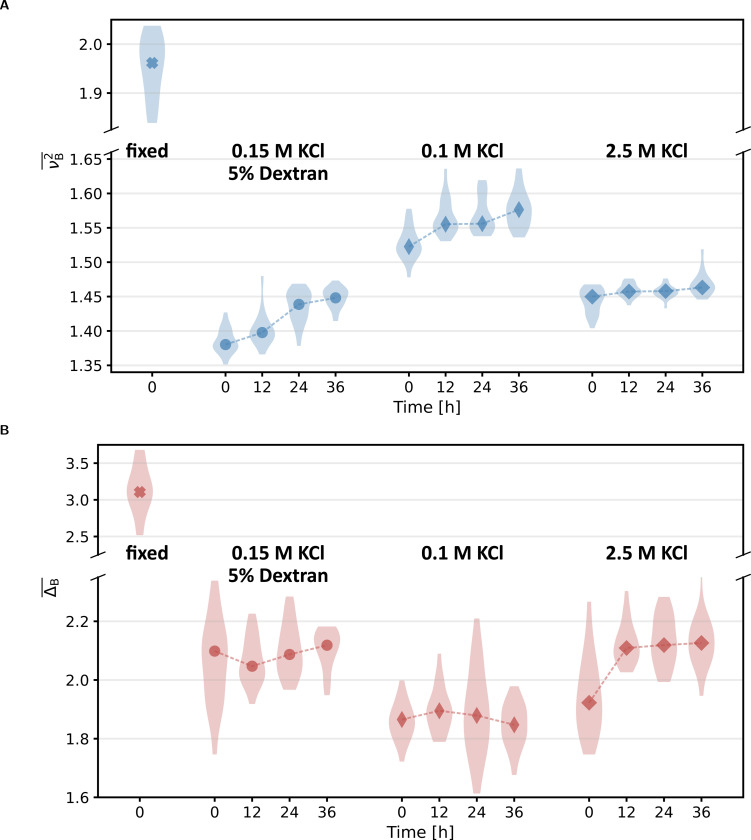
Biomolecular condensates have been identified as a ubiquitous means of intracellular organization, exhibiting very diverse material properties. However, techniques to characterize these material properties and their underlying molecular interactions are scarce. Here, we introduce two optical techniques - Brillouin microscopy and quantitative phase imaging (QPI) - to address this scarcity. We establish Brillouin shift and linewidth as measures for average molecular interaction and dissipation strength, respectively, and we used QPI to obtain the protein concentration within the condensates. We monitored the response of condensates formed by FUS and by the low-complexity domain of hnRNPA1 (A1-LCD) to altering temperature and ion concentration. Conditions favoring phase separation increased Brillouin shift, linewidth, and protein concentration. In comparison to solidification by chemical crosslinking, the ion-dependent aging of FUS condensates had a small effect on the molecular interaction strength inside. Finally, we investigated how sequence variations of A1-LCD, that change the driving force for phase separation, alter the physical properties of the respective condensates. Our results provide a new experimental perspective on the material properties of protein condensates. Robust and quantitative experimental approaches such as the presented ones will be crucial for understanding how the physical properties of biological condensates determine their function and dysfunction.
生物分子凝聚物已被确认为细胞内组织的一种普遍存在的方式,呈现出非常多样的物质特性。然而,用于表征这些物质特性及其潜在分子相互作用的技术却很匮乏。在此,我们引入两种光学技术——布里渊显微镜和定量相位成像(QPI)——来解决这一匮乏问题。我们分别将布里渊频移和线宽确立为平均分子相互作用和耗散强度的度量,并且我们使用QPI来获取凝聚物内的蛋白质浓度。我们监测了由FUS和hnRNPA1的低复杂性结构域(A1-LCD)形成的凝聚物对温度和离子浓度变化的响应。有利于相分离的条件会增加布里渊频移、线宽和蛋白质浓度。与通过化学交联固化相比,FUS凝聚物的离子依赖性老化对其内部的分子相互作用强度影响较小。最后,我们研究了改变相分离驱动力的A1-LCD的序列变异如何改变各自凝聚物的物理性质。我们的结果为蛋白质凝聚物的物质特性提供了一个新的实验视角。像本文所展示的这种稳健且定量的实验方法对于理解生物凝聚物的物理性质如何决定其功能和功能障碍至关重要。