Karagoz Pinar, Khiawjan Sansanee, Marques Marco P C, Santzouk Samir, Bugg Timothy D H, Lye Gary J
Department of Biochemical Engineering, The Advanced Centre for Biochemical Engineering, University College London, Gower Street, London, WC1E 6BT UK.
School of Engineering and Innovation, The Open University, Milton Keynes, MK7 6AA UK.
Biomass Convers Biorefin. 2024;14(21):26553-26574. doi: 10.1007/s13399-023-03745-5. Epub 2023 Jan 21.
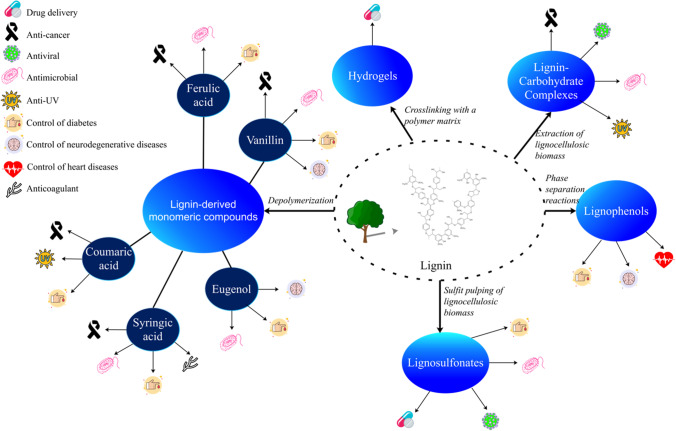
Lignocellulosic biomass is one of the most abundant bioresources on Earth. Over recent decades, various valorisation techniques have been developed to produce value-added products from the cellulosic and hemicellulosic fractions of this biomass. Lignin is the third major component accounting for 10-30% (w/w). However, it currently remains a largely unused fraction due to its recalcitrance and complex structure. The increase in the global demand for lignocellulosic biomass, for energy and chemical production, is increasing the amount of waste lignin available. Approaches to date for valorizing this renewable but heterogeneous chemical resource have mainly focused on production of materials and fine chemicals. Greater value could be gained by developing higher value pharmaceutical applications which would help to improve integrated biorefinery economics. In this review, different lignin extraction methods, such as organosolv and ionic liquid, and the properties and potential of the extracted chemical building blocks are first summarized with respect to pharmaceutical use. The review then discusses the many recent advances made regarding the medical or therapeutic potential of lignin-derived materials such as antimicrobial, antiviral, and antitumor compounds and in controlled drug delivery. The aim is to draw out the link between the source and the processing of the biomass and potential clinical applications. We then highlight four key areas for future research if therapeutic applications of lignin-derived products are to become commercially viable. These relate to the availability and processing of lignocellulosic biomass, technologies for the purification of specific compounds, enhancements in process yield, and progression to human clinical trials.
木质纤维素生物质是地球上最丰富的生物资源之一。在最近几十年里,已经开发出各种增值技术,以从这种生物质的纤维素和半纤维素部分生产增值产品。木质素是第三大主要成分,占10 - 30%(重量/重量)。然而,由于其顽固性和复杂结构,它目前在很大程度上仍未被利用。全球对用于能源和化学品生产的木质纤维素生物质的需求增加,使得可用的废弃木质素数量也在增加。迄今为止,使这种可再生但异质的化学资源增值的方法主要集中在材料和精细化学品的生产上。通过开发更高价值的药物应用可以获得更大的价值,这将有助于提高综合生物炼制的经济性。在这篇综述中,首先总结了不同的木质素提取方法,如有机溶剂法和离子液体法,以及提取的化学结构单元在药物用途方面的性质和潜力。然后,综述讨论了关于木质素衍生材料的医学或治疗潜力的许多最新进展,如抗菌、抗病毒和抗肿瘤化合物以及在控释药物递送方面的进展。目的是找出生物质的来源和加工与潜在临床应用之间的联系。如果木质素衍生产品的治疗应用要实现商业可行性,我们随后强调了未来研究的四个关键领域。这些领域涉及木质纤维素生物质的可得性和加工、特定化合物的纯化技术、工艺产率的提高以及向人体临床试验的推进。