Xu Zhilong, Jiang Gening, Dai Jie
Department of Thoracic Surgery, Shanghai Pulmonary Hospital, Tongji University School of Medicine, Shanghai, China.
Oncol Rev. 2024 Oct 18;18:1435922. doi: 10.3389/or.2024.1435922. eCollection 2024.
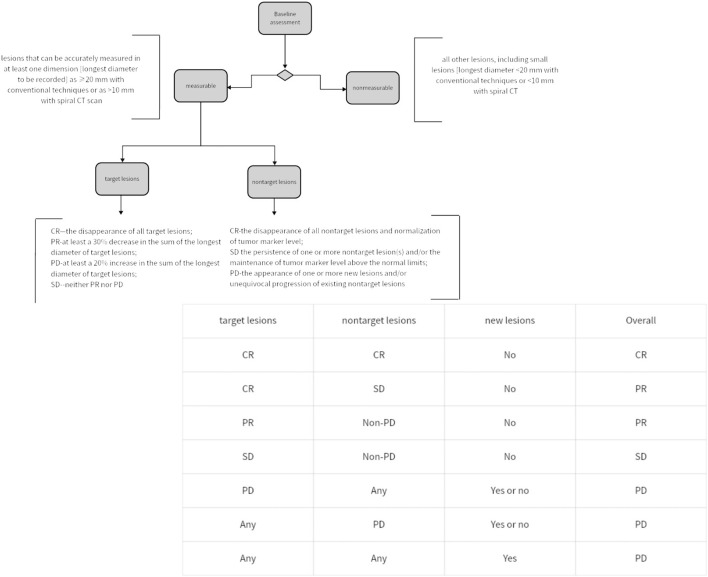
In recent years, advancements in medical treatment and imaging technologies have revolutionized the assessment of tumor response. However, the Response Evaluation Criteria in Solid Tumors (RECIST) has long been established as the gold standard for evaluating tumor treatment. As treatment modalities evolve, the need for continuous refinement and adaptation of RECIST becomes increasingly apparent. This review explores the historical evolution, current applications, limitations, and future directions of RECIST. It discusses the challenges of distinguishing true progression from pseudo-progression in ICIs (immune checkpoint inhibitors), the integration of advanced imaging tools, and the necessity for RECIST criteria tailored to specific therapies like neoadjuvant treatments. The review highlights the ongoing efforts to enhance RECIST's accuracy and reliability in clinical decision-making and the potential for developing new standards to better evaluate treatment efficacy in the rapidly evolving landscape of oncology.
近年来,医学治疗和成像技术的进步彻底改变了肿瘤反应的评估方式。然而,实体瘤疗效评价标准(RECIST)长期以来一直被确立为评估肿瘤治疗的金标准。随着治疗方式的不断发展,对RECIST进行持续完善和调整的需求日益明显。本综述探讨了RECIST的历史演变、当前应用、局限性及未来发展方向。讨论了在免疫检查点抑制剂(ICI)中区分真正进展与假性进展的挑战、先进成像工具的整合,以及针对新辅助治疗等特定疗法制定RECIST标准的必要性。该综述强调了为提高RECIST在临床决策中的准确性和可靠性而正在进行的努力,以及在肿瘤学快速发展的背景下制定更好地评估治疗效果的新标准的潜力。