Division of Image Processing, Department of Radiology, Leiden University Medical Center (LUMC), P.O. Box 9600, 2300, RC Leiden, The Netherlands.
Department of Rheumatology, Leiden University Medical Center (LUMC), P.O. Box 9600, 2300, RC Leiden, The Netherlands.
Sci Rep. 2024 Nov 4;14(1):26666. doi: 10.1038/s41598-024-78393-4.
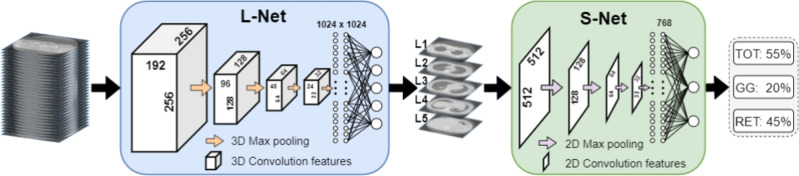
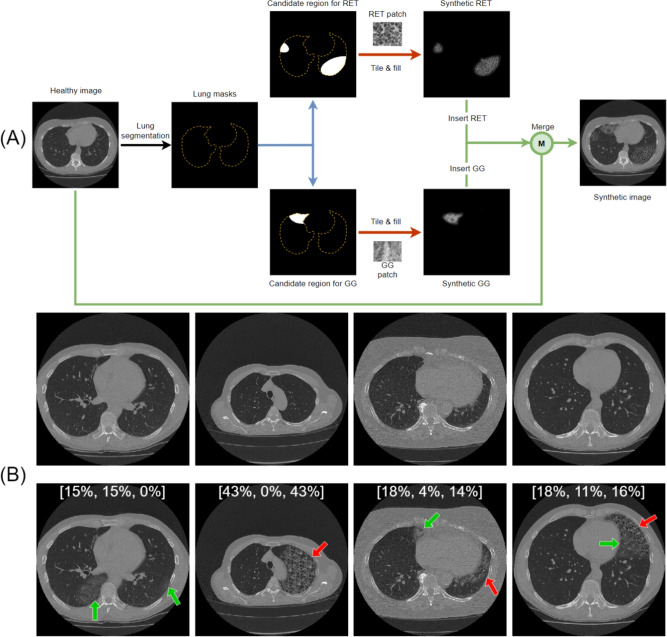
Visual scoring of interstitial lung disease in systemic sclerosis (SSc-ILD) from CT scans is laborious, subjective and time-consuming. This study aims to develop a deep learning framework to automate SSc-ILD scoring. The automated framework is a cascade of two neural networks. The first network selects the craniocaudal positions of the five scoring levels. Subsequently, for each level, the second network estimates the ratio of three patterns to the total lung area: the total extent of disease (TOT), ground glass (GG) and reticulation (RET). To overcome the score imbalance in the second network, we propose a method to augment the training dataset with synthetic data. To explain the network's output, a heat map method is introduced to highlight the candidate interstitial lung disease regions. The explainability of heat maps was evaluated by two human experts and a quantitative method that uses the heat map to produce the score. The results show that our framework achieved a of 0.66, 0.58, and 0.65, for the TOT, GG and RET scoring, respectively. Both experts agreed with the heat maps in 91%, 90% and 80% of cases, respectively. Therefore, it is feasible to develop a framework for automated SSc-ILD scoring, which performs competitively with human experts and provides high-quality explanations using heat maps. Confirming the model's generalizability is needed in future studies.
从 CT 扫描图中对系统性硬化症(SSc-ILD)的间质性肺病进行视觉评分既费力、主观又耗时。本研究旨在开发一种深度学习框架来实现 SSc-ILD 评分的自动化。自动化框架是两个神经网络的级联。第一个网络选择五个评分级别的头尾位置。随后,对于每个级别,第二个网络估计三种模式与总肺面积的比例:疾病总范围(TOT)、磨玻璃影(GG)和网状影(RET)。为了克服第二个网络中的评分不平衡,我们提出了一种使用合成数据扩充训练数据集的方法。为了解释网络的输出,引入了热图方法来突出候选间质性肺病区域。通过两位人类专家和一种使用热图生成评分的定量方法评估了热图的可解释性。结果表明,我们的框架在 TOT、GG 和 RET 评分方面的分别达到了 0.66、0.58 和 0.65 的准确率。两位专家分别在 91%、90%和 80%的情况下同意热图。因此,开发一种用于 SSc-ILD 评分自动化的框架是可行的,该框架的性能可与人类专家相媲美,并使用热图提供高质量的解释。未来的研究需要确认模型的泛化能力。