Li Junxian, Liu Ya, Li Jingjing, Feng Ziwei, Bai Lili, Feng Yujie, Zhang Pengyu, Song Fengju
Department of Blood Transfusion, Key Laboratory of Cancer Prevention and Therapy in Tianjin, Tianjin's Clinical Research Center for Cancer, National Clinical Research Center for Cancer, Tianjin Medical University Cancer Institute & Hospital, Tianjin, China.
Department of Epidemiology and Biostatistics, Key Laboratory of Molecular Cancer Epidemiology in Tianjin, Tianjin's Clinical Research Center for Cancer, National Clinical Research Center for Cancer, Tianjin Medical University Cancer Institute & Hospital, Tianjin, China.
Diabetol Metab Syndr. 2024 Nov 5;16(1):263. doi: 10.1186/s13098-024-01500-y.
To explore the association between the Oxidative Balance Score (OBS), which represents the balance of multiple oxidative stress-related dietary and lifestyle exposures, and the risk of metabolic syndrome (MetS).
A population-based cross-sectional study design was adopted and 16,850 participants in NHANES database were included in the statistics analysis stage. The OBS was constructed by combining information from 20 a priori selected pro- and antioxidant factors. Weighted logistic regression and restricted cubic splines (RCS) were used to estimate the association between OBS and MetS.
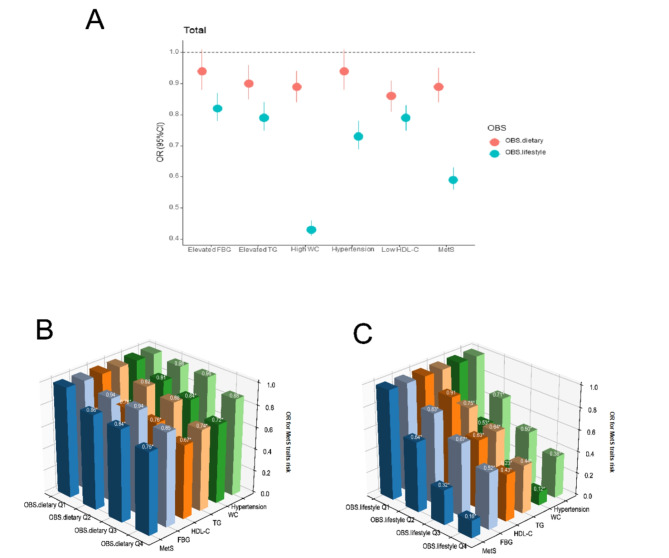
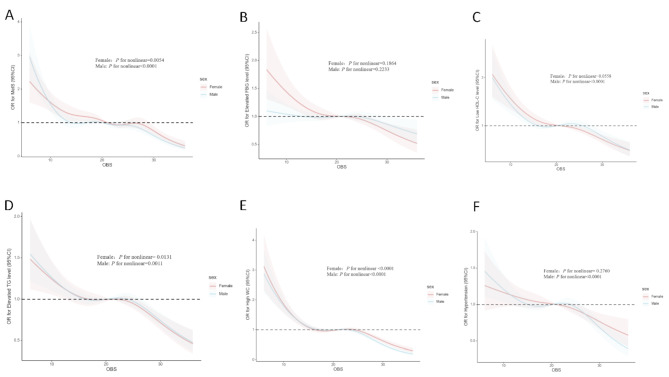
Participants in the highest OBS quartile, indicating low oxidative stress (OS) levels, exhibited a significantly lower risk of MetS (odds Ratio [OR] = 0.55, 95% confidence Interval [CI]: 0.47-0.64) compared to the lowest quartile. Specifically, higher OBS was inversely associated with abdominal obesity (OR = 0.61, 95% CI: 0.54-0.69), hypertension (OR = 0.69, 95% CI: 0.58-0.83), elevated triglycerides (OR = 0.68, 95% CI: 0.57-0.82), low high-density lipoprotein cholesterol (HDL-C) levels (OR = 0.60, 95% CI: 0.50-0.70) and fasting blood glucose (FBG) levels (OR = 0.74, 95% CI: 0.62-0.88). The observed inverse association between OBS and hypertension or FBG levels appeared to primarily influenced by BMI. The association between dietary OBS intervals and elevated FBG levels was not statistically significant in men, whereas the risk was lower by 25% in women.
A higher OBS, representing a balance of multiple oxidative stress-related dietary and lifestyle exposures, is associated with a lower risk of MetS. Therefore, adhering to an antioxidant diet and lifestyle may help prevent the occurrence of metabolic disorders.
探讨代表多种与氧化应激相关的饮食和生活方式暴露平衡的氧化平衡评分(OBS)与代谢综合征(MetS)风险之间的关联。
采用基于人群的横断面研究设计,16850名美国国家健康与营养检查调查(NHANES)数据库参与者纳入统计分析阶段。OBS通过整合20个预先选定的促氧化和抗氧化因子的信息构建而成。采用加权逻辑回归和受限立方样条(RCS)来估计OBS与MetS之间的关联。
与最低四分位数相比,处于最高OBS四分位数(表明氧化应激[OS]水平较低)的参与者患MetS的风险显著降低(优势比[OR]=0.55,95%置信区间[CI]:0.47 - 0.64)。具体而言,较高的OBS与腹型肥胖(OR = 0.61,95% CI:0.54 - 0.69)、高血压(OR = 0.69,95% CI:0.58 - 0.83)、甘油三酯升高(OR = 0.68,95% CI:0.57 - 0.82)、高密度脂蛋白胆固醇(HDL - C)水平降低(OR = 0.60,95% CI:0.50 - 0.70)以及空腹血糖(FBG)水平(OR = 0.74,95% CI:0.62 - 0.88)呈负相关。观察到的OBS与高血压或FBG水平之间的负相关似乎主要受体重指数(BMI)影响。饮食OBS区间与升高的FBG水平之间的关联在男性中无统计学意义,而女性的风险则降低了25%。
较高的OBS代表多种与氧化应激相关的饮食和生活方式暴露的平衡,与较低的MetS风险相关。因此,坚持抗氧化饮食和生活方式可能有助于预防代谢紊乱的发生。