Zhang Zhengyu, Hershkovitz Eitan, An Qi, Liu Liping, Wang Xiaoqing, Deng Zhifei, Baucom Garrett, Wang Wenbo, Zhao Jing, Xin Ziming, Moore Lowell, Yao Yi, Islam Md Rezwan Ul, Chen Xin, Cui Bai, Li Ling, Xin Hongliang, Li Lin, Kim Honggyu, Cai Wenjun
Department of Materials Science and Engineering, Virginia Polytechnic Institute and State University, Blacksburg, VA, USA.
Department of Materials Science and Engineering, University of Florida, Gainesville, FL, USA.
Nat Commun. 2024 Nov 20;15(1):10039. doi: 10.1038/s41467-024-54482-w.
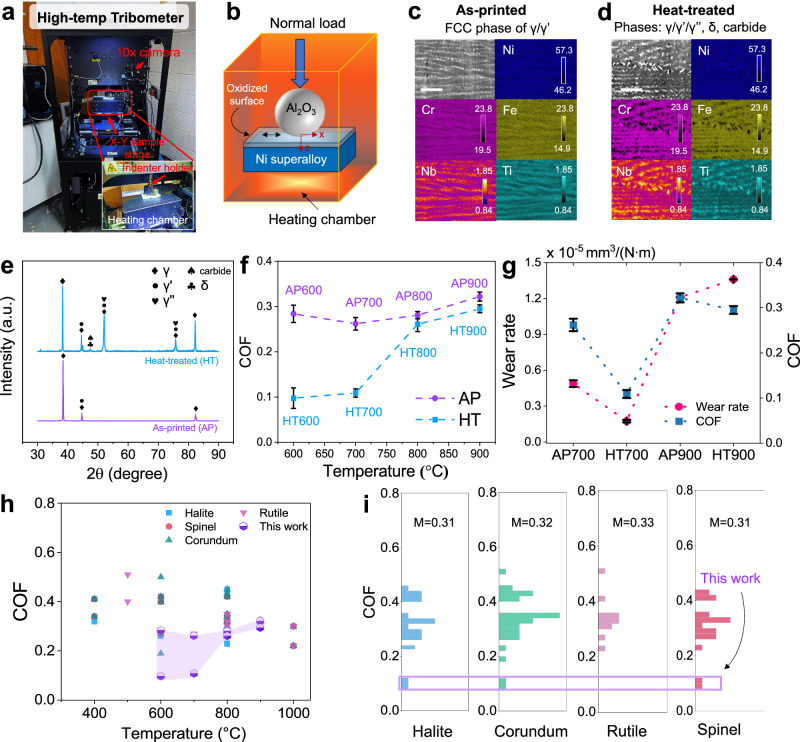
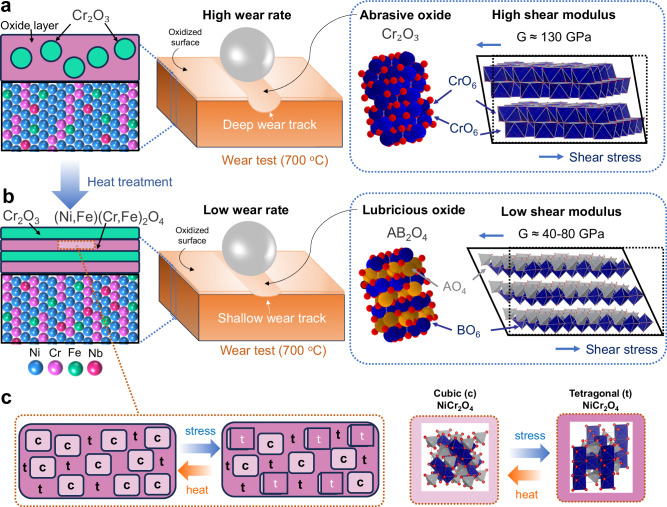
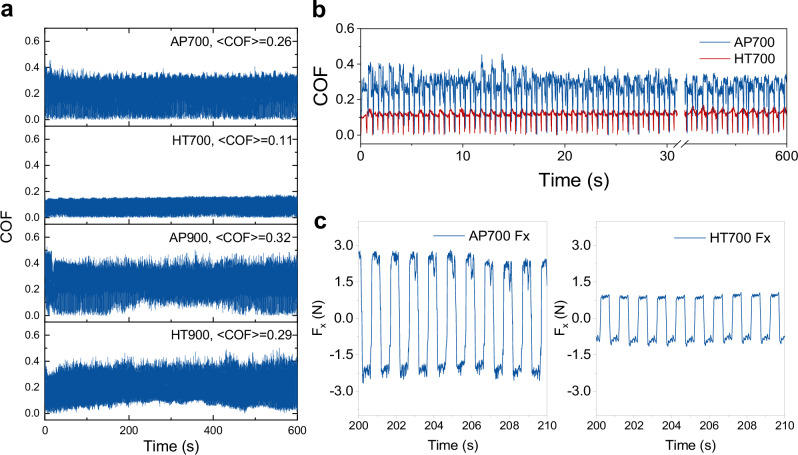
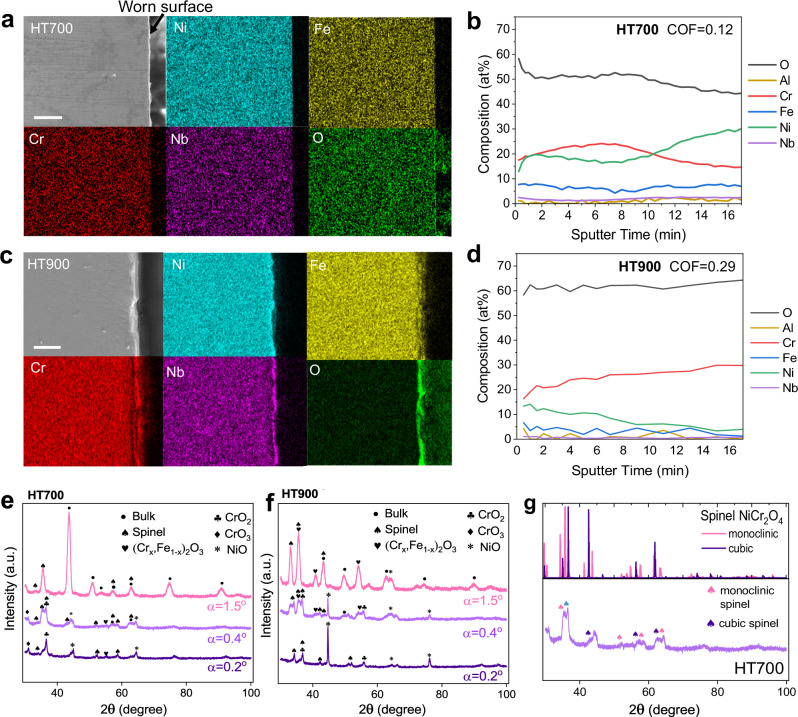
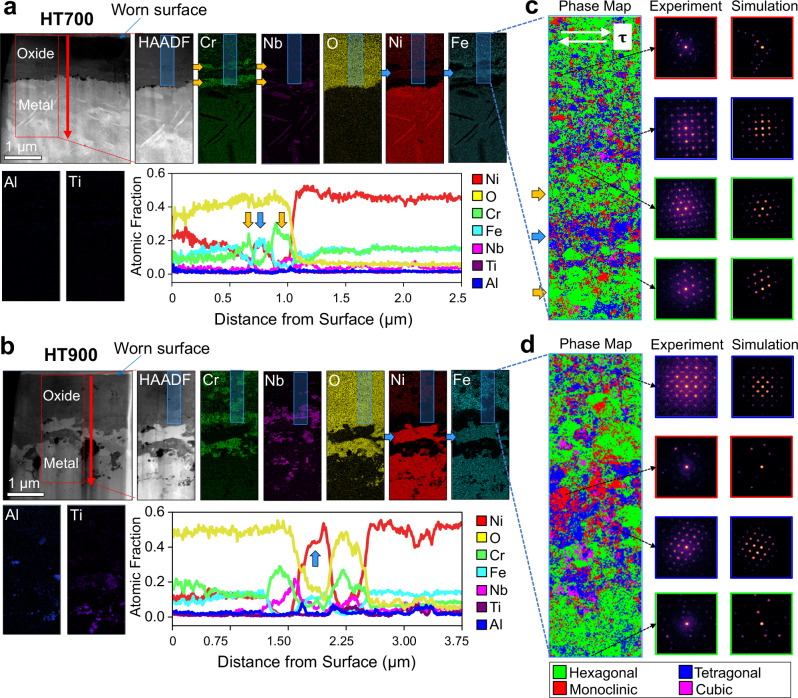
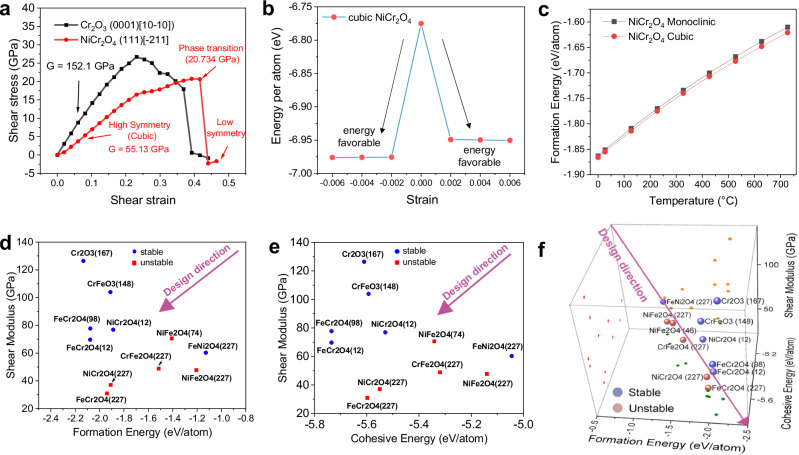
The ability to lubricate and resist wear at temperatures above 600 °C in an oxidative environment remains a significant challenge for metals due to their high-temperature softening, oxidation, and rapid degradation of traditional solid lubricants. Herein, we demonstrate that high-temperature lubricity can be achieved with coefficients of friction (COF) as low as 0.10-0.32 at 600-900 °C by tailoring surface oxidation in additively-manufactured Inconel superalloy. By integrating high-temperature tribological testing, advanced materials characterization, and computations, we show that the formation of spinel-based oxide layers on superalloy promotes sustained self-lubrication due to their lower shear strength and more negative formation and cohesive energy compared to other surface oxides. A reversible phase transformation between the cubic and tetragonal/monoclinic spinel was driven by stress and temperature during high temperature wear. To span Ni- and Cr-based ternary oxide compositional spaces for which little high-temperature COF data exist, we develop a computational design method to predict the lubricity of oxides, incorporating thermodynamics and density functional theory computations. Our finding demonstrates that spinel oxide can exhibit low COF values at temperatures much higher than conventional solid lubricants with 2D layered or Magnéli structures, suggesting a promising design strategy for self-lubricating high-temperature alloys.
在氧化环境中,金属在600°C以上的温度下实现润滑和抗磨损的能力仍然是一项重大挑战,这是由于它们的高温软化、氧化以及传统固体润滑剂的快速降解。在此,我们证明了通过对增材制造的Inconel高温合金中的表面氧化进行调控,在600-900°C时可以实现低至0.10-0.32的摩擦系数(COF),从而实现高温润滑。通过整合高温摩擦学测试、先进的材料表征和计算,我们表明高温合金上基于尖晶石的氧化层的形成促进了持续的自润滑,这是因为与其他表面氧化物相比,它们具有更低的剪切强度以及更负的生成能和内聚能。在高温磨损过程中,立方和四方/单斜尖晶石之间的可逆相变是由应力和温度驱动的。为了涵盖几乎没有高温COF数据的镍基和铬基三元氧化物组成空间,我们开发了一种计算设计方法来预测氧化物的润滑性,该方法结合了热力学和密度泛函理论计算。我们的发现表明,尖晶石氧化物在比具有二维层状或Magnéli结构的传统固体润滑剂高得多的温度下可以表现出低COF值,这为自润滑高温合金提出了一种有前景的设计策略。