Kawata Naoko, Iwao Yuma, Matsuura Yukiko, Higashide Takashi, Okamoto Takayuki, Sekiguchi Yuki, Nagayoshi Masaru, Takiguchi Yasuo, Suzuki Takuji, Haneishi Hideaki
Department of Respirology, Graduate School of Medicine, Chiba University, 1-8-1, Inohana, Chuo-Ku, Chiba-Shi, Chiba, 260-8677, Japan.
Graduate School of Science and Engineering, Chiba University, Chiba, 263-8522, Japan.
Jpn J Radiol. 2025 Apr;43(4):622-633. doi: 10.1007/s11604-024-01699-w. Epub 2024 Nov 25.
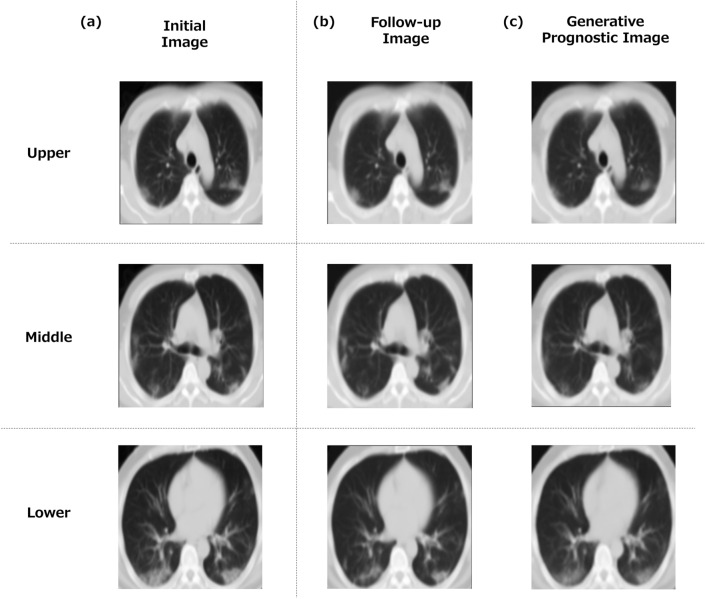
Despite a global decrease in the number of COVID-19 patients, early prediction of the clinical course for optimal patient care remains challenging. Recently, the usefulness of image generation for medical images has been investigated. This study aimed to generate short-term follow-up chest CT images using a latent diffusion model in patients with COVID-19.
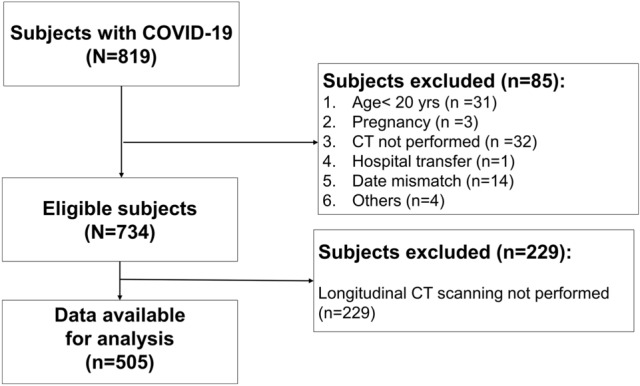
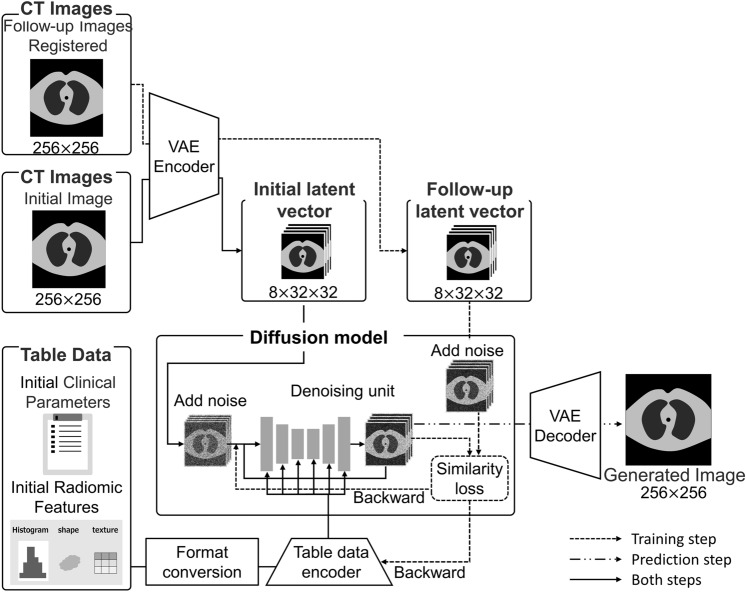
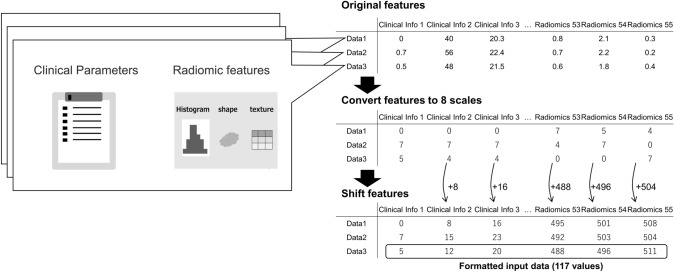
We retrospectively enrolled 505 patients with COVID-19 for whom the clinical parameters (patient background, clinical symptoms, and blood test results) upon admission were available and chest CT imaging was performed. Subject datasets (n = 505) were allocated for training (n = 403), and the remaining (n = 102) were reserved for evaluation. The image underwent variational autoencoder (VAE) encoding, resulting in latent vectors. The information consisting of initial clinical parameters and radiomic features were formatted as a table data encoder. Initial and follow-up latent vectors and the initial table data encoders were utilized for training the diffusion model. The evaluation data were used to generate prognostic images. Then, similarity of the prognostic images (generated images) and the follow-up images (real images) was evaluated by zero-mean normalized cross-correlation (ZNCC), peak signal-to-noise ratio (PSNR), and structural similarity (SSIM). Visual assessment was also performed using a numerical rating scale.
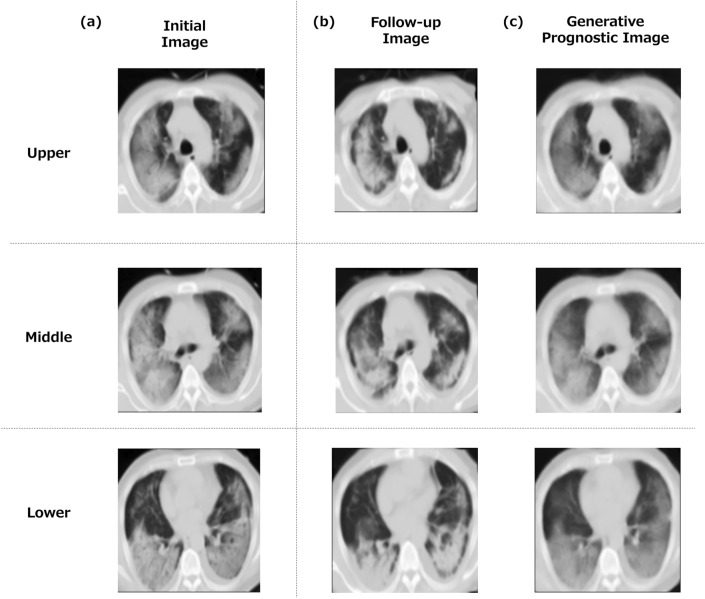
Prognostic chest CT images were generated using the diffusion model. Image similarity showed reasonable values of 0.973 ± 0.028 for the ZNCC, 24.48 ± 3.46 for the PSNR, and 0.844 ± 0.075 for the SSIM. Visual evaluation of the images by two pulmonologists and one radiologist yielded a reasonable mean score.
The similarity and validity of generated predictive images for the course of COVID-19-associated pneumonia using a diffusion model were reasonable. The generation of prognostic images may suggest potential utility for early prediction of the clinical course in COVID-19-associated pneumonia and other respiratory diseases.
尽管全球新冠肺炎患者数量有所下降,但为实现最佳患者护理而对临床病程进行早期预测仍具有挑战性。最近,已对医学图像的图像生成的实用性展开研究。本研究旨在使用潜在扩散模型生成新冠肺炎患者的短期随访胸部CT图像。
我们回顾性纳入了505例新冠肺炎患者,这些患者入院时的临床参数(患者背景、临床症状和血液检测结果)可用且已进行胸部CT成像。将受试者数据集(n = 505)分配用于训练(n = 403),其余(n = 102)保留用于评估。图像经过变分自编码器(VAE)编码,得到潜在向量。由初始临床参数和放射组学特征组成的信息被格式化为表格数据编码器。初始和随访潜在向量以及初始表格数据编码器用于训练扩散模型。评估数据用于生成预后图像。然后,通过零均值归一化互相关(ZNCC)、峰值信噪比(PSNR)和结构相似性(SSIM)评估预后图像(生成图像)与随访图像(真实图像)的相似性。还使用数字评分量表进行视觉评估。
使用扩散模型生成了预后胸部CT图像。图像相似性在ZNCC方面显示出合理值0.973±0.028,在PSNR方面为24.48±3.46,在SSIM方面为0.844±0.075。两位肺科医生和一位放射科医生对图像的视觉评估得出了合理的平均分。
使用扩散模型生成的新冠肺炎相关肺炎病程预测图像的相似性和有效性是合理的。预后图像的生成可能提示其在新冠肺炎相关肺炎及其他呼吸道疾病临床病程早期预测中的潜在用途。