Kang Kaidi, Seidlitz Jakob, Bethlehem Richard A I, Xiong Jiangmei, Jones Megan T, Mehta Kahini, Keller Arielle S, Tao Ran, Randolph Anita, Larsen Bart, Tervo-Clemmens Brenden, Feczko Eric, Dominguez Oscar Miranda, Nelson Steven M, Schildcrout Jonathan, Fair Damien A, Satterthwaite Theodore D, Alexander-Bloch Aaron, Vandekar Simon
Department of Biostatistics, Vanderbilt University Medical Center, Nashville, TN, USA.
Department of Child and Adolescent Psychiatry and Behavioral Sciences, The Children's Hospital of Philadelphia, Philadelphia, PA, USA.
Nature. 2024 Dec;636(8043):719-727. doi: 10.1038/s41586-024-08260-9. Epub 2024 Nov 27.
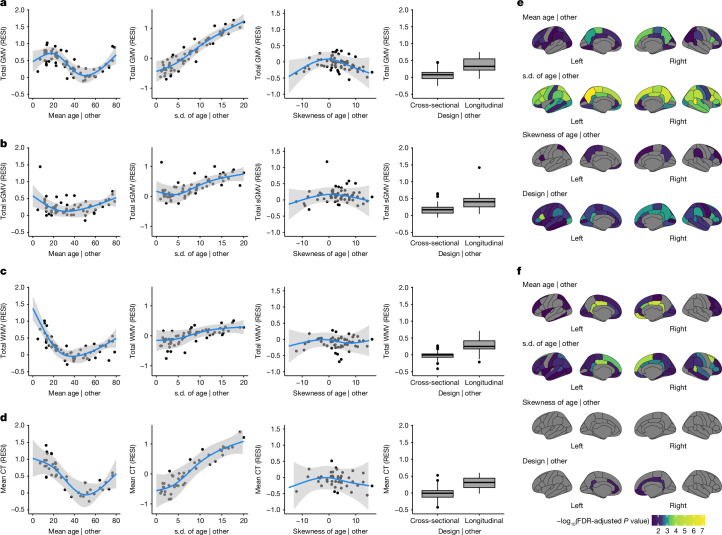
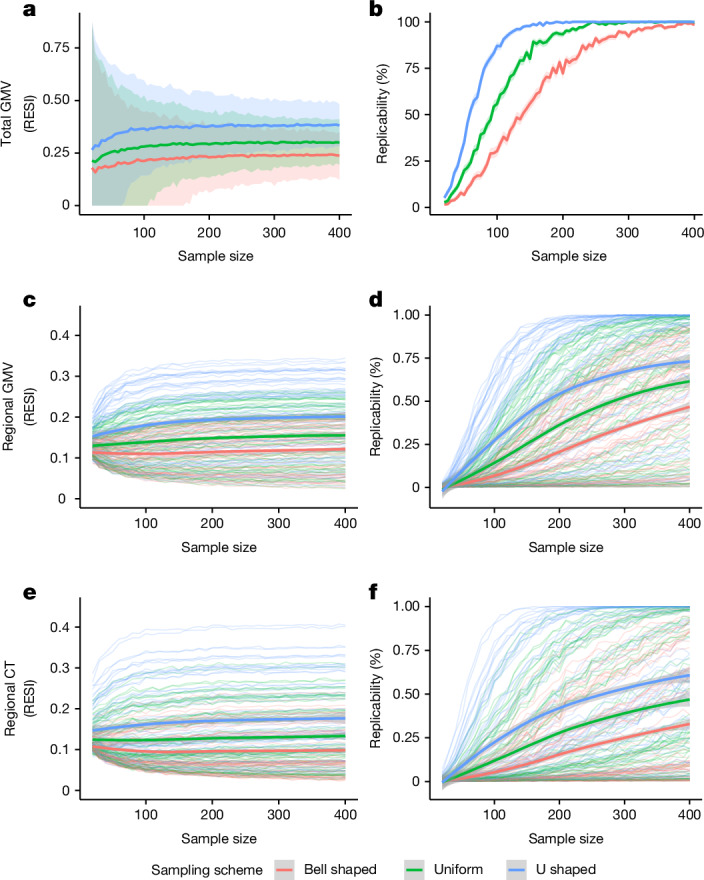
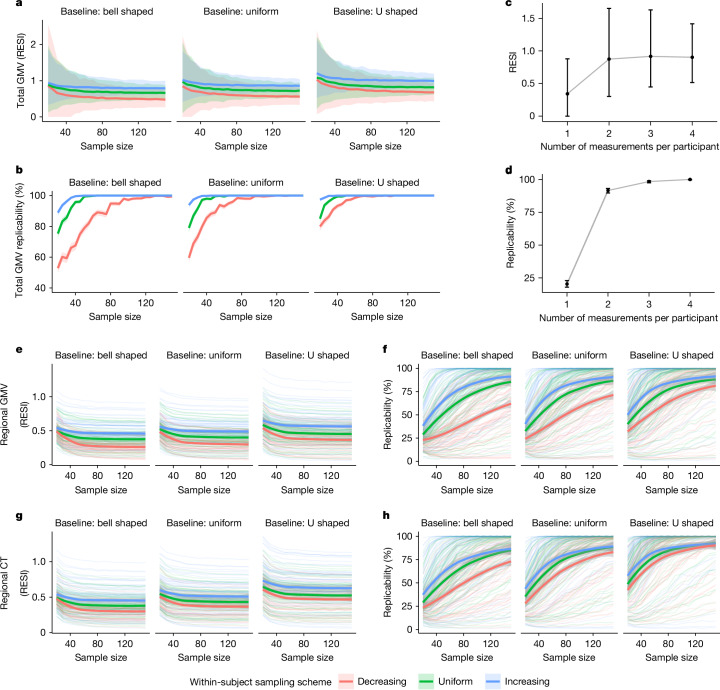
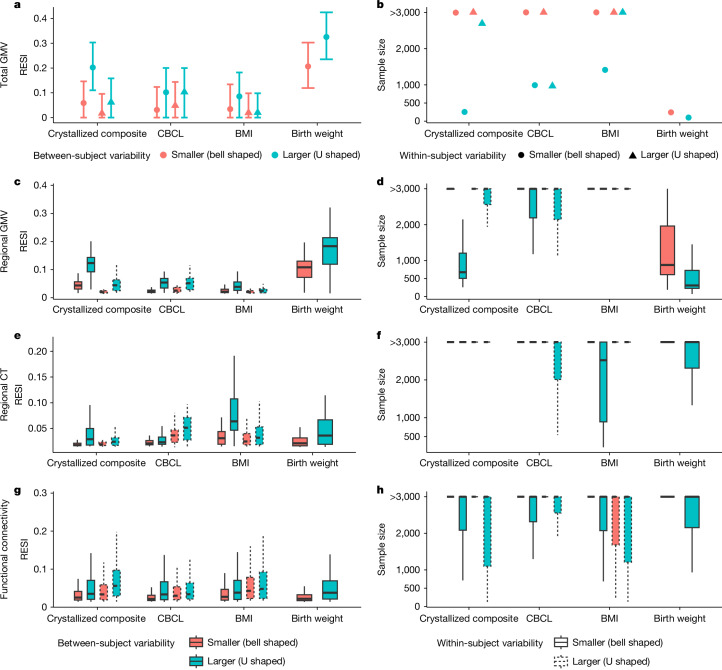
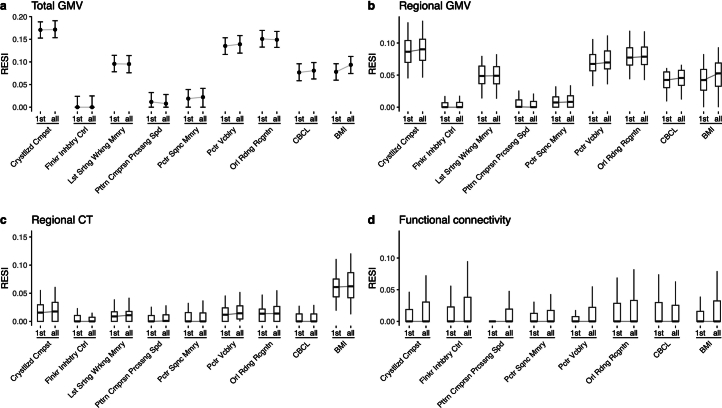
Brain-wide association studies (BWAS) are a fundamental tool in discovering brain-behaviour associations. Several recent studies have shown that thousands of study participants are required for good replicability of BWAS. Here we performed analyses and meta-analyses of a robust effect size index using 63 longitudinal and cross-sectional MRI studies from the Lifespan Brain Chart Consortium (77,695 total scans) to demonstrate that optimizing study design is critical for increasing standardized effect sizes and replicability in BWAS. A meta-analysis of brain volume associations with age indicates that BWAS with larger variability of the covariate and longitudinal studies have larger reported standardized effect size. Analysing age effects on global and regional brain measures from the UK Biobank and the Alzheimer's Disease Neuroimaging Initiative, we showed that modifying study design through sampling schemes improves standardized effect sizes and replicability. To ensure that our results are generalizable, we further evaluated the longitudinal sampling schemes on cognitive, psychopathology and demographic associations with structural and functional brain outcome measures in the Adolescent Brain and Cognitive Development dataset. We demonstrated that commonly used longitudinal models, which assume equal between-subject and within-subject changes can, counterintuitively, reduce standardized effect sizes and replicability. Explicitly modelling the between-subject and within-subject effects avoids conflating them and enables optimizing the standardized effect sizes for each separately. Together, these results provide guidance for study designs that improve the replicability of BWAS.
全脑关联研究(BWAS)是发现脑与行为关联的一项基础工具。最近的几项研究表明,为实现BWAS良好的可重复性,需要数千名研究参与者。在此,我们使用来自寿命期脑图谱联盟的63项纵向和横断面MRI研究(共77695次扫描),对一个稳健的效应量指数进行了分析和荟萃分析,以证明优化研究设计对于提高BWAS中标准化效应量和可重复性至关重要。一项关于脑容量与年龄关联的荟萃分析表明,协变量变异性较大的BWAS以及纵向研究报告的标准化效应量更大。通过分析英国生物银行和阿尔茨海默病神经影像倡议中年龄对全脑和区域脑测量指标的影响,我们发现通过抽样方案调整研究设计可提高标准化效应量和可重复性。为确保我们的结果具有普遍性,我们在青少年脑与认知发展数据集中,进一步评估了纵向抽样方案与认知、精神病理学以及人口统计学与脑结构和功能结局指标的关联。我们证明,通常使用的纵向模型,即假设个体间和个体内变化相等,可能会与直觉相反地降低标准化效应量和可重复性。明确地对个体间和个体内效应进行建模可避免将它们混淆,并能够分别为每个效应优化标准化效应量。总之,这些结果为提高BWAS可重复性的研究设计提供了指导。