Shen Peng, Qiu Yue, Sun Yan-Yan, Jiang Yue-Ying, Guan Xiu-Mei, Cheng Min, Wang Yan-Xia
School of Rehabilitation Medicine, Shandong Second Medical University, 261053 Weifang, Shandong, China.
School of Basic Medical Sciences, Shandong Second Medical University, 261053 Weifang, Shandong, China.
Rev Cardiovasc Med. 2024 Nov 4;25(11):392. doi: 10.31083/j.rcm2511392. eCollection 2024 Nov.
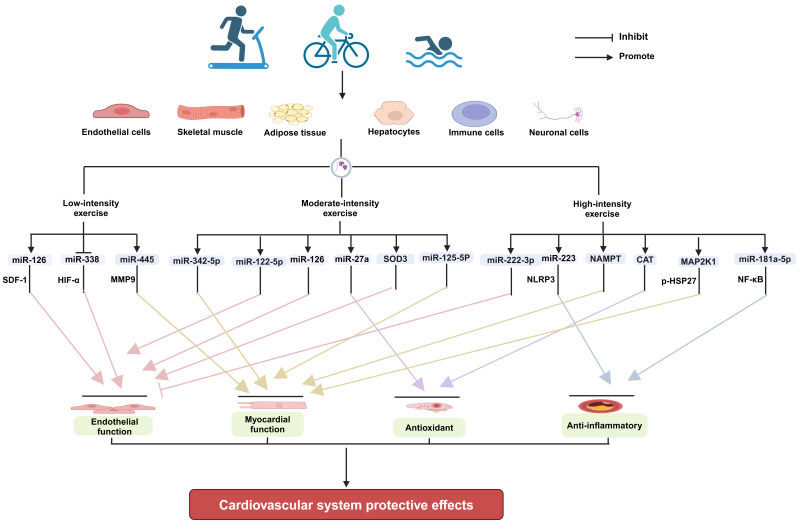
Extracellular vesicles (EVs) are nanoscale vesicles released by cells, which play an important role in intercellular communication by transporting proteins, lipids, nucleic acids, and other molecules. Different intensities of exercise can induce the release of EVs from cells and tissues, such as endothelial cells, skeletal muscle and adipose tissue, hepatocytes, immune cells, and neuronal cells. Exercise-induced EVs exert cardiovascular protective effects such as anti-inflammatory and anti-oxidative by altering their contents. This paper reviews the cell and tissue sources of EVs induced by exercise of different intensities, the regulatory effects of different exercise intensities on EVs, and their mechanisms of action in cardiovascular diseases. The aim is to provide new insights for the treatment of cardiovascular diseases and offer scientific evidence for the construction of engineered EVs mimicking the effects of exercise.
细胞外囊泡(EVs)是细胞释放的纳米级囊泡,通过运输蛋白质、脂质、核酸和其他分子在细胞间通讯中发挥重要作用。不同强度的运动可诱导内皮细胞、骨骼肌和脂肪组织、肝细胞、免疫细胞和神经元细胞等细胞和组织释放EVs。运动诱导的EVs通过改变其内容物发挥抗炎和抗氧化等心血管保护作用。本文综述了不同强度运动诱导的EVs的细胞和组织来源、不同运动强度对EVs的调节作用及其在心血管疾病中的作用机制。目的是为心血管疾病的治疗提供新的见解,并为构建模拟运动效果的工程化EVs提供科学依据。