Hu Haidai, Popp Philipp F, Hughes Thomas C D, Roa-Eguiara Aritz, Rutbeek Nicole R, Martin Freddie J O, Hendriks Ivo Alexander, Payne Leighton J, Yan Yumeng, Humolli Dorentina, Klein-Sousa Victor, Songailiene Inga, Wang Yong, Nielsen Michael Lund, Berry Richard M, Harms Alexander, Erhardt Marc, Jackson Simon A, Taylor Nicholas M I
Structural Biology of Molecular Machines Group, Protein Structure & Function Program, Novo Nordisk Foundation Center for Protein Research, Faculty of Health and Medical Sciences, University of Copenhagen, Copenhagen, Denmark.
Institute of Biology/Molecular Microbiology, Humboldt-Universität zu Berlin, Berlin, Germany.
Nature. 2025 Mar;639(8056):1093-1101. doi: 10.1038/s41586-024-08493-8. Epub 2024 Dec 11.
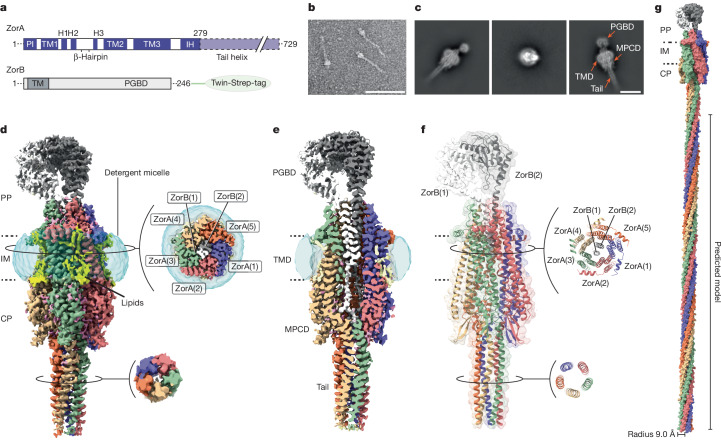
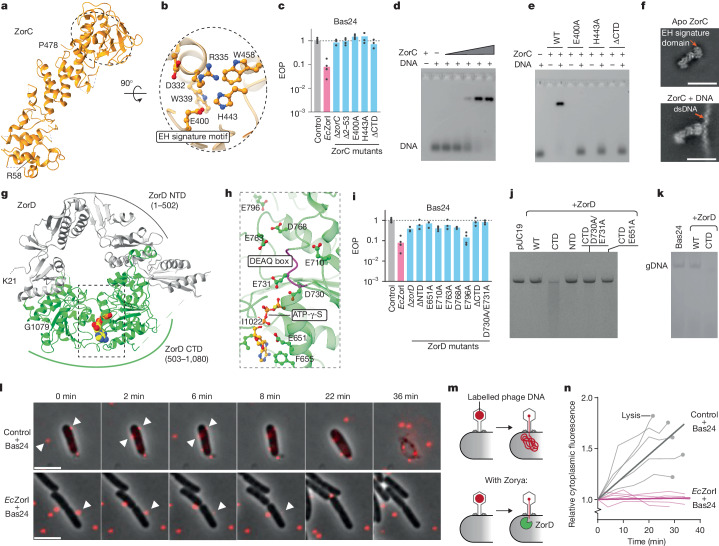
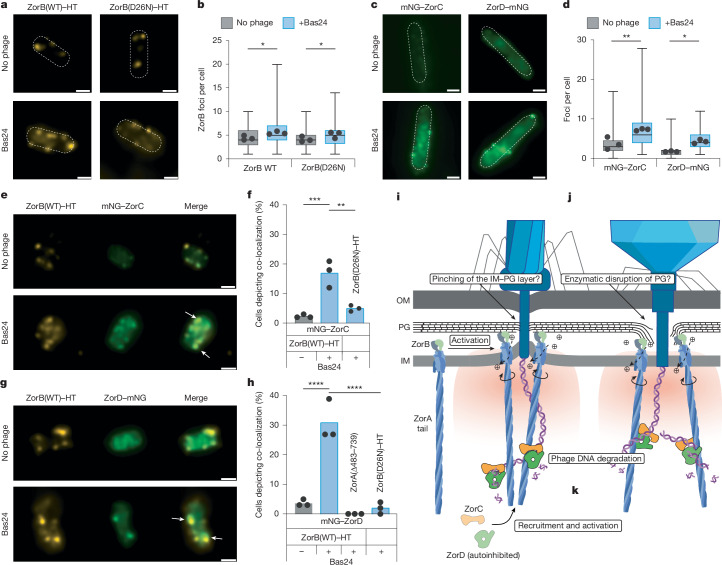
Zorya is a recently identified and widely distributed bacterial immune system that protects bacteria from viral (phage) infections. Three Zorya subtypes have been identified, each containing predicted membrane-embedded ZorA-ZorB (ZorAB) complexes paired with soluble subunits that differ among Zorya subtypes, notably ZorC and ZorD in type I Zorya systems. Here we investigate the molecular basis of Zorya defence using cryo-electron microscopy, mutagenesis, fluorescence microscopy, proteomics and functional studies. We present cryo-electron microscopy structures of ZorAB and show that it shares stoichiometry and features of other 5:2 inner membrane ion-driven rotary motors. The ZorAB complex contains a dimeric ZorB peptidoglycan-binding domain and a pentameric α-helical coiled-coil tail made of ZorA that projects approximately 70 nm into the cytoplasm. We also characterize the structure and function of the soluble Zorya components ZorC and ZorD, finding that they have DNA-binding and nuclease activity, respectively. Comprehensive functional and mutational analyses demonstrate that all Zorya components work in concert to protect bacterial cells against invading phages. We provide evidence that ZorAB operates as a proton-driven motor that becomes activated after sensing of phage invasion. Subsequently, ZorAB transfers the phage invasion signal through the ZorA cytoplasmic tail to recruit and activate the soluble ZorC and ZorD effectors, which facilitate the degradation of the phage DNA. In summary, our study elucidates the foundational mechanisms of Zorya function as an anti-phage defence system.
佐里亚是一种最近被发现且广泛分布的细菌免疫系统,可保护细菌免受病毒(噬菌体)感染。已鉴定出三种佐里亚亚型,每种亚型都包含预测的膜嵌入型佐拉 - 佐尔布(佐尔AB)复合物,该复合物与可溶性亚基配对,这些可溶性亚基在佐里亚亚型之间存在差异,特别是I型佐里亚系统中的佐尔C和佐尔D。在这里,我们使用冷冻电子显微镜、诱变、荧光显微镜、蛋白质组学和功能研究来探究佐里亚防御的分子基础。我们展示了佐尔AB的冷冻电子显微镜结构,并表明它具有与其他5:2内膜离子驱动旋转马达相同的化学计量和特征。佐尔AB复合物包含一个二聚体佐尔B肽聚糖结合结构域和一个由佐拉组成的五聚体α - 螺旋卷曲螺旋尾部,该尾部向细胞质中伸出约70纳米。我们还对可溶性佐里亚成分佐尔C和佐尔D的结构和功能进行了表征,发现它们分别具有DNA结合和核酸酶活性。全面的功能和突变分析表明,所有佐里亚成分协同工作以保护细菌细胞免受入侵噬菌体的侵害。我们提供的证据表明,佐尔AB作为质子驱动的马达,在感知到噬菌体入侵后被激活。随后,佐尔AB通过佐拉细胞质尾部传递噬菌体入侵信号,以招募和激活可溶性佐尔C和佐尔D效应器,这些效应器促进噬菌体DNA的降解。总之,我们的研究阐明了佐里亚作为抗噬菌体防御系统发挥功能的基本机制。