Apurba I K Gusral Ghosh, Islam Md Rasidul, Rahman Md Shizer, Rahman Md Ferdous, Park Jeongwon
Department of Electrical and Electronic Engineering, Bangamata Sheikh Fojilatunnesa Mujib Science & Technology University, Jamalpur, 2012, Bangladesh.
Department of Electrical and Electronic Engineering, Begum Rokeya University, Rangpur, 5400, Bangladesh.
Heliyon. 2024 Apr 3;10(7):e29144. doi: 10.1016/j.heliyon.2024.e29144. eCollection 2024 Apr 15.
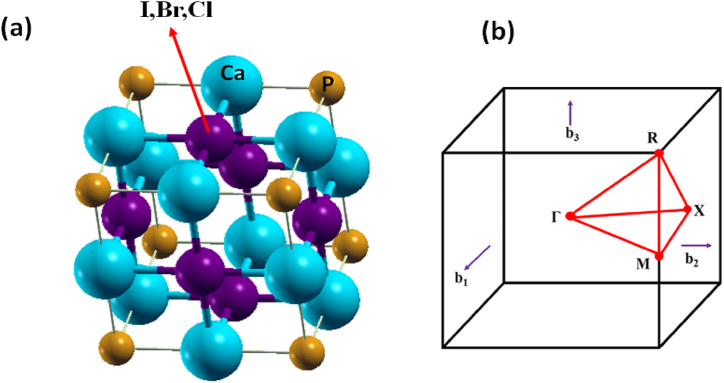
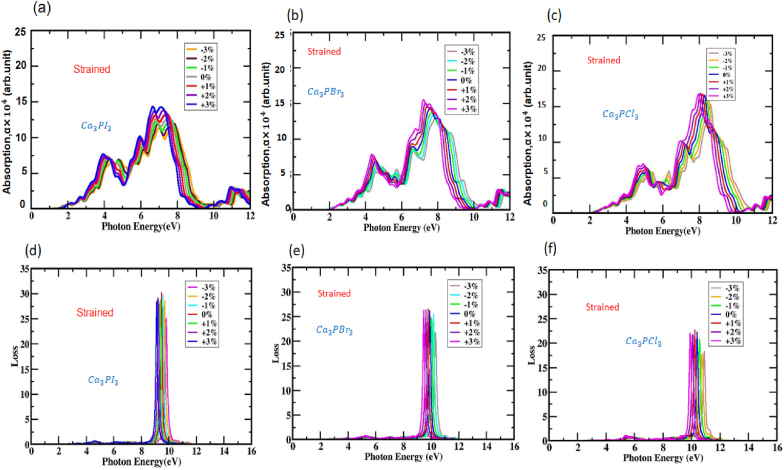
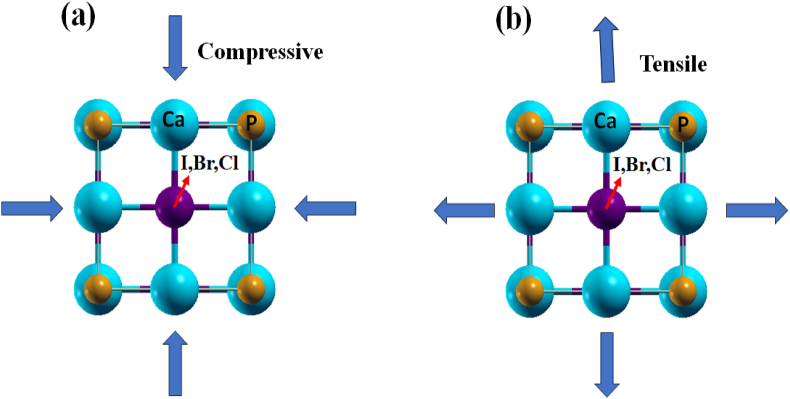
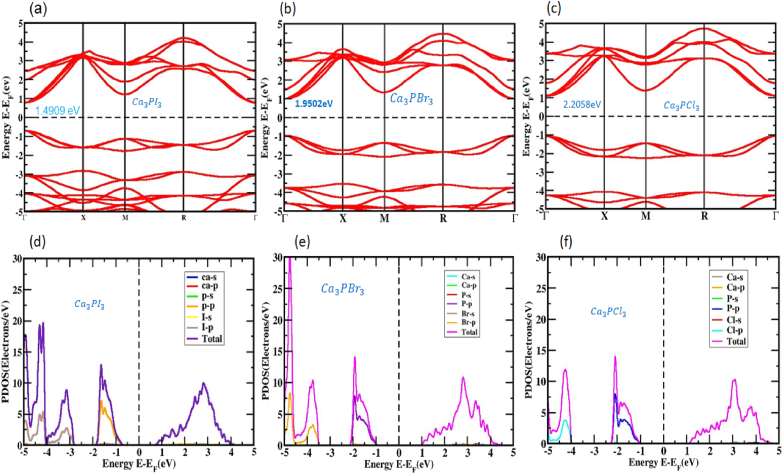
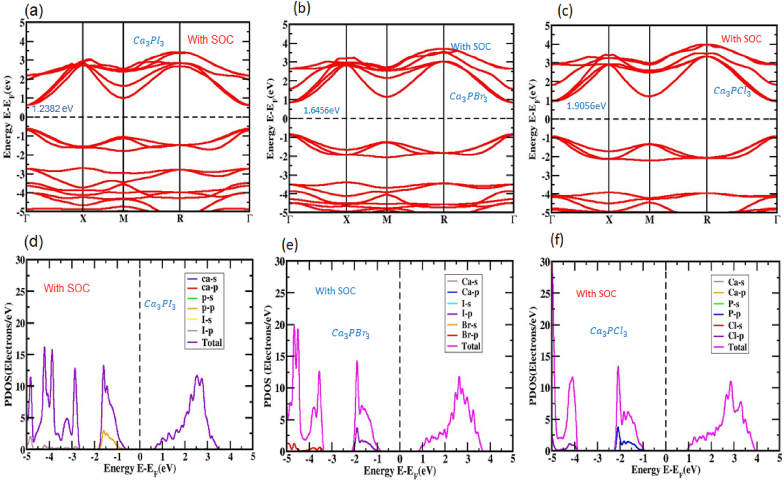
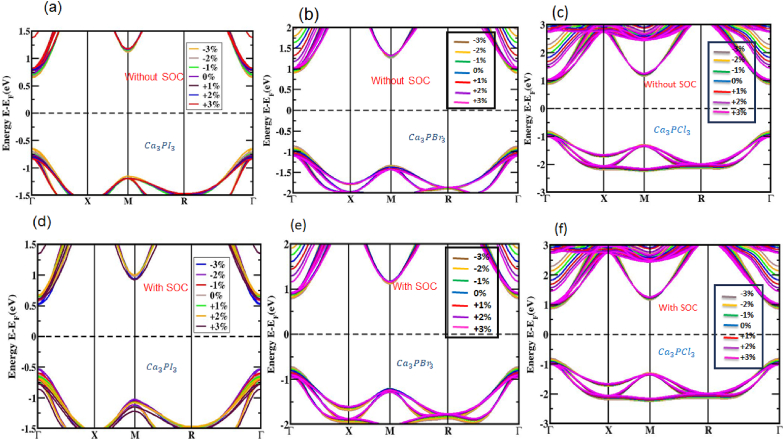
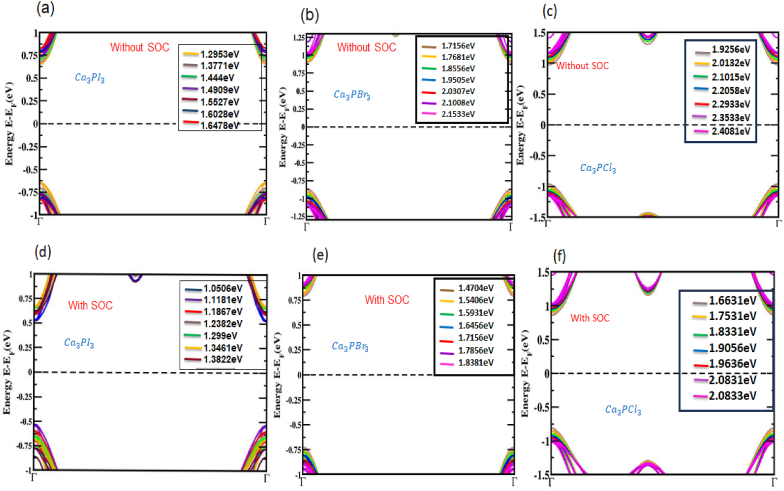
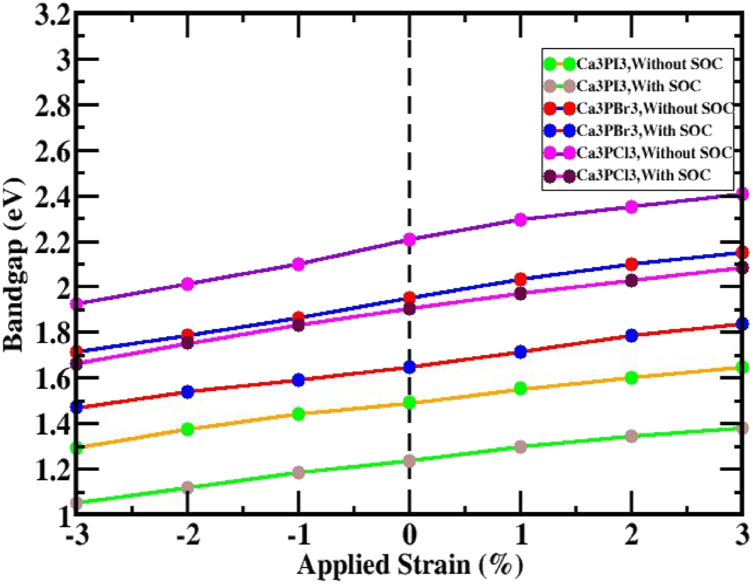
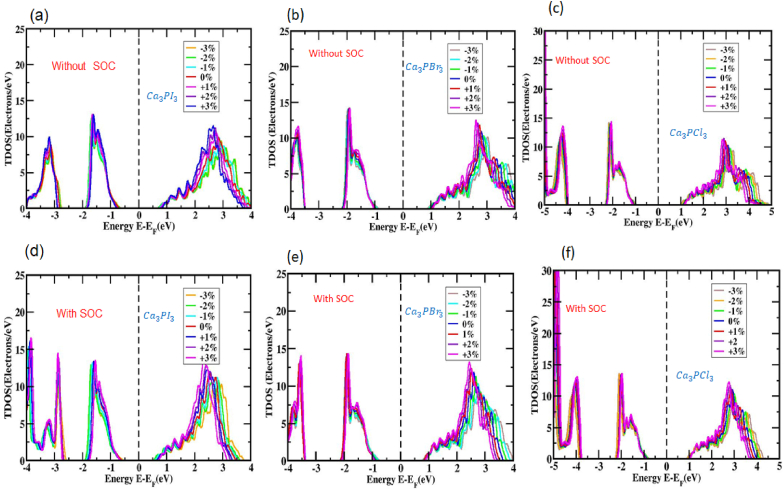
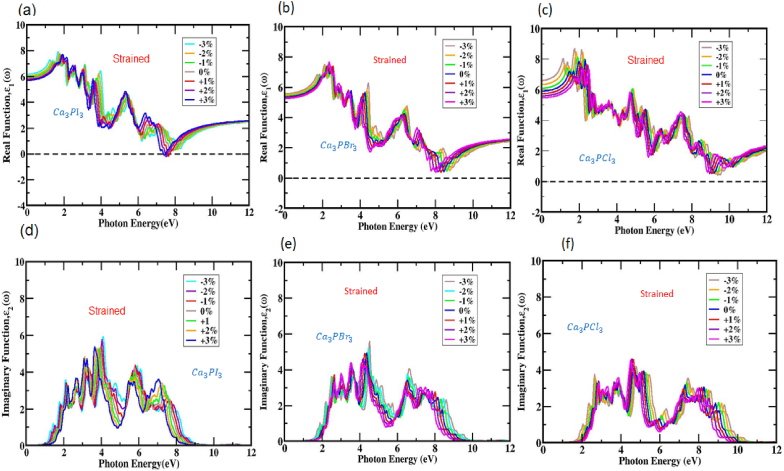
In photovoltaic technology, inorganic perovskite solar cells formed from halide have developed into a noteworthy prospect, primarily attributable to their exceptional efficiency, cost-effectiveness, and straightforward manufacturing techniques. Lead-free ABX inorganic perovskites have generated significant attention within the environmentally friendly solar industry thanks to their extraordinary characteristics encompassing thermoelectricity, optoelectronics, and elasticity. This research focuses on the attributes of the structural, electrical, and optical inorganic halide perovskites CaPX (X = I, Br, and Cl) using the first-principles density-functional theory (FP-DFT). According to the electronic band structures, CaPI, CaPBr and CaPCl show semiconductor characteristics with a straight bandgap of 1.4909 eV, 1.9502 eV, and 2.2058 eV, respectively, at the Γ(gamma)-point. Whenever one takes consideration into account the spin-orbital coupling (SOC) effect, the bandgap of the CaPI, CaPBr and CaPCl perovskites is minimized to 1.2382 eV, 1.6456 eV, and 1.9056 eV. All these structures' bandgaps are compressed under compressive strain while they expand with tensile strain. The optical properties indicate that these materials have outstanding visible light consumption capabilities due to their distinct band features, comprising functions of dielectric, consumption coefficient, and function of electron collapse. Observations indicate that the dielectric constant peaks of CaPX (where X represents I, Br, or Cl) exhibit a redshift, moving towards lower photon energy levels as compressive strain increases. Conversely, they show a blueshift behavior, shifting to a greater amount of photon energy levels by applying tensile strain. Therefore, these characteristics render CaPX perovskites highly suitable for optimizing light guidance for solar power and energy retention tools.
在光伏技术领域,由卤化物构成的无机钙钛矿太阳能电池已展现出显著的发展前景,这主要得益于其卓越的效率、成本效益以及简便的制造工艺。无铅ABX无机钙钛矿凭借其在热电、光电和弹性等方面的非凡特性,在环保太阳能产业中备受关注。本研究运用第一性原理密度泛函理论(FP-DFT),聚焦于无机卤化物钙钛矿CaPX(X = I、Br和Cl)的结构、电学和光学属性。根据电子能带结构,CaPI、CaPBr和CaPCl在Γ(伽马)点分别呈现出半导体特性,其直接带隙分别为1.4909 eV、1.9502 eV和2.2058 eV。当考虑自旋轨道耦合(SOC)效应时,CaPI、CaPBr和CaPCl钙钛矿的带隙分别减小至1.2382 eV、1.6456 eV和1.9056 eV。所有这些结构的带隙在压缩应变下会减小,而在拉伸应变下会增大。光学性质表明,由于其独特的能带特征,包括介电函数、吸收系数和电子跃迁函数,这些材料具有出色的可见光吸收能力。观察结果表明,CaPX(其中X代表I、Br或Cl)的介电常数峰值呈现红移现象,即随着压缩应变的增加,向更低的光子能量水平移动。相反,通过施加拉伸应变,它们会表现出蓝移行为,向更高的光子能量水平移动。因此,这些特性使CaPX钙钛矿非常适合用于优化太阳能和能量存储工具的光导。