Ramírez-Gallegos Ignacio, Marina-Arroyo Marta, López-González Ángel Arturo, Vallejos Daniela, Martínez-Almoyna-Rifá Emilio, Tárraga López Pedro Juan, Ramírez-Manent José Ignacio
ADEMA-Health Group University Institute of Health Sciences Research (IUNICS), 07009 Palma, Balearic Islands, Spain.
Faculty of Dentistry, University School ADEMA, 07009 Palma, Balearic Islands, Spain.
Nutrients. 2024 Dec 5;16(23):4207. doi: 10.3390/nu16234207.
Metabolic age is defined as an estimation of a person's age based on their basal metabolic rate (BMR) and other physiological health indicators. Unlike chronological age, which simply measures the number of years lived since birth, metabolic age is based on various health and fitness markers that estimate the body's "true" biological age and can be assessed using various methodologies, including bioimpedance. The aim of this study was to evaluate how age, sex, social class, smoking habits, physical activity, and adherence to the Mediterranean diet influence metabolic age.
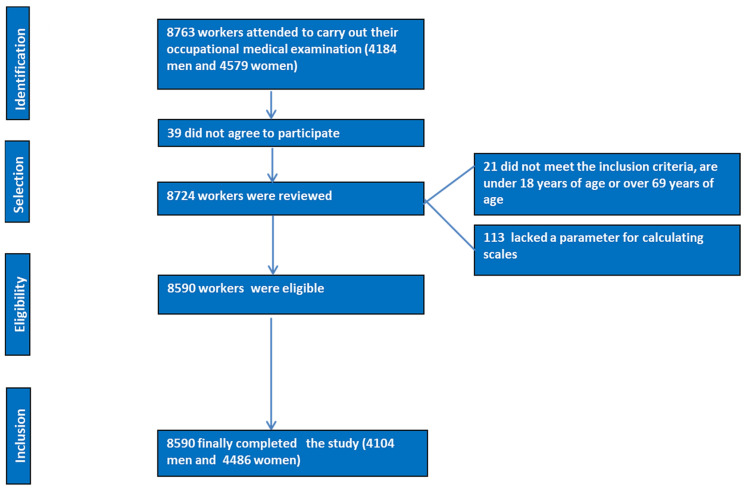
A cross-sectional, descriptive study was conducted on 8590 Spanish workers in the Balearic Islands. A series of sociodemographic variables and health-related habits were assessed, while metabolic age was measured using bioimpedance. A metabolic age exceeding chronological age by 12 years or more was considered high. A descriptive analysis of categorical variables was performed by calculating their frequency and distribution. By applying multivariate models, specifically multinomial logistic regression, we observe that all independent variables (sex, age, social class, physical activity, mediterranean diet, and smoking) show varying levels of association with the occurrence of high metabolic age values. Among these independent variables, those showing the highest degree of association, represented by odds ratios, are physical activity, adherence to the Mediterranean diet, and social class. In all cases, the observed differences demonstrate a high level of statistical significance ( < 0.001).
The factors with the greatest influence were physical inactivity, with an OR of 5.07; and low adherence to the Mediterranean diet, with an OR of 2.8; followed by social class, with an OR of 2.51. Metabolic age increased with chronological age and was higher in males, with an OR of 1.38. Smoking also had a negative impact on metabolic age, with an OR of 1.19.
Mediterranean diet is associated with a higher metabolic age. The most influential factors on metabolic age are physical activity and adherence to the Mediterranean diet, followed by the individual's socioeconomic class. Smoking also contributes to increased metabolic age, albeit to a lesser extent.
代谢年龄被定义为基于一个人的基础代谢率(BMR)和其他生理健康指标对其年龄的一种估计。与仅仅衡量自出生以来所活年份的实足年龄不同,代谢年龄基于各种健康和健身指标,这些指标估计身体的“真实”生物学年龄,并且可以使用包括生物电阻抗在内的各种方法进行评估。本研究的目的是评估年龄、性别、社会阶层、吸烟习惯、身体活动以及对地中海饮食的依从性如何影响代谢年龄。
对巴利阿里群岛的8590名西班牙工人进行了一项横断面描述性研究。评估了一系列社会人口统计学变量和与健康相关的习惯,同时使用生物电阻抗测量代谢年龄。代谢年龄超过实足年龄12岁或更多被认为是高代谢年龄。通过计算分类变量的频率和分布对其进行描述性分析。通过应用多变量模型,特别是多项逻辑回归,我们观察到所有自变量(性别、年龄、社会阶层、身体活动、地中海饮食和吸烟)与高代谢年龄值的发生呈现出不同程度的关联。在这些自变量中,以比值比表示显示出最高关联度的是身体活动、对地中海饮食的依从性和社会阶层。在所有情况下,观察到的差异都显示出高度的统计学显著性(<0.001)。
影响最大的因素是身体不活动,比值比为5.07;对地中海饮食的依从性低,比值比为2.8;其次是社会阶层,比值比为2.51。代谢年龄随实足年龄增加,男性的代谢年龄更高,比值比为1.38。吸烟也对代谢年龄有负面影响,比值比为1.19。
地中海饮食与较高的代谢年龄相关。对代谢年龄影响最大的因素是身体活动和对地中海饮食的依从性,其次是个人的社会经济阶层。吸烟也会导致代谢年龄增加,尽管程度较小。