Sasak Krzysztof, Nowak Michał, Wlodarczyk Anna, Sarniak Agata, Nowak Dariusz
Department of Medical Imaging Techniques, Medical University of Lodz, Lindleya 6, 90-131 Lodz, Poland.
Radiation Protection, University Hospital No 2, Medical University of Lodz, Zeromskiego 113, 90-549 Lodz, Poland.
Molecules. 2024 Nov 28;29(23):5635. doi: 10.3390/molecules29235635.
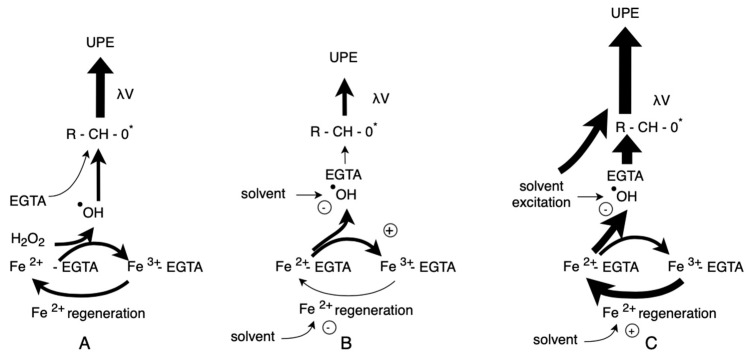
Numerous compounds that are scavengers of hydroxyl radicals (•OH) in Fenton systems have low solubility in water. Therefore, they are dissolved in organic solvents to reach suitable concentrations in the reaction milieu of the Fenton system. However, these solvents may react with •OH and iron, leading to significant errors in the results. We evaluated 11 solvents (4 alcohols, acetone, 4 esters, dimethyl-sulfoxide, and acetonitrile) at concentrations ranging from 0.105 µmol/L to 0.42 µmol/L to assess their effects on light emission, a recognized measure of •OH radical activity, in the Fe-EGTA-HO system. Six solvents inhibited and four solvents enhanced light emission at all tested concentrations. Acetonitrile, which initially suppressed light emission, lost this effect at a concentration of 0.105 µmol/L, (-1 ± 13 (2; 0) %, > 0.05). Methanol, at the lowest tested concentration, inhibited light emission by 62 ± 4% ( < 0.05), while butyl butyrate enhanced it by 93 ± 16% ( < 0.05). These effects may be explained by solvent-driven •OH-scavenging, inhibition or acceleration of Fe2+ regeneration, or photon emission from excited solvent molecules. Our findings suggest that acetonitrile seems suitable for preparing stock solutions to evaluate antioxidant activity in the Fe-EGTA-HO system, provided that the final concentration of this solvent in the reaction milieu is kept below 0.105 µmol/L.
在芬顿体系中,许多作为羟基自由基(•OH)清除剂的化合物在水中溶解度很低。因此,它们被溶解于有机溶剂中,以便在芬顿体系的反应环境中达到合适的浓度。然而,这些溶剂可能会与•OH和铁发生反应,导致结果出现重大误差。我们评估了11种浓度范围为0.105 µmol/L至0.42 µmol/L的溶剂(4种醇类、丙酮、4种酯类、二甲基亚砜和乙腈),以评估它们对Fe-EGTA-H₂O体系中发光的影响,发光是一种公认的•OH自由基活性的测量方法。在所有测试浓度下,6种溶剂抑制发光,4种溶剂增强发光。乙腈最初抑制发光,但在浓度为0.105 µmol/L时失去了这种作用,(-1 ± 13 (2; 0) %,P > 0.05)。甲醇在最低测试浓度下抑制发光62 ± 4%(P < 0.05),而丁酸丁酯则增强发光93 ± 16%(P < 0.05)。这些影响可能是由溶剂驱动的•OH清除、Fe²⁺再生的抑制或加速,或激发态溶剂分子的光子发射来解释。我们的研究结果表明,乙腈似乎适合用于配制储备溶液,以评估Fe-EGTA-H₂O体系中的抗氧化活性,前提是该溶剂在反应环境中的最终浓度保持在0.105 µmol/L以下。