Rocha José Pedro, Freitas Maria, Geraldo Dulce, Bento Fátima, Delerue-Matos Cristina, Nouws Henri P A
REQUIMTE/LAQV, Instituto Superior de Engenharia do Porto, Instituto Politécnico do Porto, Rua Dr. António Bernardino de Almeida 431, 4249-015 Porto, Portugal.
Centro de Química, Campus de Gualtar, Universidade do Minho, 4710-057 Braga, Portugal.
Biosensors (Basel). 2024 Dec 23;14(12):639. doi: 10.3390/bios14120639.
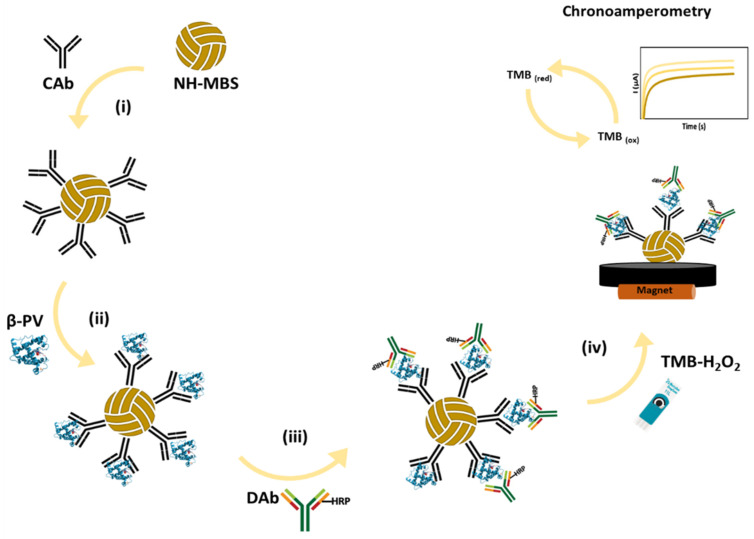
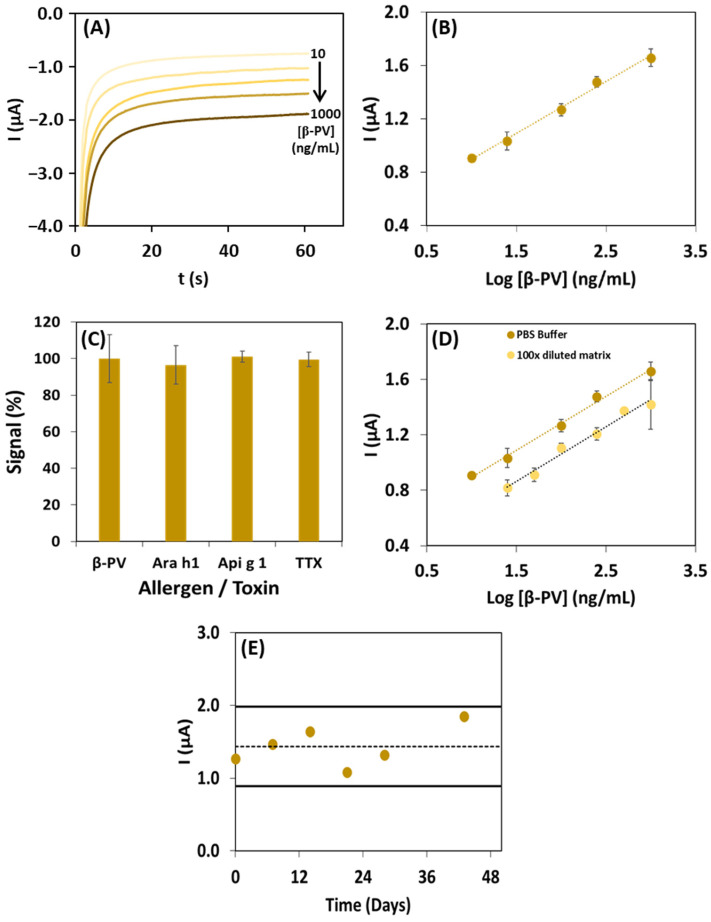
β-parvalbumin (β-PV) is the primary fish allergen responsible for most allergic reactions in individuals sensitive to fish. To ensure food safety, a sandwich-based magnetic immunoassay was developed using maleimide-functionalized magnetic beads (NH-MBs). Specific anti-β-PV antibodies were immobilized on these MBs, and a screen-printed carbon electrode was employed as the electrochemical transducer. A linear concentration range from 10 to 1000 ng/mL, a limit of detection of 1.8 ng/mL, and a limit of quantification of 7.1 ng/mL were achieved. Nineteen commercial food samples were analyzed to assess the potential of the sensor for routine use in food quality control. Important factors such as protein source and food processing (e.g., boiling, grilling, and frying) and preservation (e.g., in oil, and vacuum) were evaluated. The validated results confer the usefulness of the assay for food quality control.
β-副肌球蛋白(β-PV)是导致鱼类敏感个体发生大多数过敏反应的主要鱼类过敏原。为确保食品安全,使用马来酰亚胺功能化磁珠(NH-MBs)开发了一种基于夹心的磁免疫测定法。将特异性抗β-PV抗体固定在这些磁珠上,并使用丝网印刷碳电极作为电化学换能器。实现了10至1000 ng/mL的线性浓度范围、1.8 ng/mL的检测限和7.1 ng/mL的定量限。分析了19种商业食品样品,以评估该传感器在食品质量控制常规应用中的潜力。评估了蛋白质来源、食品加工(如煮沸、烧烤和油炸)以及保存(如在油中、真空保存)等重要因素。验证结果表明该测定法在食品质量控制中具有实用性。