Huang Yuxi, Cao Lifan, Chen Tanxing, Chang Xiaoqiang, Fang Yumei, Wu Liuliu
Henan Academy of Sciences, Zhengzhou, China.
College of Agriculture, Xinyang Agriculture and Forestry University, Xinyang, China.
PLoS One. 2024 Dec 31;19(12):e0316486. doi: 10.1371/journal.pone.0316486. eCollection 2024.
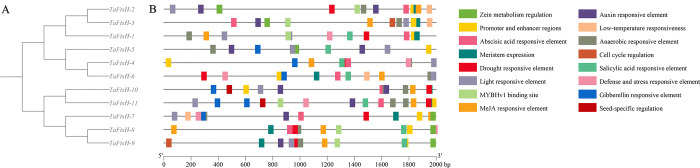
The ATP-dependent zinc metalloprotease (FtsH) protein gene family is essential for plant growth, development, and stress responses. Although FtsH genes have been identified in various plant species, the FtsH gene family in wheat (Triticum aestivum) remains unstudied. In this study, we identified 11 TaFtsH genes with uneven chromosomal distribution, significant variations in gene sequence length, and differing intron numbers among individual members. Additionally, these proteins exhibit similar physicochemical characteristics as well as secondary and tertiary structures. The FtsH genes can be classified into eight groups, each characterized by similar structures and conserved motifs. Intraspecific and interspecific comparisons further revealed extensive gene duplications within the TaFtsH gene family, indicating a closer relationship to maize. Analysis of cis-acting elements in the promoter regions of TaFtsH genes revealed developmental and stress-responsive elements in most of the genes. Expression pattern analysis showed that TaFtsH genes are expressed in all wheat tissues, though with varying patterns. TaFtsH genes displayed differential responses to CdCl2, ZnSO4, and MnSO4 stress treatments. Gene Ontology (GO) enrichment analysis indicated that TaFtsH genes are involved in protein hydrolysis. Barley stripe mosaic virus-induced gene silencing (BSMV-VIGS) technology confirmed the function of TaFtsH-1, indicating that silencing TaFtsH-1 enhances common wheat's resistance to cadmium (Cd) toxicity. In summary, this study offers an in-depth understanding of the FtsH gene family in wheat, establishing a solid basis for comprehending its functions, genetic mechanisms, and improving wheat's tolerance to heavy metal contamination.
ATP 依赖型锌金属蛋白酶(FtsH)蛋白基因家族对植物的生长、发育和应激反应至关重要。尽管已在多种植物物种中鉴定出 FtsH 基因,但小麦(Triticum aestivum)中的 FtsH 基因家族仍未得到研究。在本研究中,我们鉴定出 11 个 TaFtsH 基因,它们在染色体上分布不均,基因序列长度存在显著差异,且各个成员的内含子数量不同。此外,这些蛋白质具有相似的理化特性以及二级和三级结构。FtsH 基因可分为八组,每组具有相似的结构和保守基序。种内和种间比较进一步揭示了 TaFtsH 基因家族内广泛的基因重复现象,表明其与玉米的关系更为密切。对 TaFtsH 基因启动子区域顺式作用元件的分析表明,大多数基因中存在发育和应激反应元件。表达模式分析表明,TaFtsH 基因在小麦的所有组织中均有表达,但模式各异。TaFtsH 基因对 CdCl2、ZnSO4 和 MnSO4 胁迫处理表现出不同的反应。基因本体论(GO)富集分析表明,TaFtsH 基因参与蛋白质水解。大麦条纹花叶病毒诱导的基因沉默(BSMV-VIGS)技术证实了 TaFtsH-1 的功能,表明沉默 TaFtsH-1 可增强普通小麦对镉(Cd)毒性的抗性。总之,本研究深入了解了小麦中的 FtsH 基因家族,为理解其功能、遗传机制以及提高小麦对重金属污染的耐受性奠定了坚实基础。