Helmy Yosra A, Hafez Hafez M
Department of Veterinary Science, College of Agriculture, Food, and Environment, University of Kentucky, Lexington, KY 40546, USA.
Institute of Poultry Diseases, Freie Universität Berlin, 12309 Berlin, Germany.
Microorganisms. 2022 Dec 13;10(12):2456. doi: 10.3390/microorganisms10122456.
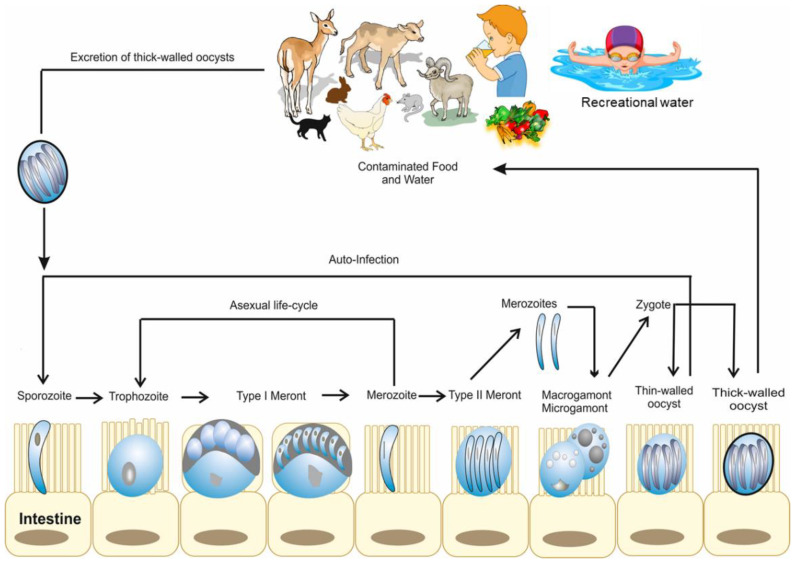
Cryptosporidiosis is a water- and food-borne zoonotic disease caused by the protozoon parasite of the genus and are the main two species causing infections in humans and animals. The disease can be transmitted by the fecal-oral route as well as the respiratory route. The infective stage (sporulated oocysts) is resistant to different disinfectants including chlorine. Currently, no effective therapeutic drugs or vaccines are available to treat and control infection. To prevent cryptosporidiosis in humans and animals, we need to understand better how the disease is spread and transmitted, and how to interrupt its transmission cycle. This review focuses on understanding cryptosporidiosis, including its infective stage, pathogenesis, life cycle, genomics, epidemiology, previous outbreaks, source of the infection, transmission dynamics, host spectrum, risk factors and high-risk groups, the disease in animals and humans, diagnosis, treatment and control, and the prospect of an effective anti- vaccine. It also focuses on the role of the One Health approach in managing cryptosporidiosis at the animal-human-environmental interface. The summarized data in this review will help to tackle future infections in humans and animals and reduce the disease occurrence.
隐孢子虫病是一种通过水和食物传播的人畜共患病,由隐孢子虫属的原生动物寄生虫引起, 是导致人类和动物感染的主要两个物种。该疾病可通过粪口途径以及呼吸道途径传播。感染阶段(孢子化卵囊)对包括氯在内的不同消毒剂具有抗性。目前,尚无有效的治疗药物或疫苗可用于治疗和控制隐孢子虫感染。为了预防人类和动物的隐孢子虫病,我们需要更好地了解该疾病是如何传播和传染的,以及如何中断其传播周期。这篇综述着重于对隐孢子虫病的理解,包括其感染阶段、发病机制、生命周期、基因组学、流行病学、既往疫情、感染源、传播动态、宿主谱、危险因素和高危人群、动物和人类的疾病、诊断、治疗与控制,以及有效抗隐孢子虫疫苗的前景。它还着重于“同一健康”方法在动物-人类-环境界面管理隐孢子虫病中的作用。本综述中总结的数据将有助于应对未来人类和动物的隐孢子虫感染,并减少疾病的发生。