Laitin Sorina Maria Denisa, Baditoiu Luminita Mirela, Laza Ruxandra, Stefan Irina-Maria, Besliu Razvan Sebastian, Susa Septimiu Radu, Oancea Cristian, Stoicescu Emil Robert, Manolescu Diana, Fira-Mladinescu Corneluta
Epidemiology University Clinic, Department XIII, "Victor Babes" University of Medicine and Pharmacy Timisoara, Eftimie Murgu Square No. 2, 300041 Timisoara, Romania.
Clinical Hospital of Infectious Diseases and Pneumoftiziology 'Dr. Victor Babes' Timisoara, 300310 Timisoara, Romania.
Antibiotics (Basel). 2024 Nov 25;13(12):1130. doi: 10.3390/antibiotics13121130.
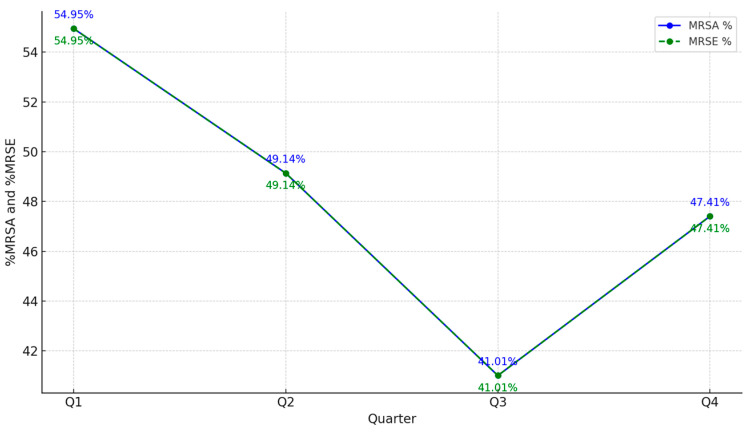
Antimicrobial resistance (AMR) is a critical global health threat, leading to increased morbidity, mortality, and healthcare costs. This study aimed to identify the most common bacterial pathogens and their resistance profiles from 2179 positive clinical cultures from inpatients at "Victor Babes" Hospital of Infectious Disease and Pneumoftiziology Timisoara in 2023. Samples were collected from sputum, bronchial aspiration, hemoculture, urine, wound secretions, catheter samples, and other clinical specimens. Key pathogens identified included , , , , and , with notable resistance patterns, observed exhibited high resistance rates, notably 41.41% in Quarter 1, while showed 35.93% resistance in the same period. , particularly MRSA, remained a persistent challenge, with 169 cases recorded over the year. and displayed alarming levels of multi-drug resistance, especially in Quarter 3 (88.24% and 22.02%, respectively). Although there was a general decline in resistance rates by Quarter 4, critical pathogens such as and continued to exhibit significant resistance (81.25% and 21.74%, respectively). The study's findings align with the broader antimicrobial resistance trends observed in Romania, where high resistance rates in , , (MRSA), , and species have been widely reported, reflecting the country's ongoing struggle with multi-drug-resistant infections. Despite some reductions in resistance rates across quarters, the persistent presence of these resistant strains underscores the critical need for strengthened antimicrobial stewardship, infection control measures, and continuous surveillance to combat the growing threat of AMR in Romania and similar healthcare settings.
抗菌药物耐药性(AMR)是对全球健康的重大威胁,会导致发病率、死亡率上升以及医疗成本增加。本研究旨在从2023年蒂米什瓦拉“维克托·巴比什”传染病与肺病医院住院患者的2179份阳性临床培养物中确定最常见的细菌病原体及其耐药谱。样本采集自痰液、支气管吸出物、血培养、尿液、伤口分泌物、导管样本及其他临床标本。鉴定出的主要病原体包括[具体病原体未给出],其具有显著的耐药模式,观察到[具体病原体未给出]呈现出较高的耐药率,尤其是第一季度为41.41%,而[具体病原体未给出]在同一时期显示出35.93%的耐药率。[具体病原体未给出],特别是耐甲氧西林金黄色葡萄球菌(MRSA),仍然是一个持续存在的挑战,全年记录了169例病例。[具体病原体未给出]和[具体病原体未给出]表现出令人担忧的多重耐药水平,尤其是在第三季度(分别为88.24%和22.02%)。尽管到第四季度耐药率总体有所下降,但[具体病原体未给出]和[具体病原体未给出]等关键病原体仍表现出显著耐药性(分别为81.25%和21.74%)。该研究结果与罗马尼亚观察到的更广泛的抗菌药物耐药趋势一致,在罗马尼亚,[具体病原体未给出]、[具体病原体未给出]、[耐甲氧西林金黄色葡萄球菌(MRSA)]、[具体病原体未给出]和[具体病原体未给出]物种的高耐药率已被广泛报道,反映出该国在应对多重耐药感染方面的持续斗争。尽管各季度耐药率有所下降,但这些耐药菌株的持续存在凸显了加强抗菌药物管理、感染控制措施以及持续监测以应对罗马尼亚及类似医疗环境中日益增长的AMR威胁的迫切需求。