Kürekci Cemil, Yüksel Murat, Celil Ozaslan Büşra Gülay, Tan Sait, Jäckel Claudia, Grobbel Mirjam, Hammerl Jens Andre
Department of Food Hygiene and Technology, Faculty of Veterinary Medicine, Hatay Mustafa Kemal University, Antakya 31060, Türkiye.
Department of Obstetrics and Gynecology, Faculty of Veterinary Medicine, Hatay Mustafa Kemal University, Antakya 31060, Türkiye.
Antibiotics (Basel). 2024 Nov 25;13(12):1134. doi: 10.3390/antibiotics13121134.
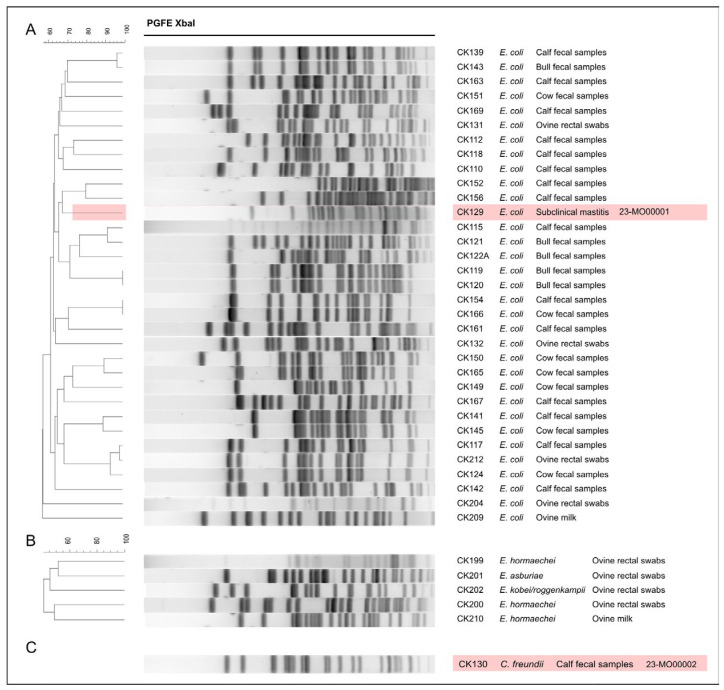
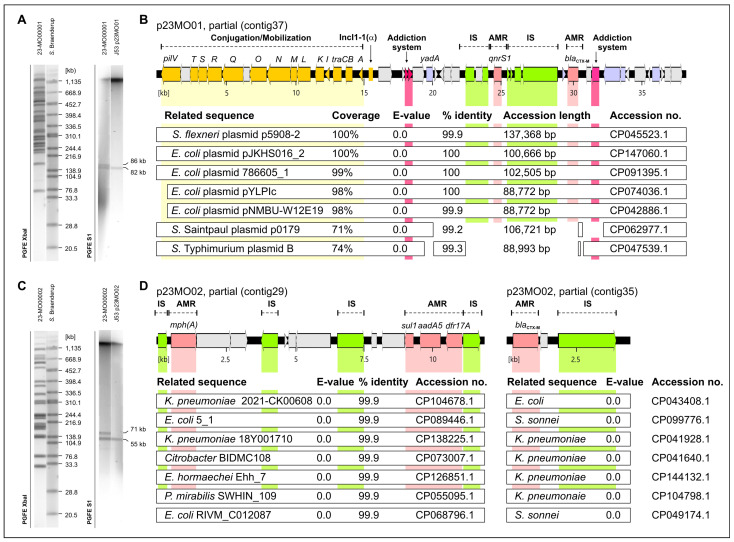
The increasing occurrence of extended-spectrum β-lactamase (ESBL)-producing , most commonly , has become a serious problem. The aim of this study was to determine the presence of ESBL-producing Gram-negative bacteria in dairy cattle, goat and sheep farms located in southern Türkiye. Samples (409 quarter milk samples and 110 fresh faecal samples from cattle, 75 bulk tank milk samples and 225 rectal swab samples from goats and sheep) were subjected to selective isolation on MacConkey agar with ceftazidime (2 µg/mL). Isolates were identified by MALDI-ToF MS. The antimicrobial susceptibility profile of the isolates was determined by the broth microdilution method. To obtain a deeper insight into the genetic diversity of isolates substantially contributing to an efficient spread of their ESBL-determinants (23-MO00001: an from mastitis and 23-MO00002 ), the transmission potential and the genetic background of the plasmid carrying the determinant was studied with whole genome analysis using Illumina sequencing. Of the samples tested, 47 from the bovine faecal samples, 1 from the subclinical mastitis milk sample, 9 from the goat/sheep rectal swab samples and 5 from the goat/sheep bulk tank milk samples had ceftazidime-resistant Gram-negative strains with the ESBL phenotype. Of the 33 ESBL-producing isolates, 66.6% were resistant to tetracycline, 57.6% to sulfamethoxazole, 48.9% to nalidixic acid, 42.4% to ciprofloxacin and 33.3% to trimethoprim. Pulsed field gel electrophoresis (PFGE) results showed that the majority of isolates (16/33) and all spp. isolates (n = 5) were not clonally related (80% similarity cut value). The sequenced strains were observed to efficiently transfer their ceftazidime resistance to the recipient strain J53 at 37 °C (transfer rates: 10-10 transconjugants per donor cell). S1-PFGE showed that the transconjugants J53(p23MO01-T1) and J53(p23MO02-T1) had acquired plasmids of about 82 kb and 55 kb plasmids, respectively. According to WGS results, the isolate was assigned to ST162, while the isolate was assigned to ST95. This study demonstrates that dairy animals are reservoirs of ESBL-producing bacteria.
产超广谱β-内酰胺酶(ESBL)的细菌,最常见的是[细菌名称未给出],其发生率不断增加,已成为一个严重问题。本研究的目的是确定位于土耳其南部的奶牛场、山羊场和绵羊场中产ESBL的革兰氏阴性菌的存在情况。对样本(409份奶牛乳房四分之一乳样和110份新鲜粪便样本、75份山羊和绵羊的大罐奶样本以及225份直肠拭子样本)在含头孢他啶(2 µg/mL)的麦康凯琼脂上进行选择性分离。通过基质辅助激光解吸电离飞行时间质谱(MALDI-ToF MS)鉴定分离株。采用肉汤微量稀释法测定分离株的抗菌药敏谱。为了更深入了解对其ESBL决定簇有效传播有重大贡献的分离株的遗传多样性(23-MO00001:一株来自乳腺炎的[细菌名称未给出]和23-MO00002),使用Illumina测序通过全基因组分析研究携带ESBL决定簇的质粒的传播潜力和遗传背景。在检测的样本中,47份奶牛粪便样本、1份亚临床乳腺炎乳样、9份山羊/绵羊直肠拭子样本和5份山羊/绵羊大罐奶样本中有产ESBL表型的对头孢他啶耐药的革兰氏阴性菌株。在33株产ESBL的[细菌名称未给出]分离株中,66.6%对四环素耐药,57.6%对磺胺甲恶唑耐药,48.9%对萘啶酸耐药,42.4%对环丙沙星耐药,33.3%对甲氧苄啶耐药。脉冲场凝胶电泳(PFGE)结果显示,大多数[细菌名称未给出]分离株(16/33)和所有[另一细菌名称未给出]分离株(n = 5)没有克隆相关性(相似性切割值为80%)。观察到测序菌株在37℃时能有效地将其对头孢他啶的耐药性转移至受体菌株J53(转移率:每供体细胞产生10 - 10个接合子)。S1-PFGE显示,接合子J53(p23MO01-T1)和J53(p23MO02-T1)分别获得了约82 kb和55 kb的质粒。根据全基因组测序(WGS)结果,[细菌名称未给出]分离株被归为ST162,而[另一细菌名称未给出]分离株被归为ST95。本研究表明,奶牛是产ESBL细菌的储存宿主。