• 文献检索
  • 文档翻译
  • 深度研究
  • 学术资讯
  • Suppr Zotero 插件Zotero 插件
  • 邀请有礼
  • 套餐&价格
  • 历史记录
应用&插件
Suppr Zotero 插件Zotero 插件浏览器插件Mac 客户端Windows 客户端微信小程序
定价
高级版会员购买积分包购买API积分包
服务
文献检索文档翻译深度研究API 文档MCP 服务
关于我们
关于 Suppr公司介绍联系我们用户协议隐私条款
关注我们

Suppr 超能文献

核心技术专利:CN118964589B侵权必究
粤ICP备2023148730 号-1Suppr @ 2026

文献检索

告别复杂PubMed语法,用中文像聊天一样搜索,搜遍4000万医学文献。AI智能推荐,让科研检索更轻松。

立即免费搜索

文件翻译

保留排版,准确专业,支持PDF/Word/PPT等文件格式,支持 12+语言互译。

免费翻译文档

深度研究

AI帮你快速写综述,25分钟生成高质量综述,智能提取关键信息,辅助科研写作。

立即免费体验

通过绿色介导的壳聚糖、钛、锆和羟基磷灰石基纳米复合材料提高玻璃离子水门汀的耐磨性:咀嚼模拟器耐久性前后的分析。

Enhancing Wear Resistance in Glass Ionomer Cement through Green-mediated Chitosan-, Titanium-, Zirconium-, and Hydroxyapatite-based Nanocomposites: An Analysis before and after Chewing Simulator Endurance.

作者信息

Sitaram Srinavasa Surya, Paulraj Jessy, Maiti Subhabrata, Shanmugam Rajeshkumar

机构信息

Department of Pedodontics, Saveetha Dental College and Hospitals, Saveetha Institute of Medical and Technical Sciences, Saveetha University, Chennai, Tamil Nadu, India.

Department of Prosthodontics, Saveetha Dental College and Hospitals, Saveetha Institute of Medical and Technical Sciences, Saveetha University, Chennai, Tamil Nadu, India.

出版信息

Int J Clin Pediatr Dent. 2024 Nov;17(11):1229-1235. doi: 10.5005/jp-journals-10005-2984. Epub 2024 Dec 19.

DOI:10.5005/jp-journals-10005-2984
PMID:39781388
原文链接:https://pmc.ncbi.nlm.nih.gov/articles/PMC11703768/
Abstract

AIM AND BACKGROUND

Glass ionomer cement (GIC) serves as a widely used restorative dental material, known for its direct bonding to tooth structures and fluoride-releasing properties. This study aims to investigate the enhancement of GIC through the incorporation of a green-mediated nanocomposite comprising chitosan, titanium, zirconium, and hydroxyapatite, with a focus on evaluating the wear resistance of the modified GIC.

MATERIALS AND METHODS

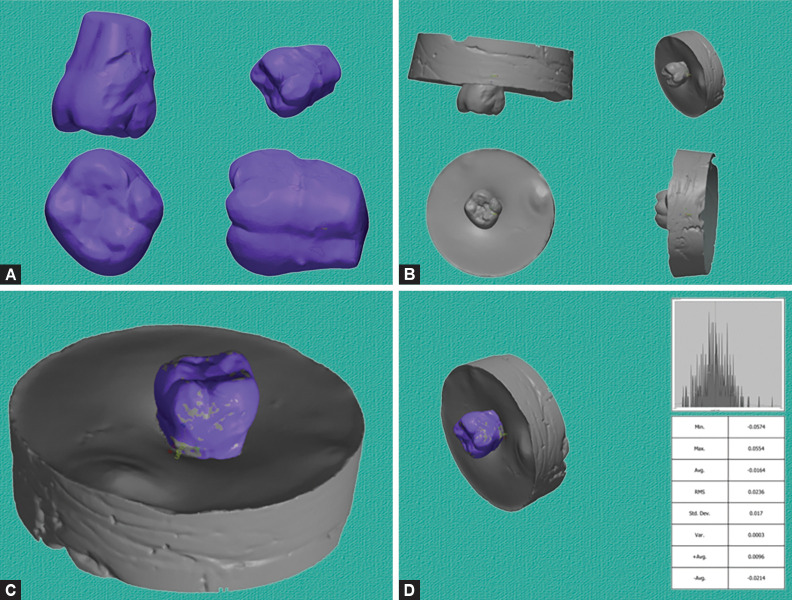
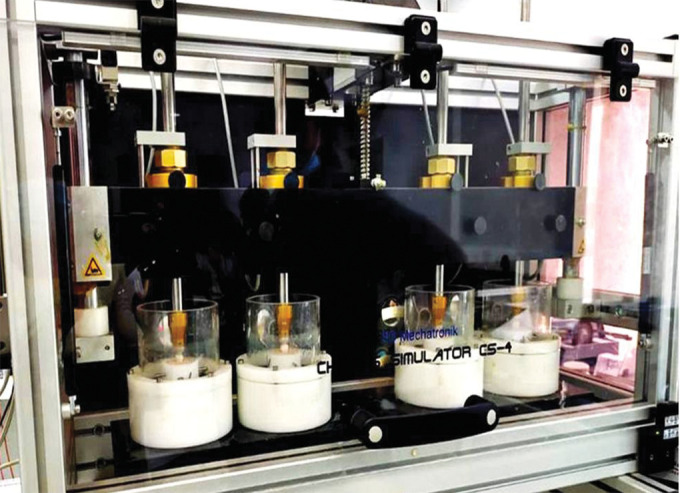
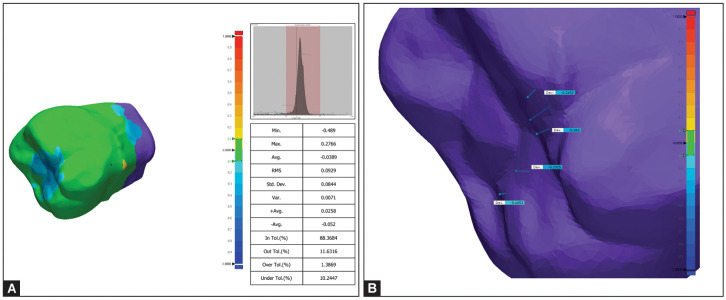
A one-pot synthesis technique was utilized to prepare a green-mediated nanocomposite incorporating chitosan, titanium, zirconium, and hydroxyapatite nanoparticles. Forty extracted teeth fulfilling the inclusion criteria were chosen for the study. Each tooth received a class I cavity preparation, and then they were divided into groups. Each group, comprising 10 teeth, received a restoration using green-mediated nanocomposite-modified GIC in varying concentrations: 3% for group I, 5% for group II, and 10% for group III. Additionally, there was a control group (group IV) consisting of conventional GIC without any modifications. To assess the wear resistance of the samples, they underwent a testing protocol, followed by placement in a chewing simulator for 30,000 cycles. Surface scans before and after chewing simulation were conducted, and deviations were superimposed using Geomagic software. The interim of root mean square (RMS), maximum deviation, and average deviation were analyzed to quantify the wear levels. Then the data obtained were subjected to statistical analysis, one-way analysis of variance (ANOVA), followed by Tukey's analysis to identify any significant differences among the groups.

RESULTS

The least deviation of RMS (0.292 ± 0.063), maximum deviation (0.664 ± 0.076), and average deviation (0.263 ± 0.049) were observed in the 5% nanocomposite-based GIC group, followed by the 10 and 3% groups. The nanocomposite-modified GIC groups exhibited superior wear resistance compared to the conventional group. This outcome addressed the limitations of traditional GIC, signifying a substantial advancement in dental restorative solutions.

CONCLUSION

The incorporation of green-mediated chitosan, titanium, zirconium, and hydroxyapatite nanocomposite into GIC demonstrated a remarkable improvement in wear resistance. This study paves the way for future advancements in dental materials, representing a significant stride toward the creation of environmentally conscious and efficacious dental restorations.

HOW TO CITE THIS ARTICLE

Sitaram SS, Paulraj J, Maiti S, Enhancing Wear Resistance in Glass Ionomer Cement through Green-mediated Chitosan-, Titanium-, Zirconium-, and Hydroxyapatite-based Nanocomposites: An Analysis before and after Chewing Simulator Endurance. Int J Clin Pediatr Dent 2024;17(11):1229-1235.
https://cdn.ncbi.nlm.nih.gov/pmc/blobs/42d0/11703768/7af6a5e13dce/ijcpd-17-1229-g003.jpg
https://cdn.ncbi.nlm.nih.gov/pmc/blobs/42d0/11703768/a200458ce0e4/ijcpd-17-1229-g001.jpg
https://cdn.ncbi.nlm.nih.gov/pmc/blobs/42d0/11703768/050577dfa985/ijcpd-17-1229-g002.jpg
https://cdn.ncbi.nlm.nih.gov/pmc/blobs/42d0/11703768/7af6a5e13dce/ijcpd-17-1229-g003.jpg
https://cdn.ncbi.nlm.nih.gov/pmc/blobs/42d0/11703768/a200458ce0e4/ijcpd-17-1229-g001.jpg
https://cdn.ncbi.nlm.nih.gov/pmc/blobs/42d0/11703768/050577dfa985/ijcpd-17-1229-g002.jpg
https://cdn.ncbi.nlm.nih.gov/pmc/blobs/42d0/11703768/7af6a5e13dce/ijcpd-17-1229-g003.jpg
摘要

目的与背景

玻璃离子水门汀(GIC)是一种广泛应用的牙科修复材料,以其与牙齿结构的直接粘结性和释氟特性而闻名。本研究旨在通过掺入由壳聚糖、钛、锆和羟基磷灰石组成的绿色介导纳米复合材料来增强GIC,重点评估改性GIC的耐磨性。

材料与方法

采用一锅合成技术制备包含壳聚糖、钛、锆和羟基磷灰石纳米颗粒的绿色介导纳米复合材料。选择40颗符合纳入标准的拔除牙齿用于研究。每颗牙齿进行I类洞制备,然后分为几组。每组10颗牙齿,分别使用不同浓度的绿色介导纳米复合材料改性GIC进行修复:I组为3%,II组为5%,III组为10%。此外,有一个对照组(IV组),使用未作任何改性的传统GIC。为评估样品的耐磨性,它们经过测试方案,然后置于咀嚼模拟器中进行30000次循环。在咀嚼模拟前后进行表面扫描,并使用Geomagic软件叠加偏差。分析均方根(RMS)、最大偏差和平均偏差的差值以量化磨损程度。然后对获得的数据进行统计分析,即单因素方差分析(ANOVA),随后进行Tukey分析以确定各组之间的任何显著差异。

结果

在基于5%纳米复合材料的GIC组中观察到RMS的最小偏差(0.292±0.063)、最大偏差(0.664±0.076)和平均偏差(0.263±0.049),其次是10%组和3%组。与传统组相比,纳米复合材料改性GIC组表现出更好的耐磨性。这一结果解决了传统GIC的局限性,标志着牙科修复解决方案的重大进步。

结论

将绿色介导的壳聚糖、钛、锆和羟基磷灰石纳米复合材料掺入GIC中显示出耐磨性的显著改善。本研究为牙科材料的未来发展铺平了道路,朝着创造具有环保意识和高效的牙科修复体迈出了重要一步。

如何引用本文

Sitaram SS, Paulraj J, Maiti S, 通过绿色介导的基于壳聚糖、钛、锆和羟基磷灰石的纳米复合材料增强玻璃离子水门汀的耐磨性:咀嚼模拟器耐久性前后分析。国际临床儿科牙科杂志2024;17(11):1229 - 1235。

相似文献

1
Enhancing Wear Resistance in Glass Ionomer Cement through Green-mediated Chitosan-, Titanium-, Zirconium-, and Hydroxyapatite-based Nanocomposites: An Analysis before and after Chewing Simulator Endurance.通过绿色介导的壳聚糖、钛、锆和羟基磷灰石基纳米复合材料提高玻璃离子水门汀的耐磨性:咀嚼模拟器耐久性前后的分析。
Int J Clin Pediatr Dent. 2024 Nov;17(11):1229-1235. doi: 10.5005/jp-journals-10005-2984. Epub 2024 Dec 19.
2
Assessing the Influence of Thermocycling on Compressive Strength, Flexural Strength, and Microhardness in Green-Mediated Nanocomposite-Enhanced Glass Ionomer Cement Compared to Traditional Glass Ionomer Cement.评估热循环对绿色介导的纳米复合材料增强玻璃离子水门汀与传统玻璃离子水门汀的抗压强度、抗折强度和显微硬度的影响。
Cureus. 2024 Mar 13;16(3):e56078. doi: 10.7759/cureus.56078. eCollection 2024 Mar.
3
Comparative Analysis of Color Stability and Its Impact on Artificial Aging: An In Vitro Study of Bioactive Chitosan, Titanium, Zirconia, and Hydroxyapatite Nanoparticle-Reinforced Glass Ionomer Cement Compared With Conventional Glass Ionomer Cement.颜色稳定性及其对人工老化影响的比较分析:与传统玻璃离子水门汀相比,生物活性壳聚糖、钛、氧化锆和羟基磷灰石纳米颗粒增强玻璃离子水门汀的体外研究
Cureus. 2024 Feb 20;16(2):e54517. doi: 10.7759/cureus.54517. eCollection 2024 Feb.
4
Comparative Evaluation of Flexural Strength of Conventional and Modified with Chitosan, Titanium Dioxide Nanopowder and Nanohydroxyapatite: An Study.壳聚糖、二氧化钛纳米粉末和纳米羟基磷灰石改性与传统材料的抗弯强度比较评估:一项研究。
Int J Clin Pediatr Dent. 2023 Aug;16(Suppl 1):S72-S76. doi: 10.5005/jp-journals-10005-2617.
5
A Comparative Evaluation of Microleakage of Glass Ionomer Cement and Chitosan-modified Glass Ionomer Cement: An in vitro Study.玻璃离子水门汀与壳聚糖改性玻璃离子水门汀微渗漏的比较评价:一项体外研究。
Int J Clin Pediatr Dent. 2014 Jan;7(1):6-10. doi: 10.5005/jp-journals-10005-1225. Epub 2014 Apr 26.
6
Prevention of secondary caries using fluoride-loaded chitosan nanoparticle-modified glass-ionomer cement.使用载氟壳聚糖纳米粒子修饰的玻璃离子水门汀预防继发龋。
Clin Oral Investig. 2024 Aug 28;28(9):504. doi: 10.1007/s00784-024-05891-0.
7
Green Synthesis, Characterization, and Evaluation of the Antimicrobial Properties and Compressive Strength of Hydroxyapatite Nanoparticle-Incorporated Glass Ionomer Cement.羟基磷灰石纳米颗粒复合玻璃离子水门汀的绿色合成、表征及其抗菌性能和抗压强度评估
Cureus. 2024 Apr 18;16(4):e58562. doi: 10.7759/cureus.58562. eCollection 2024 Apr.
8
Assessment of Nanosilver Fluoride Application on the Microtensile Bond Strength of Glass Ionomer Cement and Resin-modified Glass Ionomer Cement on Primary Carious Dentin: An Study.纳米银氟化物对乳牙龋坏牙本质上玻璃离子水门汀和树脂改性玻璃离子水门汀微拉伸粘结强度影响的评估:一项研究。
Int J Clin Pediatr Dent. 2024 May;17(5):565-569. doi: 10.5005/jp-journals-10005-2863.
9
In vitro wear rates of materials under different loads and varying pH.不同负荷和不同pH值条件下材料的体外磨损率
J Prosthet Dent. 2002 Jun;87(6):650-6. doi: 10.1067/mpr.2002.125609.
10
Characterization of Chitosan/TiO Nano-Powder Modified Glass-Ionomer Cement for Restorative Dental Applications.壳聚糖/TiO2 纳米粉体修饰玻璃离子水门汀用于修复牙科的特性研究。
J Esthet Restor Dent. 2017 Apr;29(2):146-156. doi: 10.1111/jerd.12282. Epub 2017 Feb 12.

本文引用的文献

1
Comparative analysis on efficiency and accuracy of parallel confocal microscopy and three-dimensional in motion video with triangulation technology-based intraoral scanner under influence of moisture and mouth opening - A crossover clinical trial.在潮气和张口影响下,平行共焦显微镜与基于三角测量技术的运动视频三维口内扫描仪的效率和准确性的对比分析——一项交叉临床试验。
J Indian Prosthodont Soc. 2023 Jul-Sep;23(3):234-243. doi: 10.4103/jips.jips_65_23.
2
Comparison of Antibacterial Activity, Cytotoxicity, and Fluoride Release of Glass Ionomer Restorative Dental Cements in Dentistry.玻璃离聚物修复牙科水门汀在牙科领域的抗菌活性、细胞毒性和氟释放的比较。
Med Sci Monit. 2023 Jan 23;29:e939065. doi: 10.12659/MSM.939065.
3
Nano-cellulose Reinforced Glass Ionomer Restorations: An In Vitro study.
纳米纤维素增强型玻璃离聚物修复体:一项体外研究。
Int Dent J. 2023 Apr;73(2):243-250. doi: 10.1016/j.identj.2022.07.013. Epub 2022 Sep 7.
4
Evaluation of a Method to Determine Wear Resistance of Class I Tooth Restorations during Cyclic Loading.评估I类牙齿修复体在循环加载过程中耐磨性的一种方法
Materials (Basel). 2022 Aug 8;15(15):5440. doi: 10.3390/ma15155440.
5
Conventional and Resin-Modified Glass Ionomer Cement Surface Characteristics after Acidic Challenges.酸性侵蚀后传统型和树脂改性玻璃离子水门汀的表面特性
Biomedicines. 2022 Jul 21;10(7):1755. doi: 10.3390/biomedicines10071755.
6
Impact of Nanoparticles Additions on the Strength of Dental Composite Resin.纳米颗粒添加对牙科复合树脂强度的影响。
Int J Biomater. 2022 Jul 5;2022:1165431. doi: 10.1155/2022/1165431. eCollection 2022.
7
Effectiveness of glass ionomer cements in the restorative treatment of radiation-related caries - a systematic review.玻璃离子水门汀在放射性龋修复治疗中的疗效评估——一项系统综述。
Support Care Cancer. 2022 Nov;30(11):8667-8678. doi: 10.1007/s00520-022-07168-2. Epub 2022 Jun 3.
8
Comparative evaluation of three different glass ionomer cements.三种不同玻璃离子水门汀的对比评价。
Indian J Dent Res. 2021 Oct-Dec;32(4):485-488. doi: 10.4103/ijdr.ijdr_603_21.
9
Clinical efficacy of resin-based direct posterior restorations and glass-ionomer restorations - An updated meta-analysis of clinical outcome parameters.树脂基直接后牙修复体与玻璃离子修复体的临床疗效——临床结局参数的最新荟萃分析
Dent Mater. 2022 May;38(5):e109-e135. doi: 10.1016/j.dental.2021.10.018. Epub 2022 Feb 24.
10
Evaluation of the Surface Hardness and Roughness of a Resin-Modified Glass Ionomer Cement Containing Bacterial Cellulose Nanocrystals.含细菌纤维素纳米晶体的树脂改性玻璃离子水门汀表面硬度和粗糙度的评估
Int J Dent. 2021 Dec 11;2021:8231473. doi: 10.1155/2021/8231473. eCollection 2021.