Bagheri Shakila, Kamyari Naser, Hesam Saeed, Seyedtabib Maryam
Department of Biostatistics & Epidemiology, School of Public Health, Ahvaz Jundishapur University of Medical Sciences, Ahvaz, Iran.
Department of Biostatistics and Epidemiology, Research Center for Environmental Contaminants (RCEC), School of Health, Abadan University of Medical Sciences, Abadan, Iran.
Arch Public Health. 2025 Jan 26;83(1):25. doi: 10.1186/s13690-024-01496-x.
Cigarette smoking remains a significant public health concern, with detrimental effects on both smokers and those exposed to secondhand smoke. This study investigates the factors influencing smoking behaviors in Iranian households, focusing on households with children under five years old.
We conducted a cross-sectional analysis of 8751 Iranian households using data from the Iranian Household Income and Expenditure Survey (HIES) collected by the Statistical Center of Iran (SCI) in 2021. A variety of count regression models were examined, including Poisson (P), Negative Binomial (NB), Generalized Poisson (GP) and their zero-inflated counterparts. The best fitting model was selected based on goodness-of-fit indices.
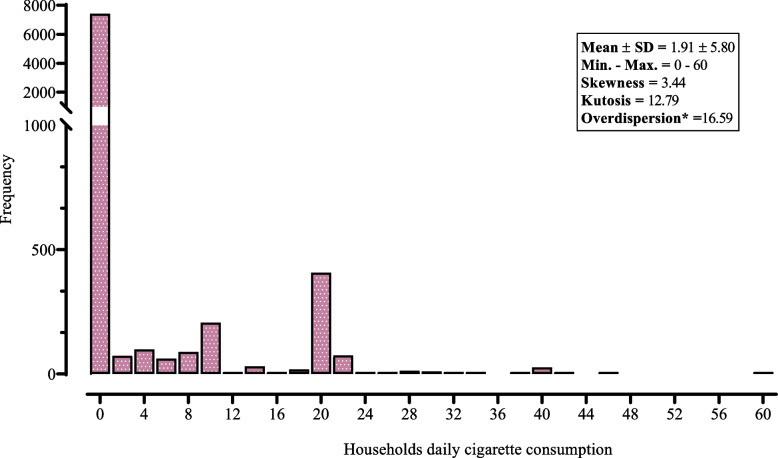
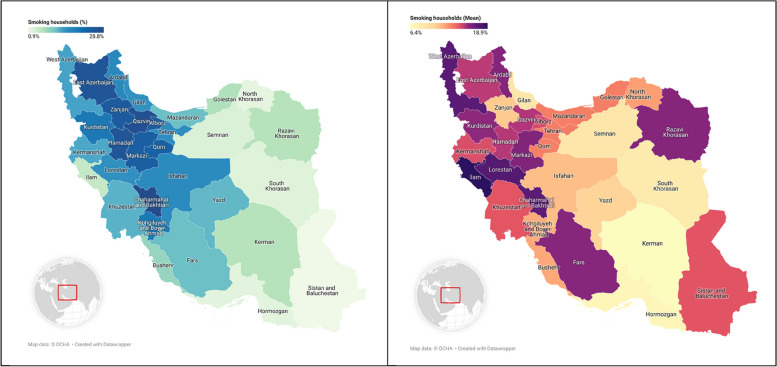
Approximately 87% of households were non-smokers, with a mean daily cigarette consumption of 14.29 (SD = 8.64) among smokers. The three-level Zero-Inflated Generalized Poisson (TL-ZIGP) model was considered a suitable model for the interpretation of the data. Key predictors of smoking included older age, male gender, lower education, higher income, and larger homes. Homeownership was negatively associated with smoking. Considerable geographic variation in smoking prevalence was observed.
Socioeconomic and demographic factors, including lifestyle and geographic regions, are associated with smoking behavior among Iranian households. A three-level ZIGP regression model is appropriate for analyzing these complex relationships. This study reveals different patterns of smoking prevalence in different population subgroups and emphasizes the need for targeted interventions to effectively reduce smoking rates.
吸烟仍然是一个重大的公共卫生问题,对吸烟者和接触二手烟的人都有不利影响。本研究调查了影响伊朗家庭吸烟行为的因素,重点关注有五岁以下儿童的家庭。
我们使用伊朗统计中心(SCI)2021年收集的伊朗家庭收入和支出调查(HIES)数据,对8751个伊朗家庭进行了横断面分析。研究考察了多种计数回归模型,包括泊松(P)模型、负二项式(NB)模型、广义泊松(GP)模型及其零膨胀对应模型。根据拟合优度指标选择最佳拟合模型。
约87%的家庭不吸烟,吸烟者的日均卷烟消费量为14.29支(标准差=8.64)。三级零膨胀广义泊松(TL-ZIGP)模型被认为是解释数据的合适模型。吸烟的关键预测因素包括年龄较大、男性、受教育程度较低、收入较高和住房面积较大。拥有自有住房与吸烟呈负相关。观察到吸烟流行率存在显著的地理差异。
社会经济和人口因素,包括生活方式和地理区域,与伊朗家庭的吸烟行为有关。三级ZIGP回归模型适用于分析这些复杂关系。本研究揭示了不同人群亚组中吸烟流行率的不同模式,并强调需要有针对性的干预措施来有效降低吸烟率。