Kwarteng Desmond Owusu, Wolf Alexander, Langdon Madisyn, Kassas Nawal, Vitale Nicolas, Kooijman Edgar Eduard
Department of Neurology, Massachusetts General Hospital and Harvard Medical School, Boston, MA, USA; Department of Biological Sciences, Kent State University, Kent, OH, USA.
Centre National de la Recherche Scientifique, Université de Strasbourg, Institut des Neurosciences Cellulaires et Intégratives, Strasbourg, France.
J Lipid Res. 2025 Mar;66(3):100749. doi: 10.1016/j.jlr.2025.100749. Epub 2025 Jan 27.
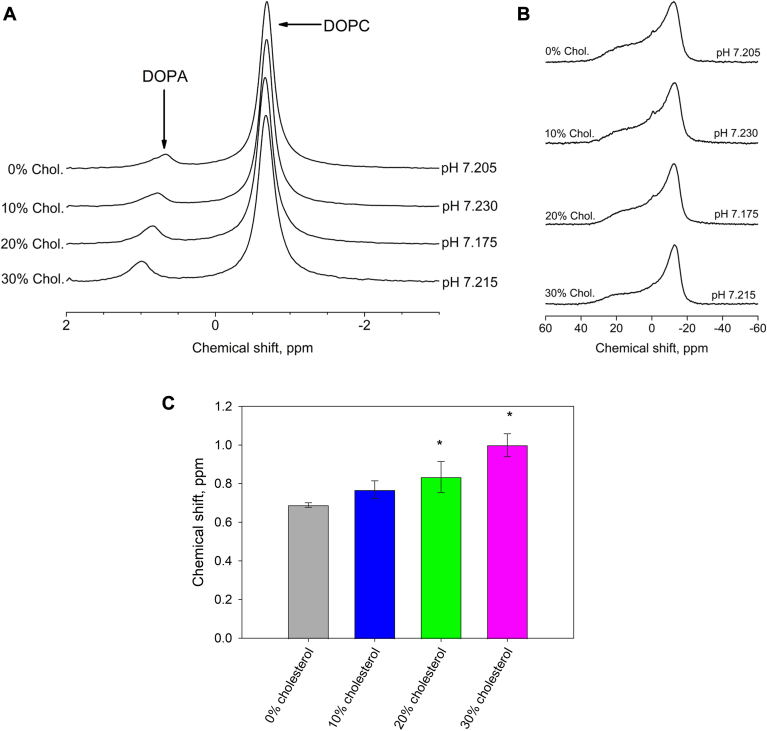
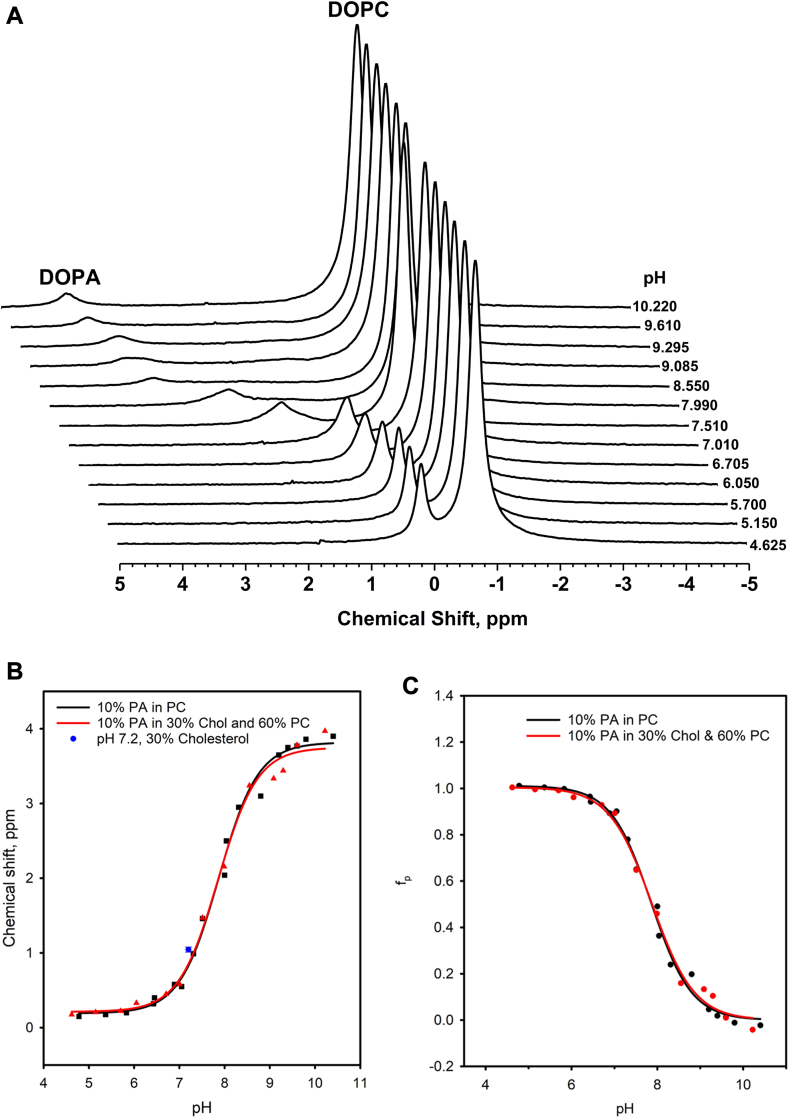
Phosphatidic acid (PA) through its unique negatively charged phosphate headgroup binds to various proteins to modulate multiple cellular events. To perform such diverse signaling functions, the ionization and charge of PA's headgroup rely on the properties of vicinal membrane lipids and changes in cellular conditions. Cholesterol has conspicuous effects on lipid properties and membrane dynamics. In eukaryotic cells, its concentration increases along the secretory pathway, reaching its highest levels toward the plasma membrane. Moreover, membrane cholesterol levels are altered in certain diseases such as Alzheimer's disease, cancer, and in erythrocytes of hypercholesteremia patients. Hence, those changing levels of cholesterol could affect PA's charge and alter binding to effector protein. However, no study has investigated the direct impact of cholesterol on the ionization properties of PA. Here, we used P MAS NMR to explore the effects of increasing cholesterol concentrations on the chemical shifts and pKa2 of PA. We find that, while the chemical shifts of PA change significantly at high cholesterol concentrations, surprisingly, the pKa2 and charge of PA under these conditions are not modified. Furthermore, using in vitro lipid binding assays we found that higher cholesterol levels increased PA binding of the Spo20p PA sensor. Finally, in cellulo experiments demonstrated that depleting cholesterol from neurosecretory cells halts the recruitment of this sensor upon PA addition. Altogether, these data suggest that the intracellular cholesterol gradient may be an important regulator of proteins binding to PA and that disruption of those levels in certain pathologies may also affect PA binding to its target proteins and subsequent signaling pathways.
磷脂酸(PA)通过其独特的带负电荷的磷酸头部基团与多种蛋白质结合,从而调节多种细胞活动。为了执行如此多样的信号功能,PA头部基团的电离和电荷依赖于邻近膜脂的特性以及细胞内环境的变化。胆固醇对脂质特性和膜动力学有显著影响。在真核细胞中,其浓度沿分泌途径升高,在质膜处达到最高水平。此外,在某些疾病如阿尔茨海默病、癌症以及高胆固醇血症患者的红细胞中,膜胆固醇水平会发生改变。因此,这些不断变化的胆固醇水平可能会影响PA的电荷,并改变其与效应蛋白的结合。然而,尚无研究调查胆固醇对PA电离特性的直接影响。在此,我们使用魔角旋转核磁共振(P MAS NMR)来探究胆固醇浓度增加对PA化学位移和pKa2的影响。我们发现,虽然在高胆固醇浓度下PA的化学位移有显著变化,但令人惊讶的是,在此条件下PA的pKa2和电荷并未改变。此外,通过体外脂质结合试验,我们发现较高的胆固醇水平增加了Spo20p PA传感器对PA的结合。最后,细胞内实验表明,从神经分泌细胞中去除胆固醇会阻止添加PA后该传感器的募集。总之,这些数据表明细胞内胆固醇梯度可能是蛋白质与PA结合的重要调节因子,并且在某些病理状态下这些水平的破坏也可能影响PA与其靶蛋白的结合以及随后的信号通路。