School of Public Health, Georgia State University, Atlanta, GA, USA.
Economics Department, University of Illinois at Chicago, Chicago, IL, USA.
Prev Med. 2018 Dec;117:107-114. doi: 10.1016/j.ypmed.2018.04.024. Epub 2018 Apr 21.
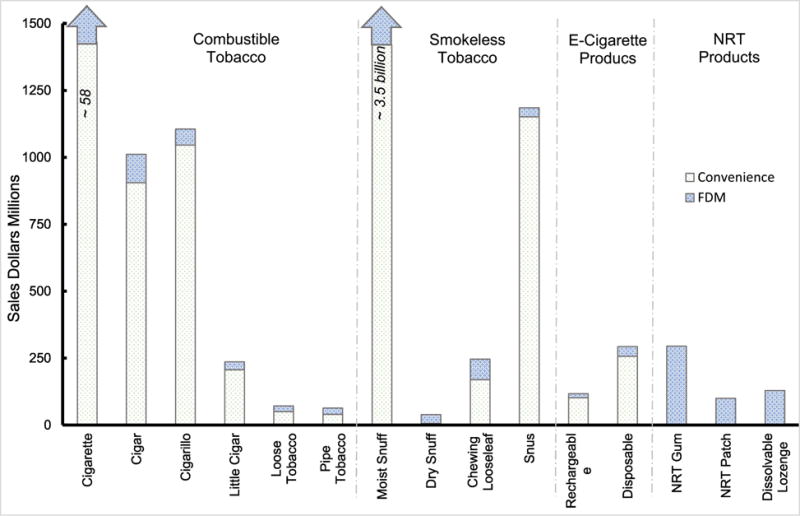
While much is known about the demand for cigarettes, research on the demand for non-cigarette tobacco products and the cross-price impacts among those products is limited. This study aims to comprehensively examine the own- and cross-price elasticities of demand for tobacco and nicotine replacement products (NRPs) in the U.S. We analyzed market-level quarterly data on sales and prices of 15 different types of tobacco products and NRPs from 2007 to 2014, compiled from retail store scanner data. Fixed effects models with controls were used to estimate their own-price elasticities and cross-price elasticities between cigarettes and the other 14 products. Our results show that, except for cigars, the demand for combustible tobacco products was generally elastic, with the estimated own-price elasticity >1 (10% increase in prices reduces sales by >10%). The own-price elasticities for smokeless tobacco products were smaller than those for combustible tobacco, although not always significant. The demand for electronic cigarettes and NRPs was found to be elastic. The cross-price elasticities with respect to cigarettes were positive for cigarillos, little cigars, loose tobacco, pipe tobacco, electronic cigarettes and NRPs, but only results for little cigars, loose tobacco, pipe tobacco, and dissolvable lozenges were consistently significant. Our findings suggest demand for tobacco products and NRPs was responsive to changes in their own prices. Substitutions or positive cross-price impacts between cigarettes and certain other products exist. It is important that tobacco control policies take into account both own- and cross-price impacts among tobacco products and NRTs.
虽然人们对香烟的需求了解很多,但对非香烟烟草产品的需求以及这些产品之间的交叉价格影响的研究有限。本研究旨在全面考察美国烟草和尼古丁替代产品(NPR)的需求的自价格和交叉价格弹性。我们分析了 2007 年至 2014 年从零售商店扫描数据中编制的 15 种不同类型的烟草产品和 NPR 的季度市场水平销售和价格数据。使用带有控制变量的固定效应模型来估计香烟和其他 14 种产品之间的自价格弹性和交叉价格弹性。我们的研究结果表明,除雪茄外,可燃烟草产品的需求通常具有弹性,估计的自价格弹性>1(价格上涨 10%会使销售量减少>10%)。无烟烟草产品的自价格弹性小于可燃烟草产品,但并不总是显著。电子烟和 NPR 的需求被发现具有弹性。雪茄、小雪茄、散装烟草、烟斗烟草、电子烟和 NPR 与香烟的交叉价格弹性为正,但只有小雪茄、散装烟草、烟斗烟草和可溶解含片的结果始终显著。我们的研究结果表明,烟草产品和 NPR 的需求对其自身价格的变化做出了反应。香烟和某些其他产品之间存在替代或正交叉价格影响。烟草控制政策必须考虑到烟草产品和 NRT 之间的自价格和交叉价格影响。