Kürklü Ahmet, Pearson Simon, Felek Turgut
Department of Agricultural Machinery and Technology Engineering, Faculty of Agriculture, Akdeniz University, Antalya, Konyaalti, 07070, Türkiye.
The Lincoln Institute of Agri-Food Techology, the University of Lincoln, Lincoln, LN2 2LG, UK.
BMC Plant Biol. 2025 Mar 15;25(1):339. doi: 10.1186/s12870-025-06307-1.
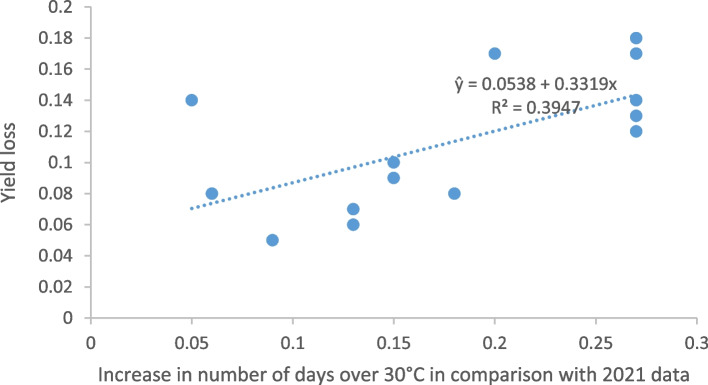
Climate change and its impact on agricultural production due to the occurrence of extreme weather events appear to be more imminent and severe than ever, presenting a global challenge that necessitates collective efforts to mitigate its effects.There have been many practical and modelling studies so far to estimate the extent of climate change and possible damages on agricultural production, suggesting that water availability may decrease by 50% and agricultural productivity between 10 and 30% in the coming years ahead. Though there have been many studies to estimate the possible level of damage by the climate change on the production of many agricultural crops, no study has been conducted on the greenhouse tomato production. Therefore, this study was conducted to discover the effects of extreme high temperatures during the 2022-2023 growing season on the high-tech Turkish tomato greenhouse industry through a survey. The results showed that all greenhouses lost yield, ranging from 6 to 53%, with an average of 12.5%. Survey data revealed that irrigation and fog system water consumption increased by 29.32% and 31.42%, respectively, while fertilizer and electricity consumption rose by 23.66% and 19%. Some 76.5% of the growers declared difficulty in climate control, 11.7% reported tomato cluster losses with no information on yield loss, 9% experienced yield losses despite no cluster losses, and 61.7% observed a decline in tomato quality, leading to reduced sales prices. Considering these findings, it is recommended that greenhouses must adopt advanced climate control technologies, expand fog system capacities, and integrate renewable energy sources to enhance resilience against climate-induced challenges. Additionally, improving water-use efficiency, optimizing cooling strategies, using new and climate-resistant varieties and adjusting cropping seasons could help mitigate yield losses due to extreme temperatures. The study results offer extremely valuable insights into greenhouse production for researchers, technology developers, and policymakers for the mitigation of climate change effects and the development of more sustainable production systems.
气候变化及其因极端天气事件的发生而对农业生产产生的影响似乎比以往任何时候都更加紧迫和严峻,这是一个全球性挑战,需要集体努力来减轻其影响。到目前为止,已经有许多实证研究和模型研究来估计气候变化的程度以及对农业生产可能造成的损害,结果表明,未来几年可用水量可能会减少50%,农业生产力会下降10%至30%。尽管已经有许多研究来估计气候变化对多种农作物产量可能造成的损害程度,但尚未有关于温室番茄生产的研究。因此,本研究通过一项调查,来探究2022 - 2023年生长季极端高温对土耳其高科技番茄温室产业的影响。结果显示,所有温室的产量都有损失,损失幅度在6%至53%之间,平均损失为12.5%。调查数据显示,灌溉和雾系统的用水量分别增加了29.32%和31.42%,而肥料和电力消耗分别增加了23.66%和19%。约76.5%的种植者表示气候控制存在困难,11.7%报告有番茄串损失但未提供产量损失信息,9%尽管没有番茄串损失但仍有产量损失,61.7%观察到番茄品质下降,导致销售价格降低。考虑到这些发现,建议温室必须采用先进的气候控制技术,扩大雾系统容量,并整合可再生能源,以增强应对气候引发挑战的恢复力。此外,提高用水效率、优化降温策略、使用新的抗气候品种以及调整种植季节,有助于减轻极端温度造成的产量损失。研究结果为研究人员、技术开发者和政策制定者减轻气候变化影响以及开发更可持续的生产系统提供了极具价值的见解。