Rattanatham Rujikorn, Mala Wanida, Kotepui Kwuntida Uthaisar, Masangkay Frederick Ramirez, Rattanawan Chutima, Lasom Supakanya, Wangdi Kinley, Kotepui Manas
Medical Technology Program, Faculty of Science, Nakhon Phanom University, Nakhon Phanom, Thailand.
Department of Medical Technology, Faculty of Pharmacy, University of Santo Tomas, 1008, Manila, Philippines.
Sci Rep. 2025 Mar 18;15(1):9316. doi: 10.1038/s41598-025-94332-3.
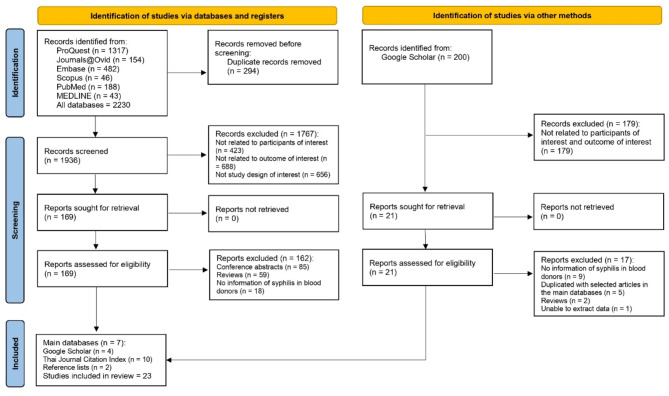
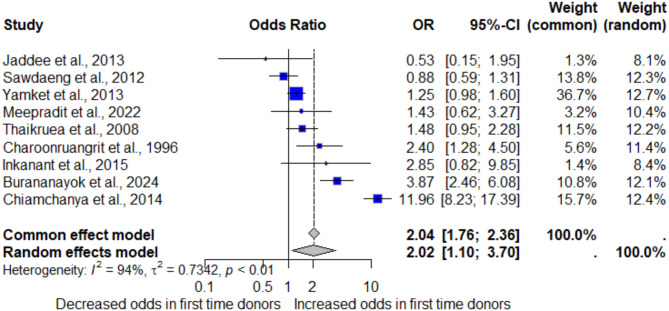
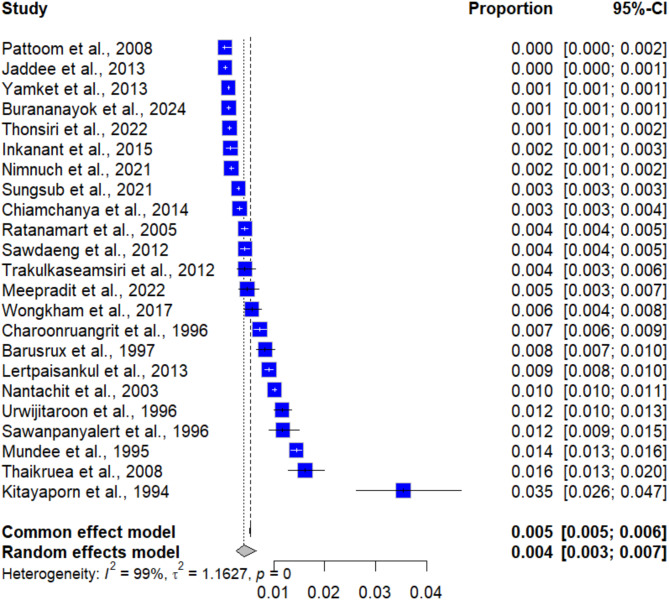
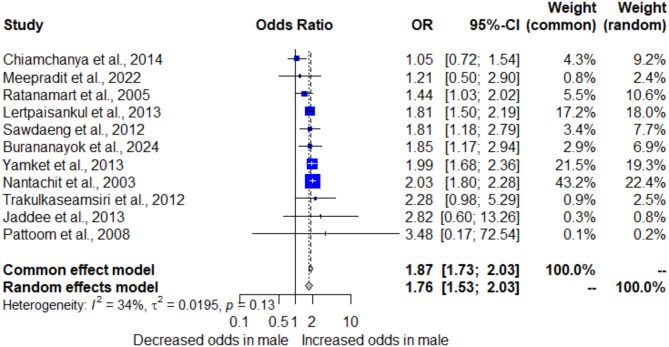
Despite rising rates of sexually transmitted infections (STIs) in Thailand, including syphilis, data on its prevalence and associated risk factors among blood donors remain scarce. This systematic review and meta-analysis aimed to estimate the prevalence of syphilis and identify the key risk factors among blood donors in Thailand to inform targeted interventions for enhanced blood safety.The study protocol was registered in PROSPERO (CRD42024560215) and conducted following PRISMA guidelines. Comprehensive searches were performed across major databases, including ProQuest, Journals@Ovid, Embase, Scopus, PubMed, and MEDLINE, to identify relevant studies. A random-effects model was used to calculate the pooled prevalence and odds ratios (ORs) for syphilis risk factors. Heterogeneity was quantified using the I² statistic, and meta-regression and subgroup analyses were employed to explore potential sources of heterogeneity. Publication bias was assessed using funnel plots and Egger's regression test. A total of 23 studies involving 1,142,910 blood donors were included. The pooled prevalence of syphilis among blood donors in Thailand was 0.42% (95% CI 0.27-0.66%, I²: 99.3%, number of infections: 6,173), with a decreasing trend over time. Male donors were significantly more likely to have syphilis (P < 0.0001; pooled OR: 1.76; 95% CI 1.53-2.03; I²: 34.2%, 651,019 participants). First-time donors also had an elevated risk of syphilis (P = 0.02; pooled OR: 2.02; 95% CI 1.10-3.70; I²: 94.0%, 215,245 participants). Additionally, the analysis revealed a significant association between increasing age and higher syphilis risk among blood donors. The systematic review and meta-analysis indicated that syphilis prevalence among blood donors in Thailand is declining; however, male and first-time donors, as well as older age groups, remain at higher risk. To enhance blood safety, targeted interventions are needed, including refining donor screening questionnaires, expanding educational campaigns for high-risk groups, and incorporating advanced screening technologies. Strengthening and regularly updating national screening policies will ensure the effective mitigation of syphilis transmission among blood donors in Thailand.
尽管泰国性传播感染(STIs)的发病率不断上升,包括梅毒,但献血者中梅毒患病率及其相关危险因素的数据仍然匮乏。本系统评价和荟萃分析旨在估计泰国献血者中梅毒的患病率,并确定关键危险因素,为加强血液安全的针对性干预措施提供依据。该研究方案已在国际前瞻性系统评价注册库(PROSPERO,注册号:CRD42024560215)注册,并按照系统评价和荟萃分析优先报告项目(PRISMA)指南进行。在包括ProQuest、Ovid期刊全文数据库、Embase、Scopus、PubMed和MEDLINE在内的主要数据库中进行了全面检索,以识别相关研究。采用随机效应模型计算梅毒危险因素的合并患病率和比值比(OR)。使用I²统计量对异质性进行量化,并采用meta回归和亚组分析来探索潜在的异质性来源。使用漏斗图和Egger回归检验评估发表偏倚。共纳入23项研究,涉及1,142,910名献血者。泰国献血者中梅毒的合并患病率为0.42%(95%置信区间0.27 - 0.66%,I²:99.3%,感染数:6,173),且随时间呈下降趋势。男性献血者感染梅毒的可能性显著更高(P < 0.0001;合并OR:1.76;95%置信区间1.53 - 2.03;I²:34.2%,651,019名参与者)。首次献血者感染梅毒的风险也较高(P = 0.02;合并OR:2.02;95%置信区间1.10 - 3.70;I²:94.0%,215,245名参与者)。此外,分析显示献血者年龄增长与梅毒风险升高之间存在显著关联。该系统评价和荟萃分析表明,泰国献血者中梅毒患病率呈下降趋势;然而,男性、首次献血者以及年龄较大的人群仍然面临较高风险。为提高血液安全,需要采取针对性干预措施,包括完善献血者筛查问卷、扩大对高危人群的教育活动以及采用先进的筛查技术。加强并定期更新国家筛查政策将确保有效降低泰国献血者中梅毒的传播。