Neijman Marise, van Sluis Klaske E, van Son Rob J J H, Stuiver Martijn M, Hilgers Frans J M, van den Brekel Michiel W M, van Alphen Maarten J A, van der Molen Lisette
Department of Head and Neck Oncology and Surgery, The Netherlands Cancer Institute, Amsterdam, the Netherlands.
Amsterdam Center for Language and Communication (ACLC), University of Amsterdam (UvA), Amsterdam, the Netherlands.
Head Neck. 2025 Aug;47(8):2209-2222. doi: 10.1002/hed.28136. Epub 2025 Mar 25.
This exploratory study investigated tracheoesophageal voicing following 6 weeks of resistance-based dysphagia rehabilitation with the SEA2.0, using a multidimensional assessment approach.
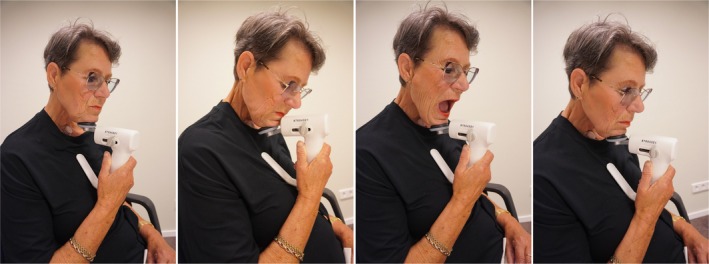
Twenty laryngectomized participants were assessed at T0 (baseline), T1 (after 6 weeks training), and T2 (after 8 weeks rest). Training included the chin tuck, jaw opening, and effortful swallow against resistance. Multidimensional assessments included acoustic analysis (AVQI, intensity, dynamic range), clinician-rated perceptual evaluations (voice tonicity, intelligibility), PROMs (VHI-10, V-RQOL, CPIB-10), and tracheal manometry and pharyngeal-/esophageal high-resolution impedance manometry during voicing.
No significant changes in mean AVQI, intensity, dynamic range, voice tonicity, intelligibility, PROMs, and physical outcomes (manometry) were found. However, several clinically relevant changes, mostly improvements, were noted in 14 participants for AVQI and PROMs.
Tracheoesophageal voice, on average, is not affected by resistance-based muscle training for swallowing rehabilitation. For some participants, however, several clinically relevant improvements in voice quality and quality of life were noticeable.
本探索性研究采用多维评估方法,调查了使用SEA2.0进行为期6周的基于阻力的吞咽障碍康复训练后气管食管发声情况。
对20名喉切除参与者在T0(基线)、T1(6周训练后)和T2(8周休息后)进行评估。训练包括收下巴、张口以及抗阻用力吞咽。多维评估包括声学分析(嗓音气声质量指数、强度、动态范围)、临床医生评定的感知评估(嗓音紧张度、可懂度)、患者报告结局量表(嗓音障碍指数-10、嗓音相关生活质量量表、癌症康复后功能评估-10)以及发声时的气管测压和咽部/食管高分辨率阻抗测压。
嗓音气声质量指数、强度、动态范围、嗓音紧张度、可懂度、患者报告结局量表及物理指标(测压)均未发现显著变化。然而,14名参与者的嗓音气声质量指数和患者报告结局量表出现了一些临床相关变化,多数为改善。
一般而言,气管食管发声不受基于阻力的吞咽康复肌肉训练的影响。然而,对一些参与者来说,嗓音质量和生活质量出现了一些临床相关的改善。